

Quick Summary
An ERP for hospitals connects finance, inventory, workforce, and patient data in one system. It removes manual data entry across different software. Staff save time. Billing errors reduce. Supply shortages become rare. The right system helps your healthcare facility grow without adding extra administrative work or duplicate processes.
Table Of Contents
Introduction
We all agree that healthcare institutions that implement ERP systems do see a great advantage and improvement in their daily operations and functions. But, when you implement an all in one solution, the real transformation begins. Many hospitals still run on disconnected software and manual paperwork. A true ERP for hospitals connects finance, supply chain, and workforce management under one system. In this blog post, we will explain how an integrated platform removes data silos, automates routine tasks, and helps your facility grow without adding administrative challenges. We will also see what features actually matter for daily hospital operations.
Key Takeaways
Manual data entry across systems causes costly errors.
An ERP for hospitals connects every department on one platform.
Match exceptions waste hours of staff time weekly.
Automation saves time in billing, inventory, and workforce.
A connected system supports growth without extra admin work.
Separate Systems Create Extra Work Every Day
Even with the use of ERP systems, healthcare staff still manually transfer data between different software applications. One employee enters patient information. Another types the same details into the billing system. A third person updates inventory records separately. This repeated data entry creates delays and introduces errors.
How separate tools waste time
A single wrong entry in a ERP for hospitals can delay an insurance claim or cause a supply shortage. For instance, if the system records ten units of a medicine but the physical stock has only eight units, staff must investigate the difference. This investigation takes time that could be used for patient care. These small discrepancies accumulate into significant financial losses each month.
This is the best HMS software in India.
Why automatic checking works better
Moving to a smart hospital management software eliminates manual data transfer. When one department enters a number, every connected department receives the same number instantly. Staff no longer need to verify matches across different systems. This type of healthcare workflow automation software detects mismatches early and prevents them from growing into larger problems.
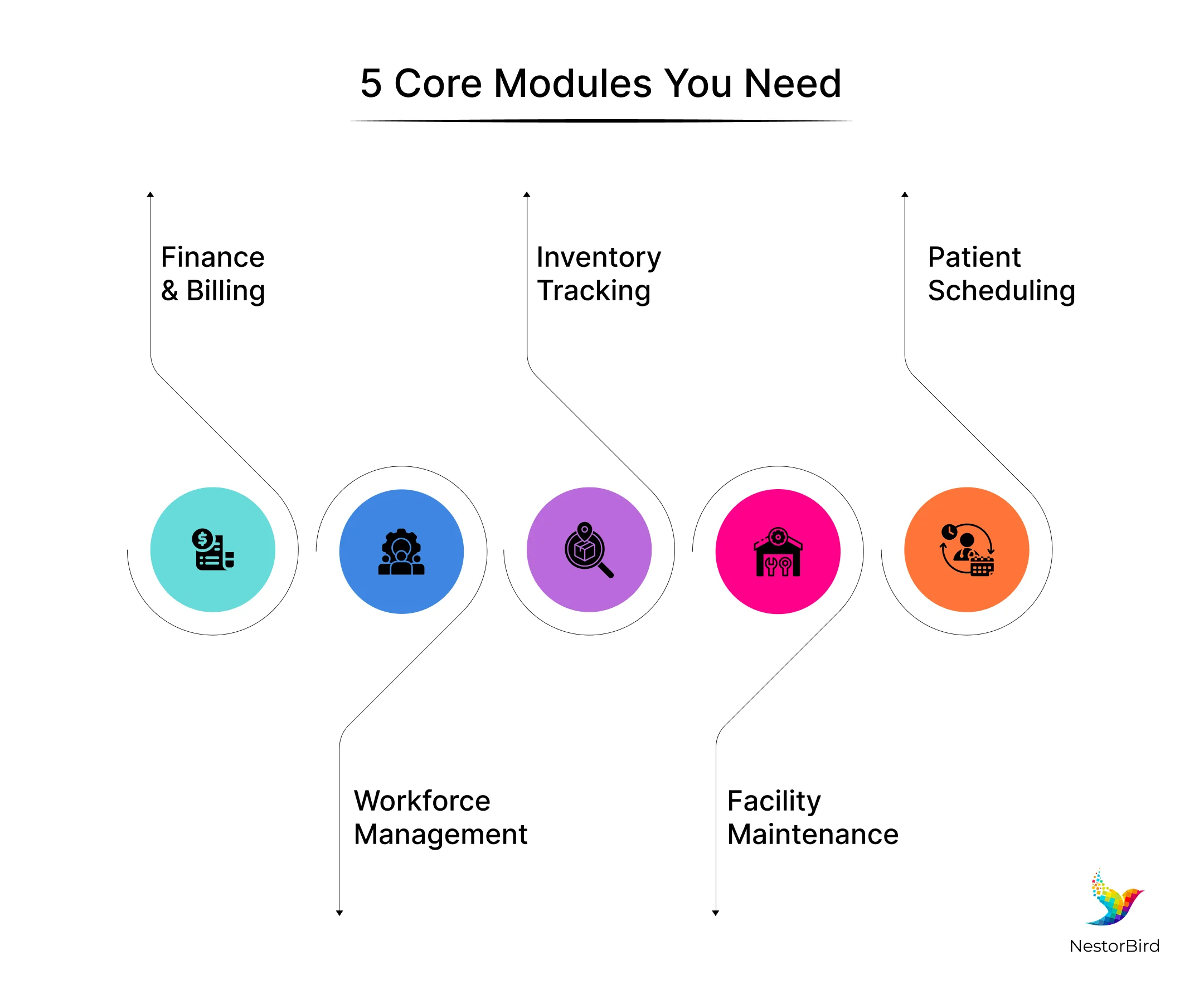
Core Features of an All-in-One Healthcare ERP
When you want to move to an all in one healthcare ERP system, it needs to have the right features that can help you grow and scale efficiently. Below are the core modules that matter most.
1. Financial Management and Revenue Cycle
This module automates claim submission and payment tracking. It reduces claim denials by catching errors before submission. For any ERP for hospitals, this feature directly supports financial growth. Faster payments mean better cash flow for the facility.
2. Efficient Supply Chain and Inventory Management
This healthcare ERP solution module tracks medical supplies from the time they are ordered until they are used for a patient. It prevents stock outs of critical items. A healthcare ERP software with this feature improves efficiency by reducing waste and keeping costs under control.
3. Proper Workforce Management
This module handles staff records, payroll processing, and license renewals in one place. It ensures that only properly credentialed staff are scheduled for duty. This reduces compliance risk and saves hours of manual paperwork every week for the HR team.
4. Regular Facility and Maintenance Management
This module schedules regular checks for medical equipment and facility systems. It prevents unexpected breakdowns that cancel surgeries or delay diagnoses. Adding ERP software for healthcare with this feature protects your equipment investment and keeps daily operations running without interruption.
5. Maintaining Patient Relationship and Appointment Management
This cloud-based ERP for healthcare module handles appointment scheduling, patient registration, and communication history in one place. It reduces no-shows through automated reminders and speeds up check-in processes. A hospital ERP system with this feature improves patient flow through the facility. Thus, less waiting time means higher patient satisfaction and more appointments per day.
Looking for fast healthcare ERP implementation in 14 days?
The ROI of Integration: Time and Cost Savings
When you implement the right all in one ERP healthcare solution, the returns and chances are high. The savings appear in daily operations, not just annual reports.
Time saved per employee
Staff members stop entering the same data multiple times. With an all-in-one healthcare management software, each employee saves several hours every week. These hours go back to patient care and higher value tasks.
Get the Best Cloud-Based Hospital Management Systems
One comprehensive and updated dashboard
When all departments use the same system, there is no need to check numbers across different spreadsheets. An ERP for hospitals eliminates duplicate work. Finance, stores, and nursing see the same inventory count and the same patient charges, so no more manual reconciliation in Excel.
Growing without extra work
Adding a new location normally means adding more administrative staff. With a connected system, the overhead does not multiply. The same Healthcare ERP software runs one location or five locations with minimal extra effort, which also helps protect your scale margins as you grow.
Conclusion
Moving to a single system for all hospital operations removes daily headaches. You stop chasing mismatched numbers across different software. Your staff saves time. Your revenue becomes more predictable. A smart hospital management software connects finance, stores, workforce, and patient records in one place. This is how you grow without adding extra administrative work. If you want a system that actually solves the problems and automates workflows across departments, solutions from NestorBird are built specifically for this purpose. We focus on making data move by itself so your team can focus on patients.

Frequently Asked Questions
It connects all departments on one platform. When one person enters data, every department sees the same information. This removes duplicate typing and the mistakes that come with it.
Yes. A good system integrates with your EHR through standard protocols. Data moves between both systems automatically so you do not need to replace everything at once.
Cloud ERP has lower upfront costs because you pay monthly and avoid hardware purchases. On-premise requires large initial investment for servers and IT staff.
Yes. Small clinics save hours each week by automating billing, appointment reminders, and inventory tracking. The right system scales as you add more providers or locations.
Buying too many features that staff never use. Start with finance, inventory, and workforce modules. Add advanced features only when you actually need them.