

Quick Summary
Australia short-term rental regulations 2027 will not follow one national rulebook. Rules can vary by state, territory, and local council. Property managers should check registration, planning, safety, insurance, strata rules, levies and records for each property. The best approach is to verify each address now, store proof of compliance, track renewal dates, and review the file when rules change.
Table Of Contents
Introduction
Short-term rental accommodation is becoming a more complex area for Australian property managers. Airbnb Australia and other platforms make listing a property simple. Compliance is not as simple. Australia short-term rental regulations 2027 must be checked at the state, territory and local level.
Property managers should start with each property address. They should then confirm which rules apply and keep clear evidence of each check.
Key Takeaways
Australia does not have one uniform STR compliance framework.
Rules can differ between states, territories, and local councils.
Registration and planning checks should be completed for each property.
Safety, insurance and strata or body-corporate rules need separate checks.
Levies and record-keeping duties can depend on the jurisdiction and booking model.
A central compliance file makes renewals and audits easier.
Digital workflows can help teams track tasks, documents, and deadlines.
Why Australia's Short-Term Rental Regulations Are Changing
Short-term rentals sit across several policy areas. These include tourism, housing, planning, and local amenity. Safety is another important concern. Governments have responded in different ways. Some focus on registration. Others use planning controls or financial measures. This is why Australia STR regulations cannot be reduced to one simple national checklist.
The growth of platform-based accommodation has also changed the work of property managers. A manager may handle bookings, guests, cleaning, and maintenance. Compliance information may sit in many places. A registration record may be in an email. An insurance policy may be in a shared drive. A council approval may be stored as a PDF. Finding these records later can take time.
A stronger process treats compliance records as part of daily operations. Each property should have a clear profile. That profile should show its location, operating model, registration status, and review dates. It should also show where supporting documents are stored. This makes the process easier to manage when rules or property circumstances change.
Australia Short-Term Rental Regulations 2027: What Property Managers Need to Check
Start with seven questions. Does the property need registration? Is short-term rental use allowed under planning rules? Does the property meet applicable safety standards? Is insurance suitable? Do strata or body-corporate rules allow the use? Are levies and records being handled correctly? Can the manager produce proof of compliance when needed?
These checks should be completed for each address. Two properties in the same portfolio may not have the same requirements. They may sit in different councils. They may also have different building rules. The operating model can matter as well. A useful compliance register should record the address, jurisdiction, property type, registration status, approvals, renewal dates and responsible staff member.
State and Territory Rules
NSW has a specific STRA framework. It includes a government STRA Register, planning rules, and fire-safety requirements. The NSW framework also includes rules for non-hosted STRA in some areas. Strata by-laws can also affect short-term rental use. Property managers should check the current NSW requirements for each property before listing or renewing a registration.
Victoria uses a different model. A short-stay levy applies to qualifying stays of less than 28 consecutive days. The Victorian State Revenue Office currently states that the levy is 7.5% of the total booking fee. Booking platforms generally handle the levy for platform bookings. Direct bookings can create different responsibilities.
The ACT also has a short-term rental accommodation levy. The current rate is 5% of the total booking amount for applicable bookings. The ACT Revenue Office states that the rate is scheduled to rise to 7.5% from 1 July 2027. This makes the change important for managers planning their 2027 processes.
Western Australia has its own registration framework. The WA Government states that hosted and unhosted STRA providers must register. Registration is annual. Local planning requirements can also apply. Some unhosted properties may need development approval, depending on the property and location.
These examples are not a substitute for legal or council advice. Rules can change. Local planning schemes can also add requirements. Managers should check the relevant government authority and local council before making a compliance decision.
What the major jurisdictions currently require
Jurisdiction | Current focus | 2027 planning point | Manager action |
|---|---|---|---|
NSW | Registration, planning, fire safety, Code of Conduct and possible strata restrictions. | Review registration, renewal and local limits. | Verify registration and supporting evidence. |
Victoria | 7.5% short-stay levy for qualifying stays under 28 days. | Review levy treatment and booking channel. | Confirm who handles the levy. |
ACT | 5% levy now; scheduled to become 7.5% from 1 July 2027. | Prepare for the 2027 rate change. | Track booking-provider duties and returns. |
WA | State-wide STRA registration and local planning rules. | Maintain registration and check planning approval. | Verify register status and local planning rules. |
7 Compliance Checks Property Managers Should Complete Before 2027
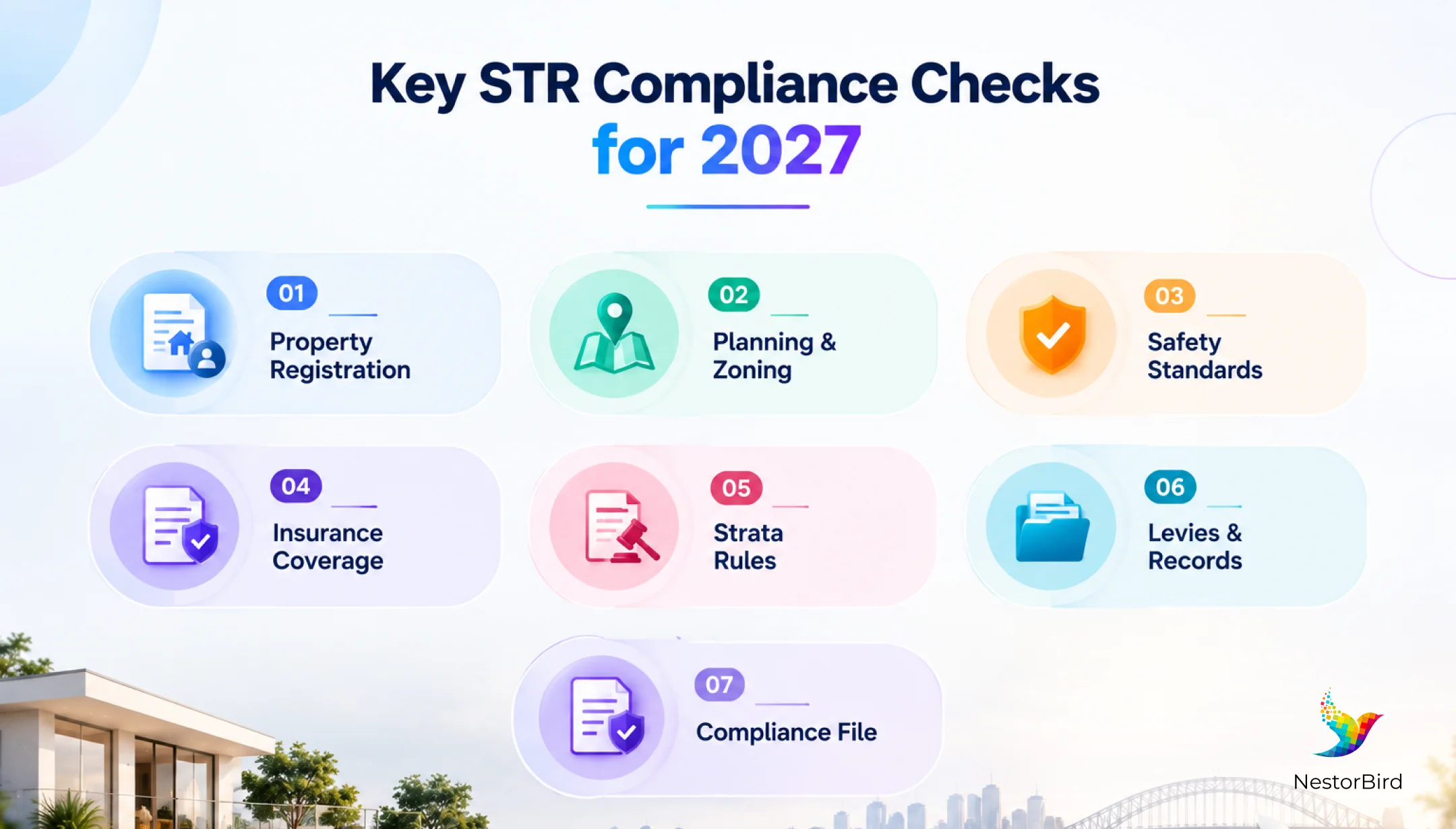
A checklist is useful only when someone owns it. Use the seven checks below as a repeatable workflow. Assign each task to a person. Add a due date. Store the evidence with the property record. Review the checklist when a rule changes or the property’s operating model changes.
1. Confirm Property Registration Requirements
Begin with the property address. Identify the state or territory and the relevant local authority. Check whether STR registration is required. Check the registration period and renewal date. Record the registration number and the source used for the check.
Keep this information in one place. Do not rely on an email inbox or a spreadsheet with no owner. A central record can show which properties need renewal soon. It can also show which properties have missing documents. This makes registration management faster across a larger portfolio.
2. Review Planning and Zoning Rules
Planning rules can be more complex than registration. A property may be registered but still face planning limits. These can include permitted use, night limits, development approval, and local council conditions. NSW and WA show why local checks matter.
Record the council’s name, date checked, and relevant planning sources. Add any approval or exemption to the property file. If the council has not yet confirmed a position, mark the item as pending. Do not label it compliant until the required evidence is available.
3. Check Safety Standards
Safety should be a routine operational check. Depending on the jurisdiction, managers may need to review smoke alarms, emergency information, and fire-safety measures. NSW has specific STRA fire safety requirements. Other jurisdictions may have different rules.
Create recurring safety tasks. Add inspection dates and outstanding actions. Store inspection evidence with the property record. This helps the manager see what is complete and what needs attention. It also reduces the risk of losing important records when staff change.
4. Verify Insurance Coverage
Short-term rental use should be disclosed to the relevant insurer. The policy should match the way the property is actually operated. A change from long-term rental to frequent short stays should trigger an insurance review.
Keep the policy details, expiry date, and confirmation of coverage in the property file. If there are special conditions, record them clearly. Managers should ask the insurer or qualified adviser about policy interpretation instead of making assumptions.
5. Review Strata and Body Corporate Rules
Shared buildings can add another layer of rules. An owners corporation, strata scheme or body corporate may have restrictions on short stays. NSW guidance also notes that strata by-laws can affect STRA in some residential premises.
Obtain the current building rules. Record any restrictions, approval, or notice that affects the property. Review the document again if the building manager or owners corporation issues an update. This keeps building-level requirements connected to the property’s record.
6. Review Levies, Taxes and Records
Financial obligations can differ by jurisdiction. Victoria currently has a 7.5% short-stay levy for qualifying stays. The ACT currently has a 5% levy and has scheduled an increase to 7.5% from 1 July 2027. The party responsible can also depend on the booking model.
Keep booking records and platform statements in an organised system. Record who is responsible for each levy. Make sure the booking data can support the required reports. A clean record makes reconciliation easier and reduces last-minute work.
7. Maintain a Compliance File
The compliance file connects every check. It should contain registration details, planning evidence, safety records, and insurance information. It should also include strata documents, levy records, and relevant policies. Add regulatory updates when they affect the property.
Give each file a named owner and a review date. Record open issues as tasks. Show who must provide missing evidence and when it is due. This creates a clear audit trail and makes property reviews much easier.
Need a structured way to manage changing requirements? Explore NestorBird digital transformation services to organise workflows, documents, and operational processes.
How Property Managers Can Build a 2027 STR Compliance Process
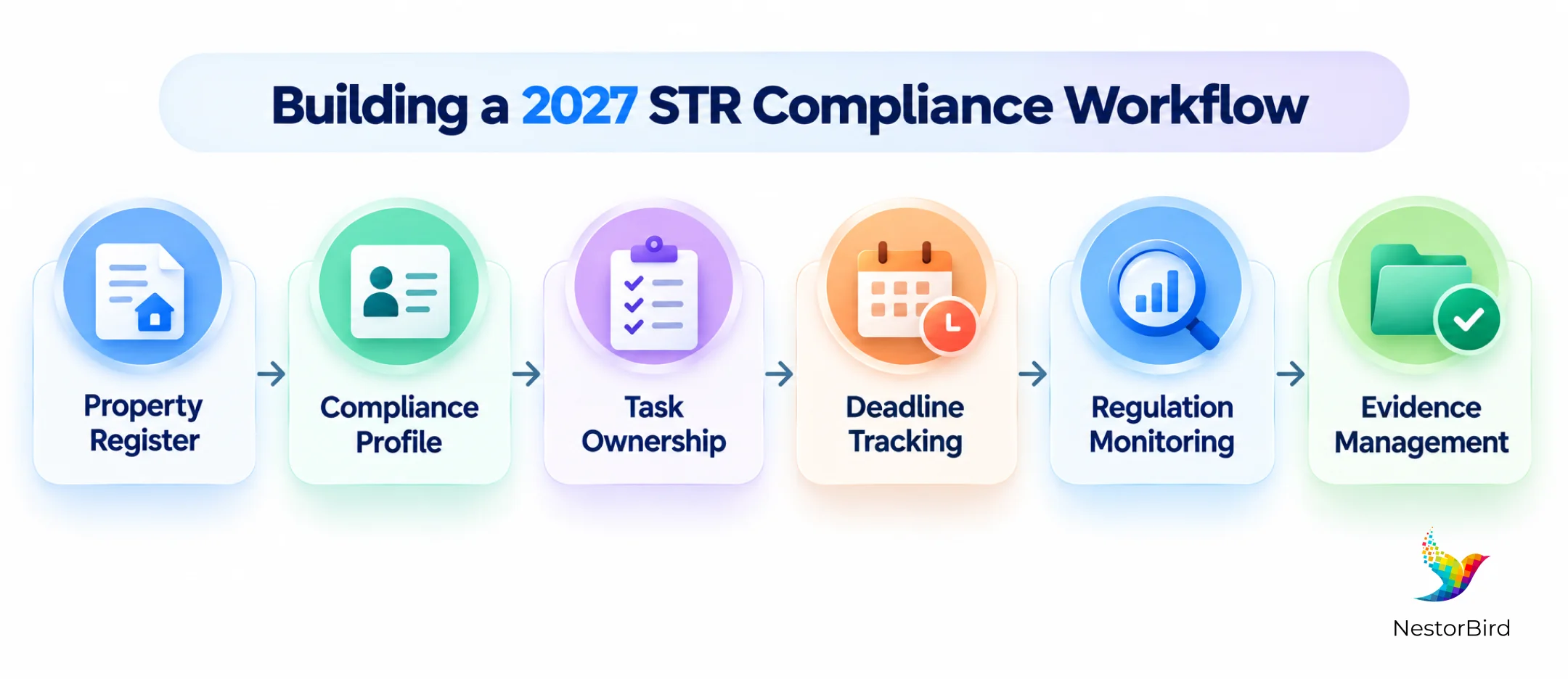
Move from a one-time audit to a repeatable process. Create a master property register first. Give each property its own compliance profile. Add fields for registration, planning, safety, insurance, strata rules and levy responsibilities. Add review dates for each item.
Next, assign ownership. Every open task should have a person and a due date. Renewal dates should create reminders. Safety checks should recur. Insurance reviews should be linked to policy expiry dates. This prevents important work from depending on memory.
Regulatory monitoring should also have an owner. That person can check relevant government updates and record changes. The next step is an impact review. Identify which properties are affected. Then create the required tasks. This avoids sending every regulatory update to every property manager.
A simple status system can help. Use labels such as Verified, Action Required, Pending Evidence, and Review Due. This gives managers a quick view of portfolio risk without turning the system into legal judgement. The evidence should always remain linked to the status.
If these workflows need to connect with wider business processes, ERP implementation services can be considered as part of a centralised operations approach.

Why Digital Systems Matter for STR Compliance
Can software help property managers manage compliance? Yes. It can centralise records, create tasks, and send reminders. It can also give managers a clear view of open work. The system does not replace government guidance, legal advice, or council decisions. It helps the team manage the work created by those requirements.
This becomes more useful when a portfolio covers several jurisdictions. A NSW property can have registration and fire-safety tasks. A Victorian property can have levy tasks. An ACT property can have a reminder for the 1 July 2027 levy change. Each property can follow the workflow that applies to it.
For businesses that need centralised data and workflow management, ERPNext software can be evaluated as part of a broader digital operations strategy.
The right system depends on the organisation. Review the current tools, data structure, and approval process before selecting or changing software. The goal is simple: make compliance work easier to assign, track and evidence.
For Australian businesses exploring local technology and ERP support, ERP services in Australia can be a useful starting point for a wider digital operations discussion.
Official Resources to Verify Current Requirements
STR rules can change. Verify current requirements before acting and use official government sources for the final compliance check.
NSW Planning — Short-term rental accommodation
Victoria State Revenue Office — Understanding the short stay levy
ACT Revenue Office — Short-term rental accommodation levy
WA Government — Short-Term Rental Accommodation Register
WA Planning — Short-term rental accommodation planning reforms
Conclusion
Preparing for Australia short-term rental regulations 2027 should start now. Do not wait for a new rule to expose a missing document. Review each property against the rules that apply to its location and operating model.
The current landscape shows clear differences between jurisdictions. NSW uses registration and planning controls. Victoria has a 7.5% short-stay levy. The ACT is scheduled to move from 5% to 7.5% on 1 July 2027. WA has statewide STRA registration. These systems are different, so one generic checklist is not enough.
The practical answer is a repeatable compliance process. Verify the rules. Save the evidence. Assign the task. Track the deadline. Review the property when the rules change. Digital systems can support this process by keeping the information visible and organised.
Need to turn compliance requirements into repeatable workflows? Explore NestorBird ERP implementation services to discuss centralised processes and documentation.

Frequently Asked Questions
There is no single national STR rule for every property. Requirements can vary by state, territory, council, and property type. Managers should check registration, planning, safety, insurance, strata rules, levies and records for each property.
It depends on jurisdiction and property. NSW requires STRA properties to be registered under its framework. WA also requires hosted and unhosted STRA providers to register. Other jurisdictions may use different controls. Check out the current government requirements for the property address.
Check registration, planning and zoning, safety, insurance, strata or body-corporate rules, levies and documentation. Also record renewal dates and assign responsibility for each open task. Keep evidence with the property record so it can be found quickly.
Airbnb is a booking platform. The property can still be subject to state, territory, and local rules. Being listed on a platform does not prove that the property meets planning, registration, safety, or building requirements. Managers should assess the property under the rules that apply to its location.
Prepare registration reviews, planning checks, safety reviews, levy changes, and stronger record management. The ACT is a clear example. Its short-term rental accommodation levy is currently 5% and is scheduled to increase to 7.5% from 1 July 2027.
No. Rules differ between jurisdictions and can also differ between local councils. NSW, Victoria, the ACT, and WA use different combinations of registration, planning, safety, and levy measures. Managers should verify the rules for each property rather than copy one state's checklist.