

Quick Summary
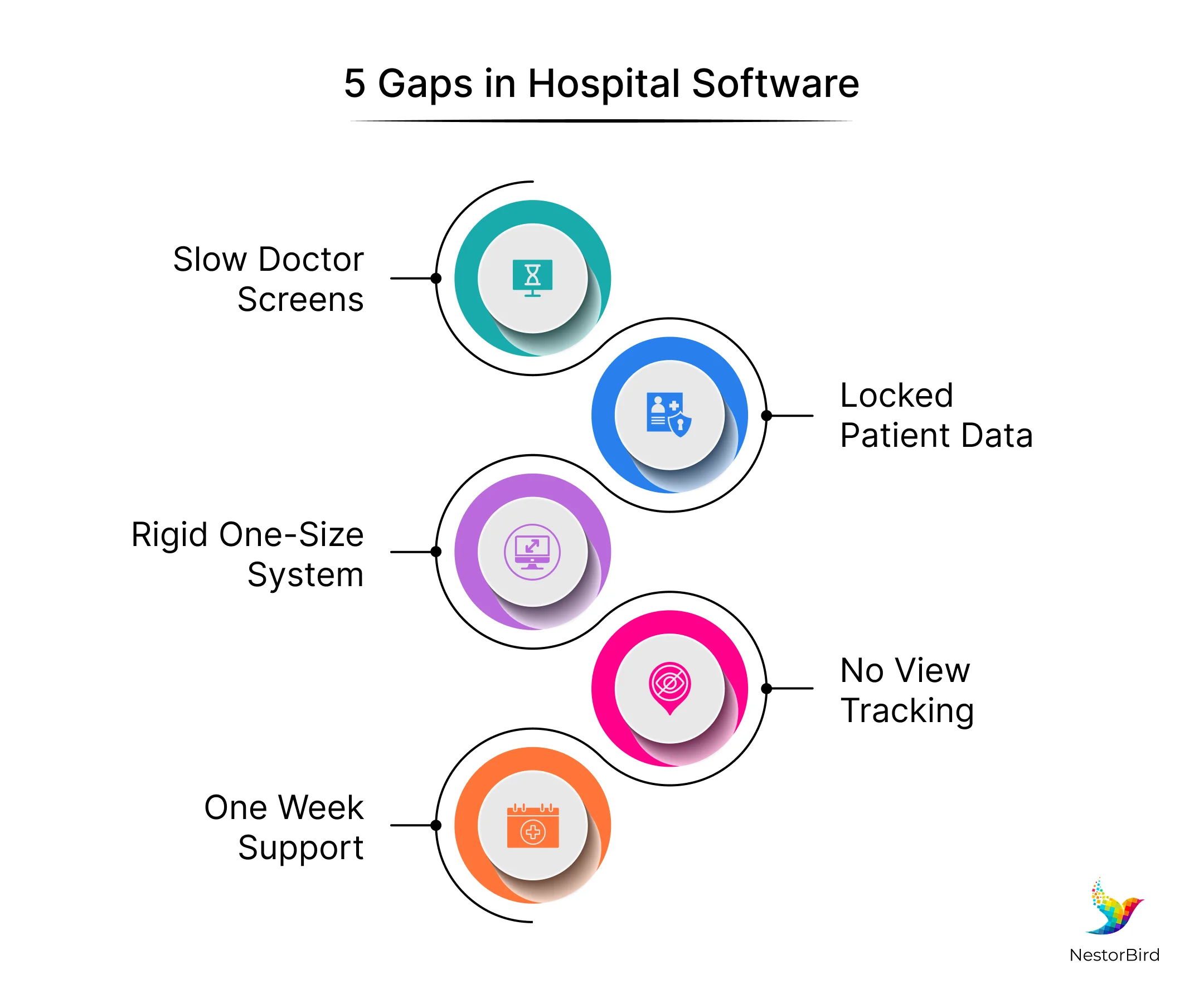
This blog post explains the five biggest gaps in hospital management software India today. Slow screens frustrate doctors. Data cannot be shared between hospitals. One-size systems do not fit speciality departments. Security tracking is weak. Support ends after one week. Each gap includes a simple fix that hospitals can apply right away.
Table Of Contents
Introduction
Many hospitals take time to make the important decision of implementing digital systems, only to find later that the software creates more problems than it solves. In this blog post, we look at why most hospital management software India options still leave big gaps in daily operations. The real issue is that many healthcare software India products focus only on billing and ignore clinical workflows. This blog post explains the biggest HMS software challenges India faces today and offers practical fixes that actually work on the ground.
Key Takeaways
Doctors reject software that needs too many clicks and slow screens.
Without ABDM compliant software, patient data cannot move between hospitals.
A single rigid system fails when different speciality departments use it.
Every software must track who viewed each patient record and when.
Ongoing training and live support are more important than fancy features.
Gap 1: Software Made for Accountants, Not for Patient Care
One of the major gaps that is present in modern hospital management software India is that it ignores the main user, the doctor. The biggest EMR software problems India faces today is that doctors find the interface too slow. When a system takes many clicks to do one small task, doctors get frustrated. They start avoiding the software completely.
Many of the best hospital management software India options fail because the buyer is the hospital owner, not the doctor. Owners want billing data. Doctors want speed. This mismatch creates a hospital information system India that nobody actually uses properly.
The fix is simple here, you can build screens for the person treating the patient, and reduce clicks. Add voice typing so doctors can speak notes instead of typing. When doctors save time, they adopt the system.
Check out the Best HMS Software for Multi-Specialty Hospitals.
Gap 2: Government Rules Are Changing, and Your Software Must Follow
Since being and staying compliant is an important aspect for hospitals, many fail to check if their software can actually share data. Without ABDM compliant software, your hospital cannot send or receive patient records from other facilities. This means when a patient visits a new doctor, their past history does not come along.
The same tests get repeated, plus time and money are wasted. Many hospital management software India products today lock data inside their own system. They were built to work alone, not with others.
The fix here is that before buying any system, ask the vendor if the right software can easily pull a patient record from another hospital across the city. The best hospital software India in the future will be the one that shares data freely, efficiently, and safely.
Always choose the Best Cloud-Based Hospital Management Systems.
Gap 3: Same Software Does Not Work for Every Department
According to the scale and type of your hospital, the right hospital software should also match how your doctors actually work. But most HMS software India products treat every department exactly the same.
A skin clinic gets the same screens as a heart surgery center, which can create confusion and frustration. Nurses create manual workarounds, write things on paper, and enter data later. This wastes time and causes errors.
One of the biggest HMS software challenges India hospitals face is forcing speciality doctors to use general workflows. An eye surgeon needs different fields than a bone specialist. A maternity ward needs different tracking than a cancer center.
To fix these issues it is best to buy modular systems. Ask the vendor if they have separate modules for different departments. If they say one size fits all, it is best to choose the right one for you.
This is how Frappe ERPNext is transforming healthcare industry
Gap 4: Hospital Says Data Is Secure, But Cannot Prove It
Hospitals usually always deal with huge amounts of sensitive patient data, and they have to protect it properly. But most healthcare software India products do not show who viewed what and when. A nurse looks at a file, but a clerk opens a record. Nobody knows if they should have access or not, which is a serious gap.
Without proper tracking, patient trust breaks. The right HMS software India must keep a clear log of every single time someone opens a patient file, which is an audit trail. A good hospital information system India will show you exactly who saw what, at what time, and for how long.
If your current system cannot do this, then your data is not truly safe. The fix to this gap is to demand visible access logs, where the software can show you the audit trail screen before you sign any deal.
Gap 5: No Support Available When Something Stops Working
For hospitals to manage daily operations without disruption, they need ongoing help and support. But most vendors provide training for one week and then vanish. This is one of the biggest HMS software challenges India hospitals face after buying a system. Here, the right hospital management software India must come with continuous training and live support.
Before you buy any healthcare software India, you can check these things. Look at how many support people the company has. Find out how quickly they respond to problems. Ask if they provide refresher training every few months. If these things are not clear, think twice before moving ahead.
Conclusion
Indian hospitals face real gaps with their software. Slow screens, data that cannot be shared, rigid systems that do not fit speciality departments, weak security tracking, and no support after purchase. These issues can greatly affect efficiency and patient care for hospitals, no matter their scale.
Fixing them starts with choosing the best HMS software in India that solves these specific issues. Solutions like Swanity from NestorBird are built to handle these exact gaps. It connects all departments in one view, tracks every patient record properly, and provides real-time visibility across OPD, IPD, pharmacy, and labs. Make sure your next software works the way your hospital actually runs.
Frequently Asked Questions
Most systems take 1 to 2 weeks to go live. This includes setup, training your staff, and moving existing data to the new system.
ABDM compliant software can share patient records with other hospitals and clinics. Without it, your hospital cannot participate in India's national digital health network.
It should track claims from submission to approval and flag stuck claims. Delayed claims block hospital cash flow and create operational problems.