
Quick Summary
BlueCherry ERP vs NestorBird Garment ERP is a useful comparison for apparel and garment manufacturers choosing a modern ERP. BlueCherry focuses strongly on fashion and apparel operations, while NestorBird offers broader manufacturing ERP capabilities, including textiles and apparel. For SMBs, the right choice depends on functionality, implementation, scalability, usability, and total cost.
Table Of Contents
Introduction
BlueCherry ERP vs NestorBird Garment ERP is an important comparison for small and mid-sized garment manufacturers looking to replace spreadsheets, disconnected tools, or outdated ERP systems. BlueCherry is strongly focused on fashion and apparel, while NestorBird provides manufacturing ERP capabilities across industries, including textiles and apparel. The better option depends on your production complexity, business size, budget, and future growth plans.
Key Takeaways
BlueCherry has a strong fashion and apparel focus.
NestorBird provides broader manufacturing ERP capabilities.
Both platforms support inventory and production management.
BlueCherry can suit complex fashion and supply-chain operations.
NestorBird can be attractive for growing SMB manufacturers.
Implementation and usability matter as much as features.
Compare total cost rather than only software pricing.
Always evaluate the ERP against your actual factory workflow.
BlueCherry ERP Overview
BlueCherry ERP is designed around the needs of fashion, apparel, and consumer-product businesses. Its ecosystem combines ERP with capabilities such as Product Lifecycle Management and Shop Floor Control.
Its Key Strengths Include
Apparel-focused operations
Supply-chain management
Inventory management
Production management
Product lifecycle management
Shop-floor control
Quality management
Reporting and analytics
This makes BlueCherry particularly relevant for established apparel businesses with complex sourcing, product development, production, and distribution requirements. For companies operating sophisticated fashion supply chains, its industry-specific approach can be a major advantage.
NestorBird Garment ERP Overview
NestorBird takes a broader manufacturing-first approach. Its manufacturing ERP supports industries including textiles and apparel, alongside other manufacturing sectors.
The platform brings areas such as: For businesses looking for Garment manufacturing software, this broader approach can also provide flexibility as the company expands into other manufacturing activities.
Production planning
Inventory
Procurement
Supply chain
Quality
Scheduling
Reporting
Finance
Business operations
These capabilities come together in a centralized ERP environment. This makes NestorBird relevant to garment businesses that want manufacturing management without limiting their ERP strategy to the fashion industry alone.
For businesses looking for Garment manufacturing software, this broader approach can also provide flexibility as the company expands into other manufacturing activities.
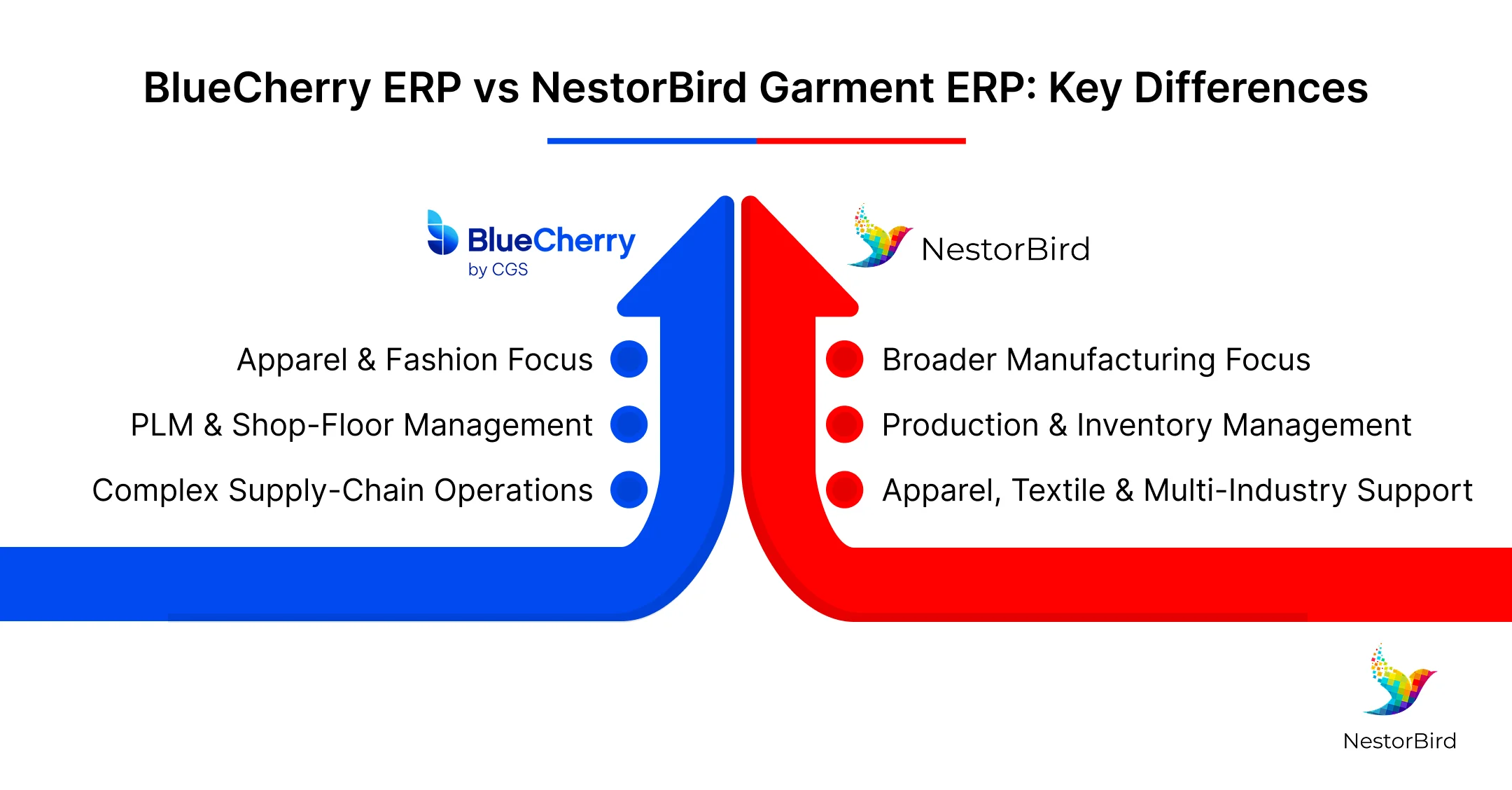
BlueCherry ERP vs NestorBird Garment ERP: Feature Comparison
Feature | BlueCherry ERP | NestorBird Garment ERP |
|---|---|---|
Apparel focus | Strong | Strong manufacturing + apparel |
Manufacturing ERP | Yes | Yes |
Inventory management | Yes | Yes |
Production management | Yes | Yes |
Supply-chain management | Strong | Yes |
Shop-floor management | Strong | Yes |
PLM | Yes | Manufacturing-focused |
Quality management | Yes | Yes |
Reporting & analytics | Yes | Yes |
Multi-industry manufacturing | Limited focus | Strong |
SMB suitability | Depends on requirements | Strong potential fit |
Cloud capabilities | Yes | Yes |
The key difference is positioning. BlueCherry is more fashion-centric, while NestorBird is designed as a broader manufacturing ERP platform. This is the heart of any practical Garment ERP software comparison.
Apparel and Garment Manufacturing
For apparel manufacturers, ERP software must go beyond basic accounting and inventory.
A Garment Factory May Need to Manage
Styles and SKUs
Sizes and colors
Fabrics and accessories
Purchase orders
Production schedules
Work-in-progress
Quality inspections
Finished goods
Dispatch
BlueCherry has an advantage when highly specialized fashion workflows are central to the business. NestorBird, meanwhile, focuses on connecting manufacturing processes such as procurement, production, inventory, quality, and reporting. Therefore, businesses searching for ERP for clothing manufacturers should evaluate how easily each system maps to their real production workflow.
Inventory Management
Inventory control is critical in garment manufacturing. Manufacturers may manage fabric, thread, buttons, zippers, packaging, work-in-progress, and finished garments simultaneously.
Both platforms address inventory management, but the right choice depends on the complexity of your inventory structure.
Questions to Ask Before You Decide
When evaluating Apparel inventory management software, ask:
Can it track raw materials and finished goods?
Can it manage variants?
Can it track warehouse movements?
Can production consume materials accurately?
Can management see current stock quickly?
The best system is the one that provides visibility without making daily operations unnecessarily complicated.

Production Planning and Management
Production planning directly affects delivery timelines and profitability. An effective ERP should help managers understand what needs to be produced, what materials are available, which orders are pending, which production stages are delayed, what capacity is available, and when an order will be completed.
BlueCherry’s shop-floor and apparel focus can be valuable for complex production environments. NestorBird focuses on broader manufacturing capabilities such as production planning, scheduling, inventory, and operational reporting.
For an SMB factory, simplicity is important. A powerful ERP isn’t useful if workers struggle to use it every day.
Cloud ERP and Scalability
Cloud ERP can help manufacturers access business information across factories, offices, warehouses, and remote locations.
Both BlueCherry and NestorBird support modern cloud-oriented ERP approaches. For a growing garment company, scalability should also be considered.
Today’s business may have one factory and one warehouse. Tomorrow, it may have multiple factories, warehouses, sales channels, and locations. A good Cloud ERP for garment manufacturers should therefore support growth without forcing the business to completely replace its ERP later.
Implementation and Usability
ERP implementation is often more important than the feature list.
Before Selecting a System, Evaluate
Implementation timeline
Data migration
Employee training
Customization requirements
Integration requirements
Vendor support
Future upgrades
For SMBs, an ERP should be practical enough for employees to adopt quickly. The best Manufacturing ERP software isn't necessarily the one with the most modules. It's the one that solves important problems without creating unnecessary complexity.
Pricing and Total Cost
ERP pricing depends on factors such as number of users, modules, implementation, customization, integrations, data migration, training, and support.
Therefore, don’t compare platforms using only their subscription price. Instead, calculate the total cost of ownership. A system with more features may cost more but provide better value for a complex manufacturer. On the other hand, an SMB may not need an enterprise-level platform.
Which Is Better for SMB Manufacturers?
Choose BlueCherry If You Need
Deep apparel functionality
Fashion-specific workflows
Complex sourcing
Advanced supply-chain management
PLM capabilities
Detailed shop-floor operations
Consider NestorBird If You Need
Broader manufacturing ERP
Apparel and textile support
Production and inventory management
Procurement and supply-chain management
Flexible manufacturing operations
A platform that can support wider manufacturing requirements
For many SMBs, the priority should be fit, usability, scalability, and implementation, rather than simply choosing the platform with the longest feature list.
BlueCherry ERP Alternative: When Should You Consider One?
Looking for a BlueCherry ERP alternative doesn’t mean BlueCherry is unsuitable.
You May Want to Evaluate Alternatives When
Your company is relatively small.
You need broader manufacturing capabilities.
You want a simpler implementation.
Your budget is limited.
Your operations extend beyond apparel.
You require different customization options.
You want an ERP that can scale with changing manufacturing requirements.
A good alternative should solve your operational challenges rather than simply replicate another ERP's features.
How to Choose the Right Garment ERP
Step 1: Map Your Workflow
Document the journey from purchasing raw materials to dispatching finished goods.
Step 2: Identify Problems
Find bottlenecks in inventory, production, procurement, quality, and reporting.
Step 3: Create Must-Have Features
Separate essential requirements from optional features.
Step 4: Request a Real Demo
Ask vendors to demonstrate your actual garment manufacturing workflow.
Step 5: Compare Total Cost
Include implementation, training, migration, customization, integrations, and support.
Businesses evaluating ERP for SMB manufacturers can also use a structured ERP checklist before making the final decision.
Conclusion
The BlueCherry ERP vs NestorBird Garment ERP decision ultimately comes down to business fit. BlueCherry is a strong option for apparel businesses requiring deep fashion-specific functionality, supply-chain visibility, PLM, and shop-floor capabilities.
NestorBird takes a broader manufacturing approach, supporting textiles and apparel alongside other manufacturing industries.
For SMB garment manufacturers, the smartest approach is to compare actual workflows, implementation requirements, scalability, usability, and total cost.
Don’t choose an ERP simply because it has more features. Choose the platform that your team can adopt, your business can afford, and your operations can grow with.

Frequently Asked Questions
Not necessarily. BlueCherry has a stronger fashion-specific focus, while NestorBird provides broader manufacturing ERP capabilities that include textiles and apparel. The better choice depends on your business requirements.
It can be, depending on the company's complexity and requirements. SMBs should compare its functionality and implementation requirements with other manufacturing ERP options.
Yes. NestorBird's manufacturing ERP supports textiles and apparel along with other manufacturing industries.
The Best ERP for small manufacturers should balance functionality, usability, implementation, scalability, integrations, and total cost. There is no single platform that is best for every business.
Yes. Modern ERP systems can manage raw materials, work-in-progress, finished goods, procurement, stock movements, and warehouse operations. Specific variant and apparel workflows should be verified during a demo.
Look for production planning, inventory, procurement, quality management, reporting, supply-chain visibility, variant management, integrations, scalability, and ease of use.
Yes. Cloud ERP can make operational data accessible across factories, offices, warehouses, and management teams while reducing dependence on local infrastructure.