
Quick Summary
Cloudbeds vs NestorBird PMS is a comparison between two different approaches to hotel technology. Cloudbeds provides a broad hospitality platform covering PMS operations, direct booking, distribution, payments, integrations, reporting, and guest experience. The supplied NestorBird brief emphasizes implementation, customization, integrations, deployment, and ongoing support. The right choice depends on the hotel's workflows, required integrations, operational complexity, and growth plans.
Table Of Contents
Introduction
Choosing the right hotel property management system can affect reservations, front-desk work, guest information, room availability, reporting, and online bookings. For an independent hotel, the decision should be based on how the property actually operates rather than on a feature list alone.
This Cloudbeds vs NestorBird PMS comparison looks at the main areas hotel owners should evaluate: PMS operations, booking management, integrations, reporting, customization, implementation, support, and scalability.
Key Takeaways
Cloudbeds offers a broad hospitality platform with PMS, booking, distribution, payments, integrations, reporting, and guest-experience capabilities.
Cloudbeds currently advertises more than 450 integration partners and an open API for custom integrations.
Cloudbeds provides a direct Booking Engine connected with its PMS.
The supplied NestorBird brief emphasizes customization, integrations, implementation, deployment, and ongoing support.
Specific NestorBird hospitality features should be confirmed during a product demonstration before publication or purchase.
The right PMS should fit the hotel's current workflows and future requirements.
Cloudbeds vs NestorBird PMS: What's the Difference?
Cloudbeds is positioned as a broad hospitality technology platform. Its current offering combines property management with capabilities such as channel management, direct booking, payments, integrations, guest experience, reporting, and revenue-related tools.
The supplied NestorBird brief takes a more implementation-focused approach. It highlights consultation, customization, integration, deployment, and ongoing support, while advising that product-level features should only be included when they are confirmed by available NestorBird information.
For an independent hotel, this creates two different evaluation paths: a broader pre-built hospitality ecosystem on one side, and a potentially more tailored implementation approach on the other. The important question is which model fits the property’s actual operating requirements.
Comparison Factor | Cloudbeds | NestorBird PMS |
|---|---|---|
PMS capabilities | Broad hospitality PMS platform | Evaluate based on confirmed product scope |
Front desk | Supported within Cloudbeds PMS | Confirm during product evaluation |
Online reservations | Booking Engine available | Confirm required capability |
Channel management | Integrated channel management | Confirm required integrations |
Reporting | Operational and business reporting | Evaluate required business reports |
Integrations | 450+ partners and open API | Integration and customization emphasized |
Customization | Integrations and API support | Customization emphasized in supplied brief |
Implementation | Onboarding and support resources | Implementation and deployment emphasized |
Cloudbeds Overview
Cloudbeds is a cloud-based hospitality management platform designed to connect hotel operations, distribution, direct bookings, payments, integrations, and guest-related activities. Its current platform presents these capabilities as part of a connected hospitality ecosystem.
For an independent hotel, this breadth can reduce the need to manage several disconnected systems. It can also be useful for properties that depend on OTA distribution, direct website bookings, or a wide range of hospitality integrations.
Key Features and Capabilities
Property and room management
Reservations and online bookings
Booking Engine
Channel management
Front-desk operations
Reporting and analytics
Payments and integrations
Cloudbeds currently advertises more than 450 integration partners and provides an open API for custom integrations. Its Booking Engine also connects direct reservations with the PMS, making booking and availability management part of the same workflow.
NestorBird PMS Overview
The supplied brief presents NestorBird PMS as an option to evaluate around operational fit, customization, integration requirements, implementation, deployment, and support. It specifically identifies flexible workflows and tailored implementation as considerations for hotels that may need more than a standard setup.
When implementation involves configuration, migration, testing, training, and go-live planning, NestorBird’s ERP implementation services can provide relevant supporting context.
Key Features and Capabilities
The available NestorBird brief does not provide enough verified information to claim that NestorBird PMS natively includes every capability listed for Cloudbeds. In particular, specific claims about a native booking engine, OTA channel manager, or individual hospitality integrations should be confirmed with the NestorBird team.
The material does establish an emphasis on customization, integration, deployment, and ongoing support. That makes the implementation discussion especially important for hotels with specific workflows or broader business-process requirements.
Cloudbeds vs NestorBird PMS: Feature-by-Feature Comparison
PMS and Front-Desk Management
A PMS should help the front desk manage reservations, room availability, guest details, check-ins, check-outs, payments, and daily operational tasks. Cloudbeds documents these types of hotel workflows within its PMS platform.
For NestorBird, the supplied brief does not provide a detailed front-desk feature list. During a demo, ask the vendor to show your real workflows rather than simply confirming that a feature exists.
Booking Engine and Online Reservations
Direct bookings can be important for independent hotels because they provide another route for accepting reservations through the hotel’s own website. Cloudbeds offers a dedicated Booking Engine connected with its PMS, allowing guests to check availability and complete direct reservations.
The supplied NestorBird brief does not confirm an equivalent native booking engine. If direct booking is a major requirement, this should be verified before the platform is selected.
Channel Management and Integrations
Channel management matters when a property sells rooms through multiple OTAs or distribution channels. Cloudbeds documents channel-management capabilities for synchronizing availability, rates, and inventory across connected channels.
NestorBird’s brief emphasizes integrations and customization but does not specify a fixed list of OTA or channel connections. Ask whether each required integration is native, API-based, partner-supported, or custom-built.
Reporting, Analytics and Business Visibility
Hotel managers need reports that make daily operations easier to understand. Depending on the property, this can include reservations, occupancy, revenue, guest activity, operational performance, and management reporting.
For broader context around centralized business processes and reporting, see the NestorBird ERP system guide.
Cloudbeds provides reporting capabilities within its hospitality platform. For NestorBird, reporting requirements should be demonstrated using the exact metrics and reports the hotel management team needs.
Customization, Scalability and Support
Customization becomes important when a hotel’s workflows do not fit neatly into a standard software setup. The supplied NestorBird brief specifically highlights flexible workflows, tailored implementation, customization, broader business-process integration, and direct implementation or support requirements.
For hotels evaluating configuration, deployment, and tailored workflows, the ERP implementation resource provides additional implementation context.
Cloudbeds also supports customization through integrations and its open API. Support and implementation should be evaluated separately from the feature list: ask who manages migration, training, integrations, testing, and post-go-live support.
Cloudbeds vs NestorBird PMS: Which Fits an Independent Hotel?
There is no universal answer because independent hotels can operate very differently. A small boutique property may have very different requirements from a larger independent hotel or a growing multi-property business.
Consider Cloudbeds If…
Cloudbeds may be relevant when a hotel wants a broad hospitality ecosystem with PMS, direct booking, channel management, payments, integrations, and guest-experience capabilities. It can also be relevant when OTA distribution and a large integration ecosystem are important parts of the hotel’s technology requirements.
Consider NestorBird PMS If…
NestorBird should be evaluated when customization, integration, tailored implementation, and direct implementation support are important buying criteria. The supplied brief specifically identifies flexible workflows and broader business-process integration as considerations.
Hotels wanting to understand the wider software ecosystem can also explore NestorBird and then discuss the specific PMS requirements with the team.
How to Choose the Right PMS for Your Independent Hotel
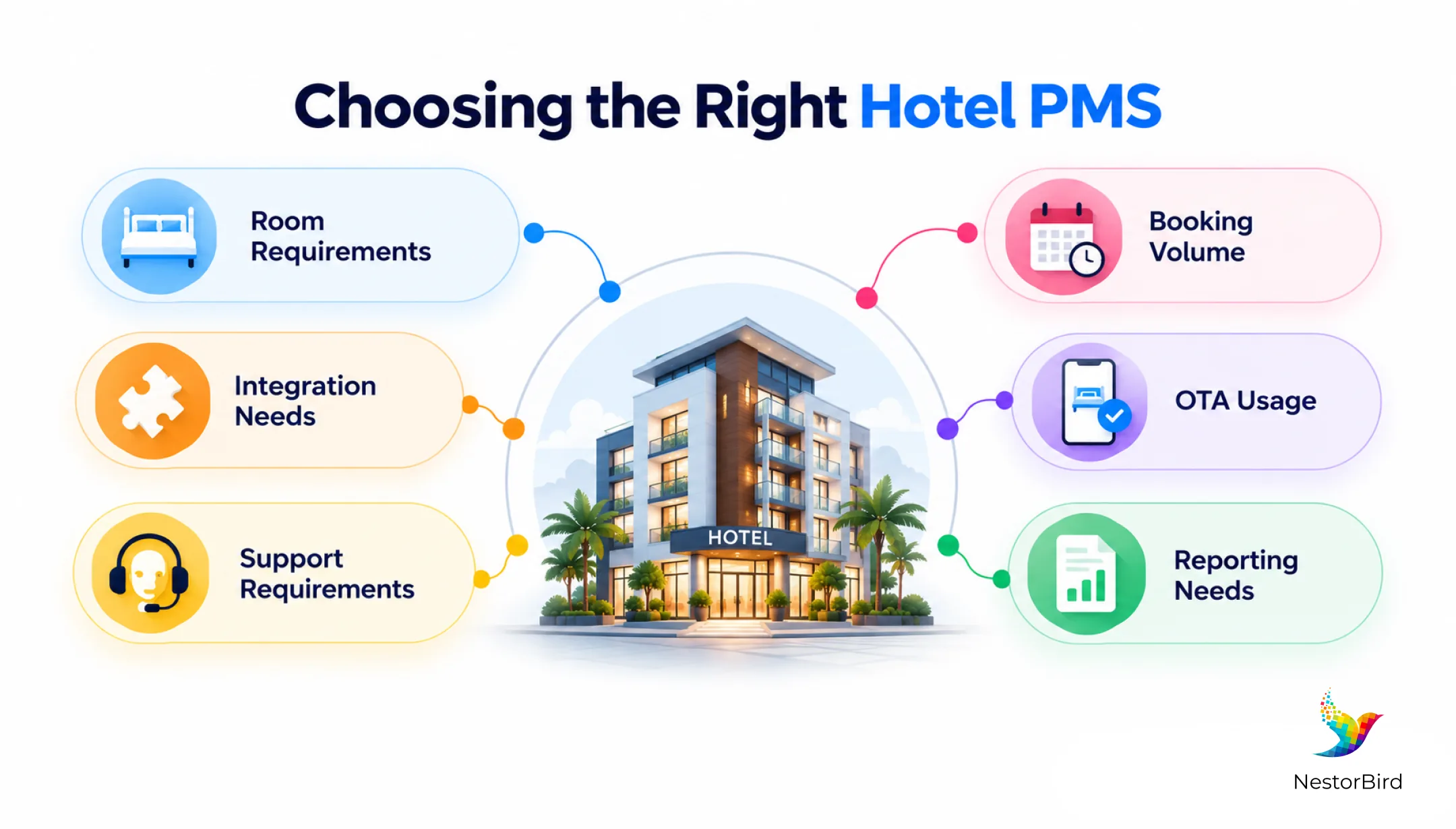
Start by documenting the hotel’s real operating model. Look at the number of rooms and properties, reservation volume, direct versus OTA bookings, required integrations, front-desk workflow, reporting requirements, customization needs, implementation and training expectations, scalability, and total cost of ownership.
Number of rooms and properties
Reservation volume and booking sources
Direct versus OTA booking mix
Required integrations and payment systems
Front-desk and daily hotel workflows
Reporting and analytics requirements
Customization requirements
Migration, implementation, and training
Scalability and future growth
Total cost of ownership
During vendor demonstrations, use real hotel scenarios. Ask the vendor to show reservation changes, cancellations, room assignments, online bookings, payment adjustments, reporting, and the exact integrations your property needs. This gives the hotel a much clearer basis for comparison than a generic feature checklist.
Cloudbeds vs NestorBird PMS: Final Verdict
The practical answer depends on the hotel’s operating model. Cloudbeds provides a documented hospitality platform with PMS, direct booking, channel management, payments, integrations, reporting, and guest-experience capabilities.
The supplied NestorBird brief emphasizes customization, integrations, deployment, implementation, and support. Because the available brief does not confirm every hospitality feature, hotels should validate the exact PMS capabilities they require before making a final decision.
The most useful question is not simply which PMS has more features. It is which platform can support the hotel’s workflows with the right combination of functionality, integration, customization, implementation, support, and scalability.
Conclusion
Choosing between Cloudbeds and NestorBird PMS should begin with the hotel’s requirements rather than a generic feature list. Cloudbeds provides a broad hospitality ecosystem, while the supplied NestorBird requirements emphasize customization, integration, implementation, deployment, and support.
For an independent hotel, map the current workflows, identify required integrations, define reporting needs, test implementation requirements, compare total costs, and request realistic demonstrations. The result should be a PMS that fits how the hotel operates today while leaving room for future growth.
Frequently Asked Questions
Cloudbeds is documented as a broad hospitality platform covering PMS operations, direct booking, distribution, payments, integrations, reporting, and guest-experience capabilities. The supplied NestorBird brief emphasizes customization, integrations, implementation, deployment, and support. Specific NestorBird PMS capabilities should be confirmed directly.
NestorBird can be evaluated where an independent hotel prioritizes flexible workflows, customization, integration, and tailored implementation. The supplied brief does not establish parity with every Cloudbeds capability, so booking-engine, channel-management, and other required functions should be validated.
The answer depends on the hotel's required functionality, booking model, integrations, reporting needs, customization requirements, implementation expectations, and total cost. A small hotel should evaluate its real workflows rather than selecting software based only on the size of a feature list.
Evaluate reservations, room management, front-desk workflows, online booking, channel management, reporting, payments, integrations, customization, implementation, training, scalability, and support. The priority of each feature depends on the hotel's operating model.
Yes. A PMS can connect reservation and availability data with online booking tools. Cloudbeds, for example, documents a Booking Engine that connects with its PMS so guests can view availability and rates and completed reservations can flow back into the system.
Document the hotel's rooms, properties, reservation sources, OTA usage, direct-booking requirements, integrations, front-desk workflows, reporting needs, customization requirements, implementation expectations, scalability, and total cost. Then test those requirements during vendor demonstrations.