

Quick Summary
Manufacturing ERP connects your materials, machines, and orders into one schedule. It replaces guesswork with real production control. You get accurate production planning and dynamic scheduling. This reduces delays, handles rush orders, and improves on time delivery without extra manual work.
Table Of Contents
Introduction
To efficiently manage your manufacturing business, you need a clear view of what to make, when to make it, and what materials are needed. Without proper systems, production planning becomes guesswork, and scheduling falls apart when delays happen. In this blog post, we will explain how manufacturing ERP connects your entire shop floor data into one place. You get better production control and real-time visibility. With manufacturing management software, your planning becomes accurate, and your scheduling adapts to real changes without manual rework.
Key Takeaways
Manufacturing ERP replaces spreadsheets with real control.
Production planning software aligns materials and machines.
Production scheduling software handles rush orders easily.
Work order management cuts downtime and delays.
ERP for manufacturing improves on time delivery.
Key Challenges in Traditional Production Planning and Scheduling
There are many challenges that manufacturing businesses face, and usually cannot avoid if they are not using the right production planning software. These problems directly hurt delivery dates and increase costs.
Lack of real-time visibility causes machine downtime and missed deadlines. Managers do not see shop floor issues until it is too late.
Manual data entry errors create wrong inventory counts and incorrect order dates. This leads to overproduction or missing raw materials.
Resource conflicts happen when the same machine or worker is double booked. Rush orders make this problem worse every day.
Supply disruptions from vendors change material arrival times. Production stops because order management does not talk to the planning system.
Poor workflow optimization keeps jobs waiting between processes. Labor shortages then spread delays across all open work orders.
Spreadsheets fail in dynamic environments because they cannot update automatically. Every new change requires full manual recalculation.
Know more about Manufacturing ERP Software.
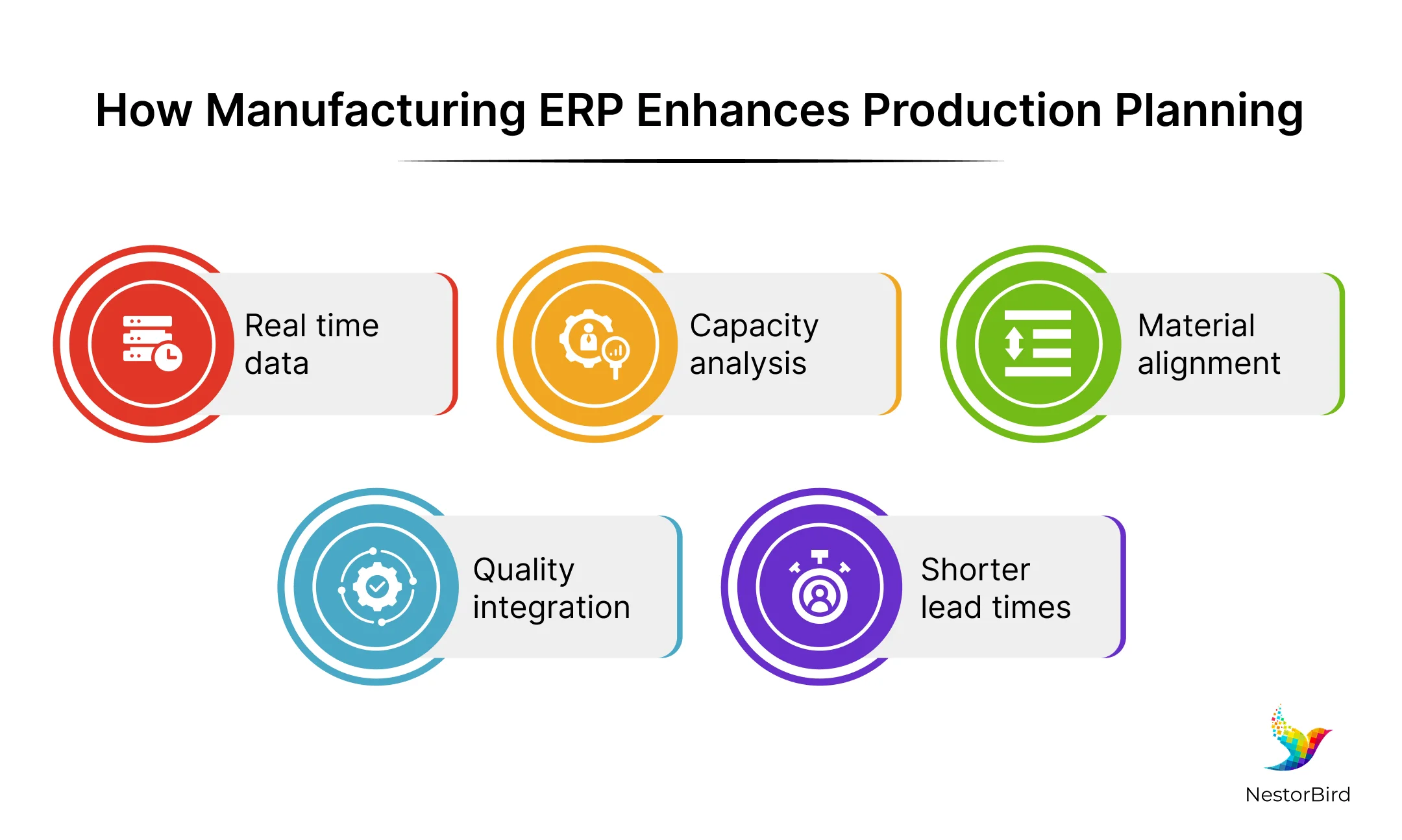
How Manufacturing ERP Enhances Production Planning
When it comes to managing your production planning efficiently, basic tools fall short. Manufacturing ERP brings real-time data from the shop floor into one system. This data feeds your forecasts, making them more accurate.
Better Resource Use
The system performs manufacturing resource planning to check machine and labor availability. It aligns demand with actual capacity. ERP production planning modules then create master schedules that respect your limits. Inventory management updates automatically, so materials are ready when needed.
Smarter Scheduling
Production planning software inside ERP for manufacturing optimizes how you use bills of materials (BOMs). It reduces lead times by flagging shortages before they cause delays. Quality management checks are added directly into the plan. This stops rework from breaking your schedule.
Manufacturing management software gives you production control, so your plan becomes realistic, not optimistic. This cuts waiting time and improves on-time delivery.

How Manufacturing ERP Streamlines Production Scheduling
To be able to properly and efficiently schedule your production floor, you need a system that adapts fast. Production scheduling software inside manufacturing ERP automates this entire process.
Real Time Changes
The software handles both finite and infinite capacity rules. When a machine breaks down, it recalculates job sequences automatically. You get real time adjustments without manual work.
Better Shop Floor Control
Work order management becomes visual and simple. Production tracking through barcode scans feeds live data back into the schedule. Supply chain management integrates so materials arrive just in time for each operation.
Handling Disruptions
Rush orders no longer destroy your plan. The ERP for manufacturing uses algorithm driven sequencing to fit urgent jobs without breaking everything else. Workflow optimization reduces idle time between stages. For multi stage processes, the schedule respects dependencies. This minimizes downtime and improves manufacturing efficiency across all shifts.
Check out how to drive manufacturing ERP excellence with NestorBird.
Measurable Benefits and ROI for Manufacturers
Manufacturers can easily see real returns after adopting manufacturing ERP. The system directly improves daily operations and profit margins.
Higher Efficiency
Manufacturing efficiency increases because machines run longer without idle time. Production control becomes tighter, reducing waste from overproduction or waiting. Most users cut lead times by twenty to thirty percent.
Better Delivery and Quality
On time delivery rates cross 95% with accurate scheduling. Quality management improves because inspections are built into each step. Order management connects customer promises directly to shop floor reality.
Lower Costs and Scalability
Scrap and rework costs drop significantly. ERP production planning helps you scale without adding extra managers. Manufacturing resource planning prevents buying too much raw material or stocking the wrong items.
Competitive Edge
You respond faster when customers change their minds. Production scheduling software lets you say yes to rush orders confidently. This agility becomes your competitive advantage over slower competitors who still use spreadsheets.
NestorBird Key Insight: Without manufacturing resource planning, your production schedule is just a wish. With it, every machine hour and material becomes a tracked, accountable part of profit.
Implementation Tips and Best Practices
You can start with a full audit of your current workflow before selecting any manufacturing management software.
Pick a scalable ERP for manufacturing that grows with your order volume and product lines.
It is best to clean your inventory management data before going live. Bad inputs create bad schedules.
Train shop floor staff on production tracking first. Their daily use decides success or failure.
Integrate quality management from day one so inspections become part of the routine plan.
You can use production planning software to run in parallel with your old system for two weeks minimum.
Avoid customizing too early. Use standard production scheduling software features before asking for changes.
Conclusion
A disorganized production plan hurts your delivery dates and raises costs. Manufacturing ERP fixes this by connecting your materials, machines, and orders into one clear schedule. With ERP production planning, you handle rush orders without breaking existing jobs. If you need software built for practical shop floor operations, the solutions from NestorBird give you exactly this level of control without extra complexity. Start with a small step, and your planning will improve fast.

Frequently Asked Questions
Yes, production scheduling software automatically resequences jobs based on priority. It shifts non-urgent orders later and fits the rush order into available capacity.
Finite capacity respects machine and labor limits. Infinite capacity assumes unlimited resources. ERP for manufacturing uses finite scheduling to create realistic, achievable production plans.
Not necessarily. Many manufacturing management software solutions include built-in production tracking via barcode or mobile scans. This feeds real-time data back to your schedule.