

Quick Summary
Healthcare ERP connects clinical and administrative workflows by linking patient registration, clinical services, EHR/EMR, pharmacy, inventory, billing, revenue cycle, finance, and reporting. Instead of departments maintaining disconnected records, healthcare ERP software creates connected data flows that help authorized teams coordinate operations and access relevant information across the patient journey.
Table Of Contents
Introduction
A patient’s journey moves through multiple hospital functions. Registration, appointments, clinical care, diagnostics, pharmacy, billing, finance, and reporting all create related information.
Healthcare ERP software connects these workflows so information can move between teams instead of being repeatedly entered into separate systems. This creates a more connected path from patient activity to operational and financial records.
Interoperability remains an active healthcare technology priority. In 2026, the Office of the National Coordinator for Health Information Technology continued publishing standards and implementation guidance for exchanging both clinical and administrative information. ONC also notes that many hospitals already exchange data with third-party technology for clinical and administrative use cases, although much of that exchange still relies on proprietary or non-standard approaches. This makes workflow design and integration important considerations when evaluating healthcare ERP.
Key Takeaways
Healthcare ERP connects clinical and administrative data through shared workflows.
Patient registration can initiate appointments, clinical, billing, and administrative processes.
EHR/EMR information can connect with pharmacy and inventory workflows when integrations support those processes.
Clinical services can create information that feeds billing and revenue-cycle workflows.
Finance and accounting can receive relevant transactions generated by healthcare operations.
Connected reporting gives authorized teams a broader view across departments.
What Is Healthcare ERP and How Does It Connect Clinical and Administrative Operations?
Healthcare ERP is an integrated system that connects healthcare operations such as patient management, clinical workflows, inventory, billing, finance, and reporting through shared data and connected processes.
A practical way to understand healthcare ERP software is to follow the information created during a patient’s journey. Registration creates patient information. A clinical encounter creates service information. Pharmacy and inventory may create stock transactions. Billing creates charges, while finance records the resulting financial activity.
The important point is that these are connected events, not isolated departmental tasks. The ERP layer can provide relationships between them, subject to the organization’s architecture, configuration, permissions, and integrations.
Healthcare ERP vs EHR, EMR, and HIS
EHR, EMR, HIS, and ERP are related but are not interchangeable terms. An EHR primarily manages electronic health information, while an EMR generally refers to a digital medical record used within a provider or practice. A Hospital Information System supports hospital-specific clinical and administrative information management.
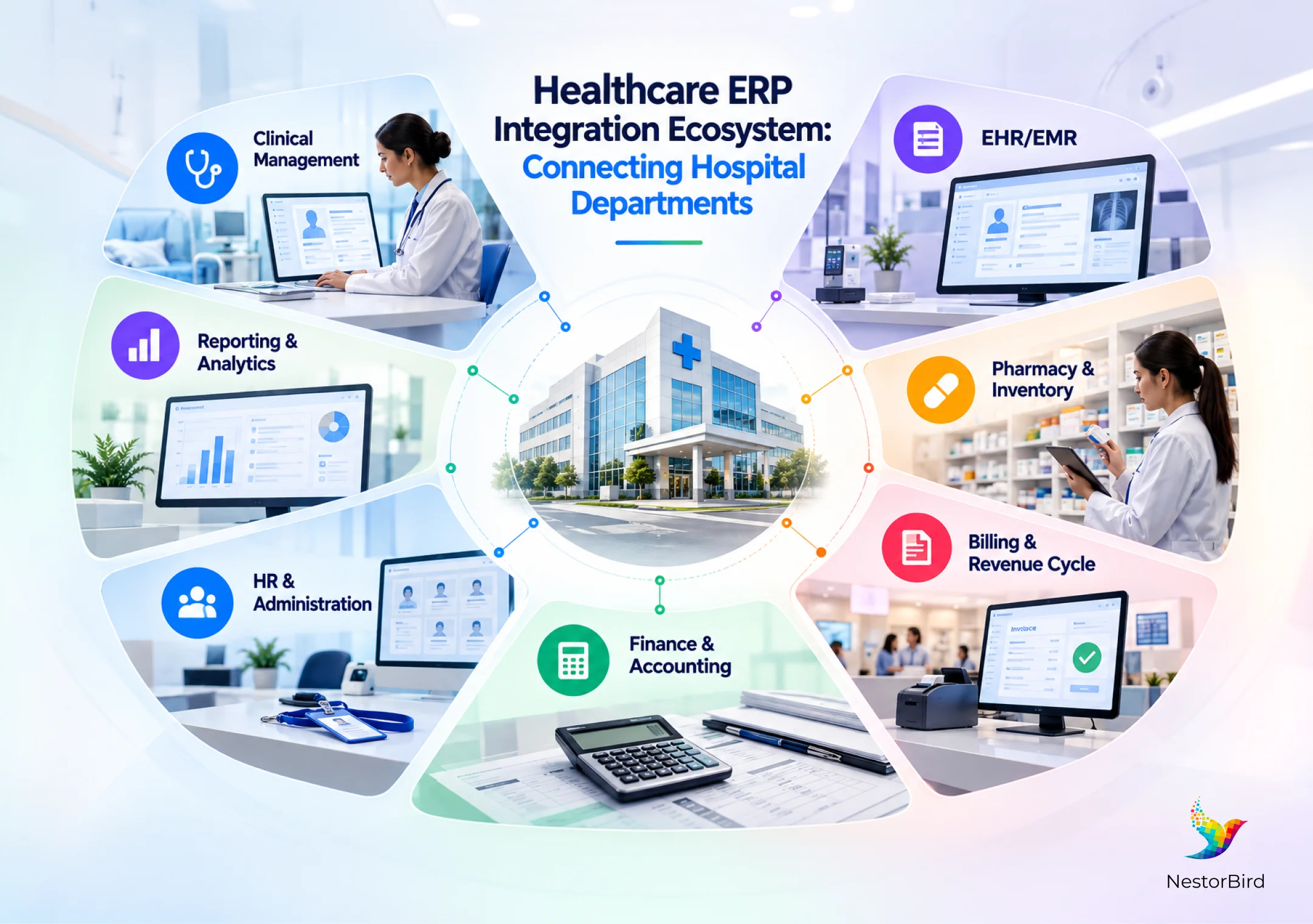
Healthcare ERP focuses more broadly on enterprise operations. It can connect patient and clinical workflows with inventory, billing, procurement, finance, HR, and reporting. In some organizations, ERP works alongside specialist EHR, laboratory, pharmacy, or imaging systems rather than replacing them.
Connecting Patient Registration, Clinical Workflows, and EHR/EMR
Registration is often the first operational step in a patient’s journey. Once core patient information is created or confirmed, it can be associated with an appointment, admission, clinical encounter, orders, services, and relevant records.
This is where hospital management software can support the connection between front-desk and clinical workflows. Instead of entering the same patient details at every stage, related teams can work from information associated with the same patient and encounter.
Clinical workflow management is about coordinating activities among registration teams, doctors, nurses, diagnostics, pharmacy, and other care teams. Automation can support structured handoffs, but clinical decisions and approvals still depend on authorized professionals and the organization’s configured processes.
Linking Clinical Services with Inventory, Pharmacy, and Resources
Clinical work often creates operational demand. A treatment may require medicine, a procedure may consume medical supplies, and diagnostics may require specific materials or resources. These activities can affect pharmacy, inventory, procurement, and billing workflows.
A simple example is a medication order. The doctor records the requirement, pharmacy processes the order, inventory reflects the issue, and a related transaction may become available to billing when the system is configured for that workflow.
The exact sequence depends on the ERP, EHR, pharmacy, and inventory architecture. The objective is not to automate every clinical decision; it is to connect the operational transactions created around patient care.
Connecting Hospital Billing, Insurance, and Revenue Cycle Management
Billing is the point where clinical activity begins to become financial activity. Consultations, procedures, diagnostics, medicines, and other services may create charges according to the organization’s billing rules.
An integrated hospital ERP software workflow can connect relevant service information with billing processes. A simplified flow is Services or Procedures → Charges → Patient Bill → Insurance Claim → Payment or Settlement → Revenue Records.
Revenue cycle management covers the financial processes associated with capturing charges, submitting claims where applicable, processing payments, and managing outstanding balances. Integration can reduce the need to recreate the same operational information at every stage, although outcomes depend on configuration, payer requirements, data quality, and staff processes.
Integrating Healthcare Finance, Accounting, and Administrative Data
Healthcare operations eventually create financial transactions. Patient services can create revenue, purchasing creates expenses, supplier invoices create payables, and payments affect receivables. Connecting these transactions gives finance teams more context about where financial activity originates.
A connected flow can look like this: Billing and Payments → Accounts Receivable → Accounting → Expenses and Procurement → Financial Reporting. This makes healthcare finance and accounting part of the same operational story rather than a separate end-of-process activity.
The result is a clearer relationship between clinical demand, operational consumption, procurement, and financial records. Access should remain role-based so users only see information appropriate to their responsibilities.
How Healthcare ERP Integration Enables End-to-End Workflow Automation
Healthcare workflow automation is most useful when it removes unnecessary handoffs. The goal is not to automate every decision; it is to make structured information available to the next authorized team when an event occurs.
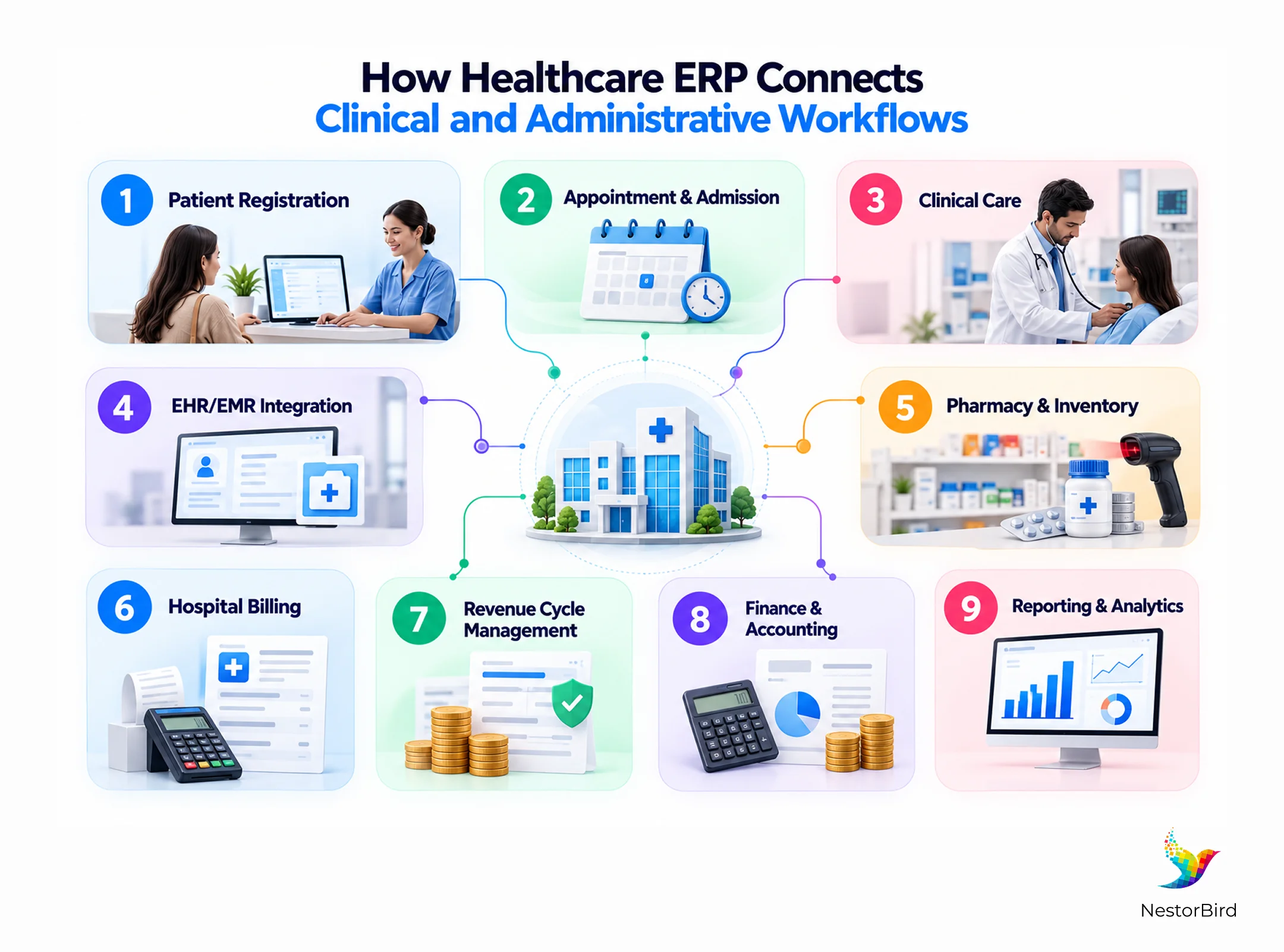
A connected workflow can begin with patient registration and continue through appointment or admission, clinical service, EHR/EMR updates, medication or supply issuance, inventory updates, billing, payment or insurance processing, accounting, and management reporting.
This process-based approach is important because a system can contain many modules without truly connecting them. Integration should therefore be evaluated by asking what information moves between workflows, when it moves, who can access it, and what transaction or action it triggers.
Clinical-to-Administrative Workflow
Patient registers.
Appointments or admissions are created.
Clinical service is recorded.
Relevant clinical information is added to the EHR/EMR.
Medication or supplies are issued.
Inventory records are updated.
Billable services and charges are generated.
Insurance or payment workflow begins.
Financial transactions reach accounting.
Management reports reflect the activity.
This sequence shows why healthcare ERP is fundamentally connected to processes. One event can create information that another department needs, and the value of integration comes from preserving those relationships across the workflow.
Data Visibility, Reporting, and Coordination Across Departments
Connected workflows also improve the structure of operational reporting. Authorized users can work with information about patient activity, clinical services, inventory, pharmacy, billing, revenue-cycle status, expenses, procurement, and departmental performance.
The key is not simply putting every dataset on one dashboard. Reporting is useful when the underlying information is connected, current enough for the intended decision, and governed by appropriate access controls.
For example, a procurement manager may use consumption data to review replenishment needs, while finance may examine the related purchase transactions. An administrator may review patient activity alongside billing or departmental information. Different users can therefore work from connected operational data without receiving unrestricted access to unrelated information.
What to Consider Before Implementing Healthcare ERP Integration
Start with workflow mapping rather than software screens. Document the patient journey from registration through clinical care, diagnostics, pharmacy, billing, payment, accounting, and reporting. Then identify every manual handoff, duplicate entry, spreadsheet, approval, and reconciliation point.
Next, review integration requirements. Determine which systems must exchange information, which standards or APIs are available, what data must move, and how identity matching and data validation will work. ONC’s current interoperability guidance highlights the continuing importance of standards for clinical and administrative data exchange.
Finally, plan governance and adoption. Healthcare data requires controlled access, clear ownership, auditability, and security. Staff training is equally important because even a technically connected system will struggle if the configured workflow does not match how teams actually work.
Conclusion
The value of healthcare ERP is not simply placing patient management, billing, inventory, pharmacy, finance, and reporting modules in one platform. The real value comes from connecting the workflows between them.
The central chain is straightforward: Patient → Registration → Clinical Care → EHR/EMR → Inventory and Pharmacy → Billing → Revenue Cycle → Finance → Reporting. Each stage creates information that can support another stage when the systems and processes are properly integrated.
For organizations evaluating an ERPNext healthcare implementation, the practical starting point is the workflow itself. Map the information, handoffs, approvals, integrations, and reporting requirements before deciding how the technology should be configured.
A connected healthcare ERP model can bring clinical and administrative operations closer together, but its effectiveness depends on architecture, interoperability, data governance, security, workflow design, and user adoption.

Frequently Asked Questions
Healthcare ERP is an integrated system that connects healthcare operations with administrative processes such as patient management, inventory, billing, finance, procurement, and reporting.
It links related transactions across the patient journey. Registration can lead to an appointment, clinical activity can create operational transactions, and relevant services can feed billing, finance, and reporting workflows.
EHR and EMR primarily focus on electronic clinical records, while healthcare ERP connects broader operational and administrative processes such as inventory, billing, finance, procurement, and reporting.
Relevant clinical services can be associated with chargeable transactions so billing receives the information required to process patient or payer accounts, subject to configuration and integration.
Revenue cycle management covers the financial process around healthcare services, including charge capture, billing, claims where applicable, payments, and outstanding balances.