
Quick Summary
ERP for Packaging Industry connects production planning, raw material management, inventory, wastage tracking, costing, and reporting in one workflow. Packaging manufacturers can use an ERP system to plan jobs, check material availability, monitor production, compare planned and actual consumption, record wastage, and understand job-level costs. The result is better operational visibility and faster decisions without depending on disconnected spreadsheets and manual records.
Table Of Contents
Introduction
Packaging manufacturing involves much more than converting raw materials into finished products. ERP for Packaging Industry helps connect production planning, materials, inventory, wastage, costing, and reporting so teams can work from the same operational information. Instead of reconciling separate spreadsheets and registers, manufacturers can follow a connected workflow from order and material planning to production, finished goods, and cost analysis.
For businesses evaluating ERP Software for Packaging Industry, the key question is simple: can the system reflect the way your factory actually operates? A useful ERP should make production status easier to see, material usage easier to control, and job costs easier to understand.
Key Takeaways
ERP connects packaging production, procurement, inventory, costing, and reporting.
Production planning becomes more structured when orders, materials, machines, and priorities are connected.
Raw material consumption can be compared with planned requirements to identify unusual usage.
Wastage can be recorded against production instead of being treated only as a month-end adjustment.
Job-level costing gives management clearer visibility into material, production, and overhead costs.
Centralized reporting helps teams act on production, inventory, wastage, and cost information faster.
Why Packaging Manufacturers Need ERP Software
Packaging businesses deal with changing order quantities, customer specifications, material requirements, production priorities, and delivery commitments. A small material shortage can stop a job, while excess stock can lock up working capital. If production and procurement teams work from different records, managers can spend more time reconciling information than solving the underlying problem.
This is where Packaging ERP Software can create practical value. Instead of treating purchasing, inventory, production, and costing as separate activities, ERP connects them through a shared workflow. The system can provide a common operational record that helps teams understand what is required, what is available, what is being produced, and what the job is actually costing.
Managing Production, Materials, and Costs Across Operations
Think of a packaging order as a chain. Sales creates the requirement, procurement secures materials, stores makes them available, production converts them, quality checks the output, and dispatch prepares the finished goods. If information breaks at any handoff, the next team has to stop and ask for an update.
An integrated ERP reduces these handoff gaps by keeping connected information around the same workflow. NestorBird’s current manufacturing resources describe production planning, MRP, work orders, job cards, inventory, quality, and production monitoring as connected manufacturing capabilities.
How ERP for Packaging Industry Improves Production Management
Production planning becomes difficult when planners have to collect order information, stock positions, machine availability, and delivery priorities from different sources. ERP for Manufacturing brings these inputs together so production decisions can be based on a more complete operational picture.
Production Planning and Scheduling
A strong production plan answers four practical questions: what should be produced, when should it be produced, where should it be produced, and what resources are required? ERP can connect sales orders, production requirements, material availability, work centres, and capacity information to create a more structured schedule.
For packaging manufacturers, this becomes especially useful when several jobs compete for the same machine or production process. Planners can consider delivery priorities and available capacity before assigning work. The goal is not to make every order appear immediately achievable; it is to make constraints visible early enough to manage them.
When production planning and material requirements are connected, the planner can also identify material shortages before the job reaches the shop floor. This is where the article’s first internal link belongs: ERP software for manufacturing. Use it here as the natural next step for readers who want broader manufacturing ERP capabilities after understanding production planning.
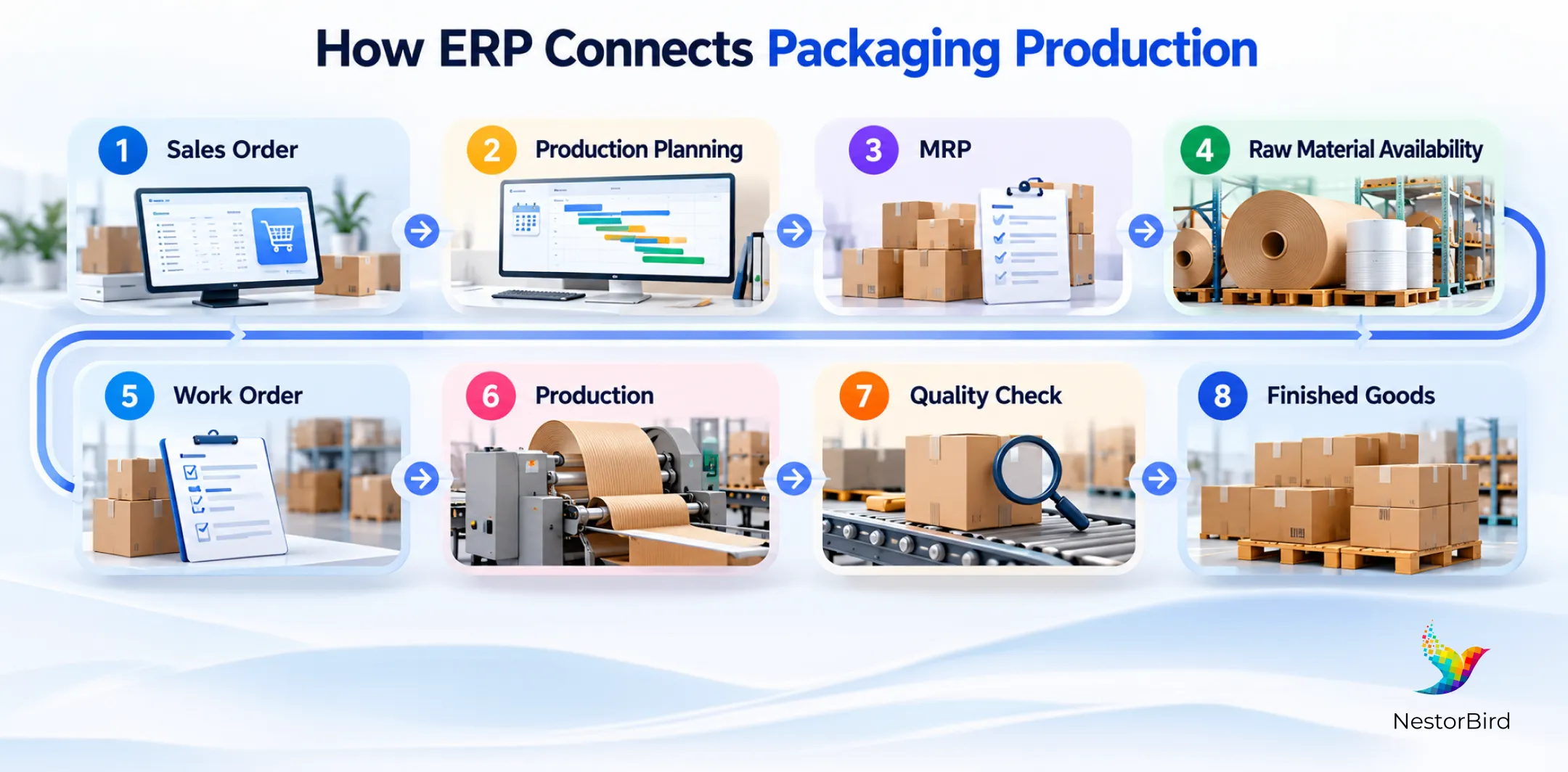
Monitoring Production Progress
Planning is only half the process. Once a job starts, managers need to know whether actual production is following the plan, where work is delayed, and what remains to be completed.
Centralized production data can help teams compare planned and actual output. If one stage falls behind, managers can respond earlier instead of discovering the delay only when the next department asks why the material has not arrived.
NestorBird’s manufacturing software page currently highlights production monitoring, production plans, MRP, work orders, job cards, capacity planning, inventory, and dashboards as part of its manufacturing capabilities.
Controlling Raw Material Usage and Production Wastage
Material control is one of the most important areas for packaging manufacturers because raw material consumption directly influences production cost. Paper, board, films, inks, adhesives, laminates, and other materials need to be available at the right time and consumed within expected limits.
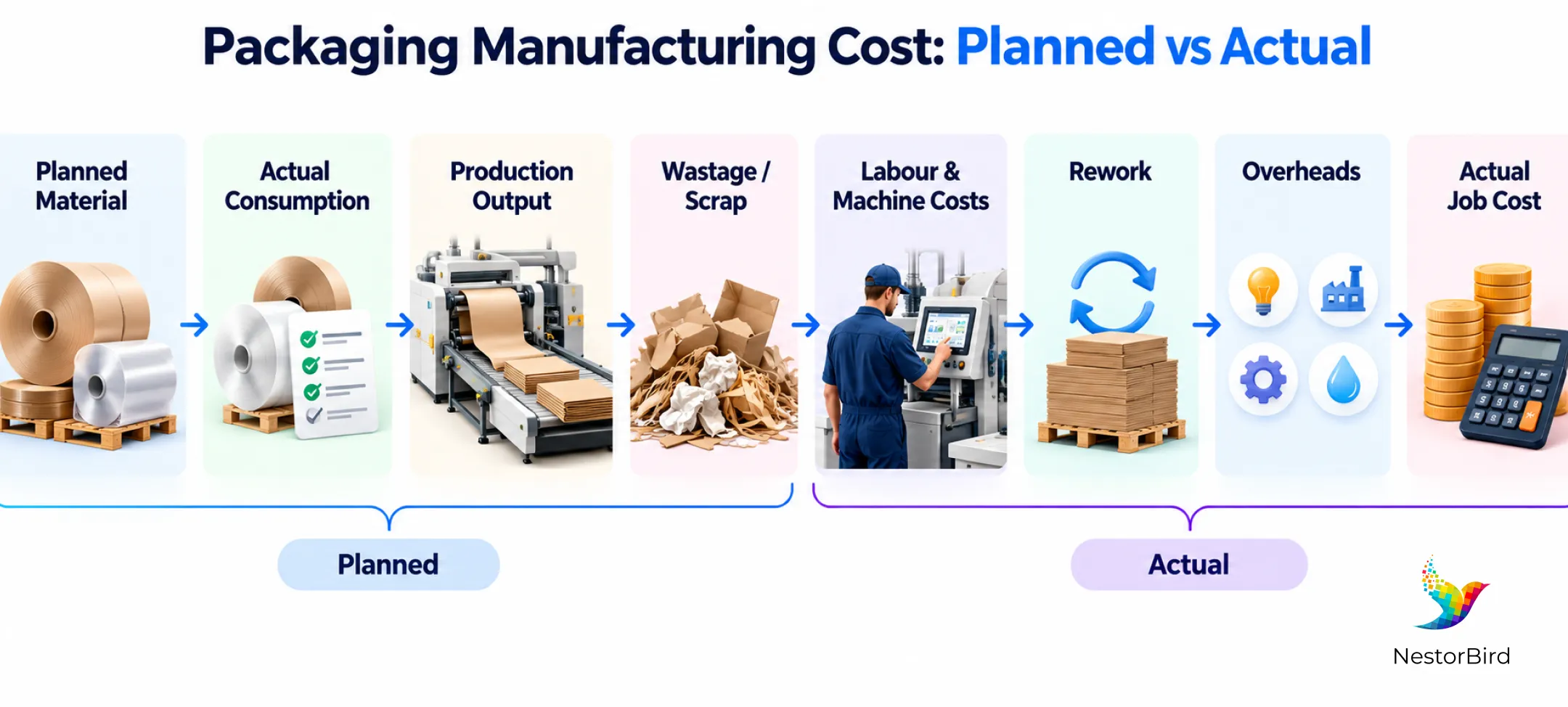
The challenge is not only knowing how much material was purchased. Management also needs to understand how much was planned for a job, how much was issued, how much became finished output, and how much was lost through scrap, trimming, setup, rejects, or other production activities.
Raw Material Planning and Inventory Control
ERP can connect material requirements with inventory and procurement. This gives purchasing teams a better view of available stock, planned requirements, incoming supplies, and material shortages before production begins.
For readers moving from packaging-specific requirements into a broader manufacturing platform, the exact contextual internal link is ERPNext manufacturing ERP software. It is placed here because this paragraph is specifically discussing material planning, inventory, MRP, and production requirements.
NestorBird’s ERPNext manufacturing page describes production planning, MRP, inventory management, BOMs, work orders, job cards, batch and serial tracking, and quality inspection as manufacturing functions.
Tracking Wastage Against Production
A useful wastage process asks more than, ‘How much waste did we generate?’ It asks, ‘Which job or process generated it, what was expected, and why did the difference occur?’
For readers who want to explore the wider manufacturing workflow behind production, inventory, and shop-floor control, see manufacturing ERP software. This link is intentionally placed in the wastage section because wastage analysis is part of the broader production-management workflow.
ERP can record planned versus actual material consumption and associate wastage with production activity. This makes recurring losses easier to investigate by job, process, product, or production stage.
A recent ERPNext packaging example also describes controlled wastage calculations for packaging production, including standard wastage and quotation-cost implications. This reinforces why wastage should be connected to costing rather than maintained as an isolated spreadsheet figure.
For practical implementation, manufacturers can structure the workflow around four questions:
What material consumption was planned?
What material was actually consumed?
What quantity was produced and accepted?
Where did the difference occur?
Improving Packaging Manufacturing Costing
Packaging costing becomes complicated when every order has different specifications, quantities, materials, processes, setup requirements, and delivery expectations. A quotation can look profitable at the beginning and become less attractive after actual material consumption, wastage, rework, labour, and operational costs are recorded.
This is why Manufacturing Costing Software and job-level costing are valuable. A connected ERP can organize costs around a product, production order, or customer job instead of relying only on broad monthly averages.
Once the business understands the required workflow, the next step is controlled deployment. That makes this the appropriate place for the internal link ERP implementation. It gives commercially interested readers a natural path from understanding ERP capabilities to understanding how implementation is approached.
Cost Component | What ERP Can Help Track |
|---|---|
Raw materials | Paper, board, film, ink, adhesive, plastic, and other production materials. |
Labour | Production labour associated with the job or operation. |
Machine and operations | Machine time and production activities. |
Setup and changeover | Setup-related production costs where applicable. |
Wastage and scrap | Planned versus actual material loss. |
Rework | Additional production activity caused by rejects or corrections. |
Overheads | Applicable manufacturing and operational overheads. |
The real advantage is visibility. If actual job costs repeatedly exceed estimates, management can investigate the reason instead of discovering the problem only after month-end reporting. Over time, historical job data can also help improve future quotations and costing assumptions.
How Packaging ERP Connects Inventory, Production & Reporting
The biggest ERP benefit is not one individual module. It is the connection between modules. Procurement alone cannot explain production efficiency, inventory alone cannot explain job profitability, and costing alone cannot explain why material consumption exceeded expectations.
This is where the internal link ERP for manufacturing fits naturally. The surrounding content is explaining the broader value of a connected manufacturing system, so the anchor should point readers to the wider manufacturing ERP capability rather than interrupting a packaging-specific workflow earlier in the article.
The connected flow can be represented as:
Procurement → Raw Materials → Inventory → Production → Wastage → Finished Goods → Costing → Reporting.
When these activities share operational data, reporting becomes more useful. Production teams can focus on schedules and output, procurement can focus on material requirements, warehouse teams can monitor stock movement, and management can focus on cost, productivity, and profitability.
Choosing the Right ERP for Packaging Industry
Not every ERP will automatically fit a packaging factory. A system may handle accounting and purchasing well but still require significant configuration for production planning, BOMs, job costing, wastage, or shop-floor workflows.
Start with the actual production process. Can the system represent your products, BOMs, operations, work orders, machines, material requirements, and finished goods? Then evaluate inventory, costing, reporting, quality, and integration with finance.
Implementation also matters. NestorBird’s current manufacturing ERP information presents implementation as a structured journey involving planning, system selection, installation, data migration, testing, training, improvements, and go-live.
Production planning and scheduling
Material Requirements Planning (MRP)
BOM management
Raw material and finished-goods inventory
Production tracking and work orders
Wastage and scrap recording
Job-level costing
Quality management
Purchasing and supplier management
Dashboards and operational reporting
Finance and accounting integration
The better question is not, ‘Does the ERP have the most features?’ It is, ‘Can the ERP accurately represent how our packaging business operates?’ That is the difference between buying software and building a usable operational system.
Conclusion
ERP for Packaging Industry can help manufacturers bring production planning, raw material management, inventory, wastage tracking, costing, and reporting into one connected workflow. The objective is not simply to replace spreadsheets; it is to make operational information easier to capture, connect, and act on.
When material planning is connected to production, shortages become easier to identify. When consumption is connected to output, wastage becomes easier to investigate. When actual costs are connected to jobs, management gains a clearer view of profitability.
The attached brief specifically asks the article to focus on production planning, raw material management, wastage tracking, inventory, and costing. Those areas should remain the center of the published version rather than turning the article into a generic list of ERP features.
Ready to build a connected ERP workflow for packaging manufacturing? Explore NestorBird’s manufacturing capabilities and discuss your production, inventory, costing, and reporting requirements with the team.

Frequently Asked Questions
ERP for the packaging industry is software that connects production, inventory, procurement, costing, wastage, and reporting. It gives manufacturers a shared operational view so teams can coordinate material requirements, production activities, finished goods, and costs through one connected workflow.
ERP helps reduce wastage by comparing planned material requirements and actual consumption. Manufacturers can record scrap, rejects, and production losses against specific jobs or stages, making recurring material losses easier to identify and investigate.
Yes. Packaging ERP software can connect customer orders, material availability, production requirements, work centres, capacity, priorities, and delivery schedules. This helps planners create structured schedules and monitor planned versus actual production.
ERP connects material requirements with inventory and procurement information. Teams can view available stock, planned requirements, incoming supplies, and material movements in one workflow, helping reduce shortages and unnecessary purchasing.
Yes. ERP can organize costs around individual jobs or production orders, including raw materials, operations, labour, setup, wastage, rework, and applicable overheads. Comparing estimated and actual costs improves job-level profitability visibility.
Packaging manufacturers should prioritize production planning, BOM management, MRP, inventory control, production tracking, wastage recording, job costing, quality management, purchasing, reporting, and finance integration. The system should also fit the company's actual production workflow.