

Quick Summary
ERP for Healthcare can connect billing, insurance claim records, payer responses and financial entries so hospital teams can see what has been billed, paid or left unresolved. Healthcare Billing Software manages charges and invoices; connected workflows can support claim follow-up and payment reconciliation. Results depend on accurate data, payer rules, configuration and staff review.
Table Of Contents
Introduction
Even when care is delivered correctly, outdated insurance details, incomplete claims or mismatched receipts can delay hospital payments. Healthcare Billing Software manages charges and invoices; ERP for Healthcare can connect those records with claim status and financial entries. This guide explains the workflows and what hospitals should evaluate.
Key Takeaways
Accurate patient, policy and service data help prevent avoidable claim issues.
Pre-submission validation can flag missing information, but does not guarantee approval.
Reconciliation explains differences between approved amounts, remittances and actual receipts.
Receivables tracking helps teams prioritise overdue balances and follow-up.
Software value depends on confirmed integrations, sound configuration and clear staff ownership.
Common Healthcare Billing and Insurance Claim Challenges
Billing and claims rely on registration, clinical documentation, coding, payer rules and finance records. When information is inconsistent or spread across tools, staff re-enter data and trace issues manually. This can delay submissions and hide outstanding balances.
Inaccurate Information and Incomplete Documentation
An outdated policy number, incorrect patient detail, missing authorisation or incomplete record can cause a claim to be returned or denied. If a policy is renewed but the old number remains on file, staff must verify coverage and correct the claim. Registration checks and documentation reviews reduce this rework.
Rejections, Denials and Payment Mismatches
A rejection usually means a claim failed an initial data or format check; a denial follows payer review and means some or all may not be paid. A payment mismatch occurs when the receipt differs from the approved amount because of adjustments, patient responsibility or partial payment. Investigate each issue rather than assuming the cause.
How Healthcare Billing Software Supports Accurate Billing
Healthcare Billing Software organises charges, invoices, calculations and payment records. It helps staff check whether bills reflect consultations, diagnostics, medicines and procedures delivered. Configured rates support consistent calculations, while validation can flag missing fields or duplicates. Staff must review exceptions and keep billing rules current.
Insurance Coverage and Billing Checks
Verified policy details and eligibility checks clarify what may be covered and what the patient may owe. Eligibility does not guarantee reimbursement; authorisations, exclusions, coding and payer review still matter. Reusing validated records reduces repeated typing, but access controls and correction processes remain essential.
How ERP for Healthcare Connects Billing and Claims Management
An integrated healthcare ERP can link patient administration, service records, billing, claim status and finance entries. This can help teams trace a transaction from bill to payer response and receipt without searching separate spreadsheets. Workflows depend on available modules, configuration and integrations. Explore healthcare ERP solutions and how healthcare ERP works.
Standalone Billing Software vs. Integrated Healthcare ERP
Standalone billing software | Integrated healthcare ERP |
|---|---|
Primarily supports billing tasks. | Can connect billing with wider administrative and financial workflows. |
May require manual transfer of data to other tools. | Configured modules can share relevant records. |
Reporting may rely on separate systems. | Connected data can improve cross-functional visibility. |

The Medical Insurance Claim Management Workflow
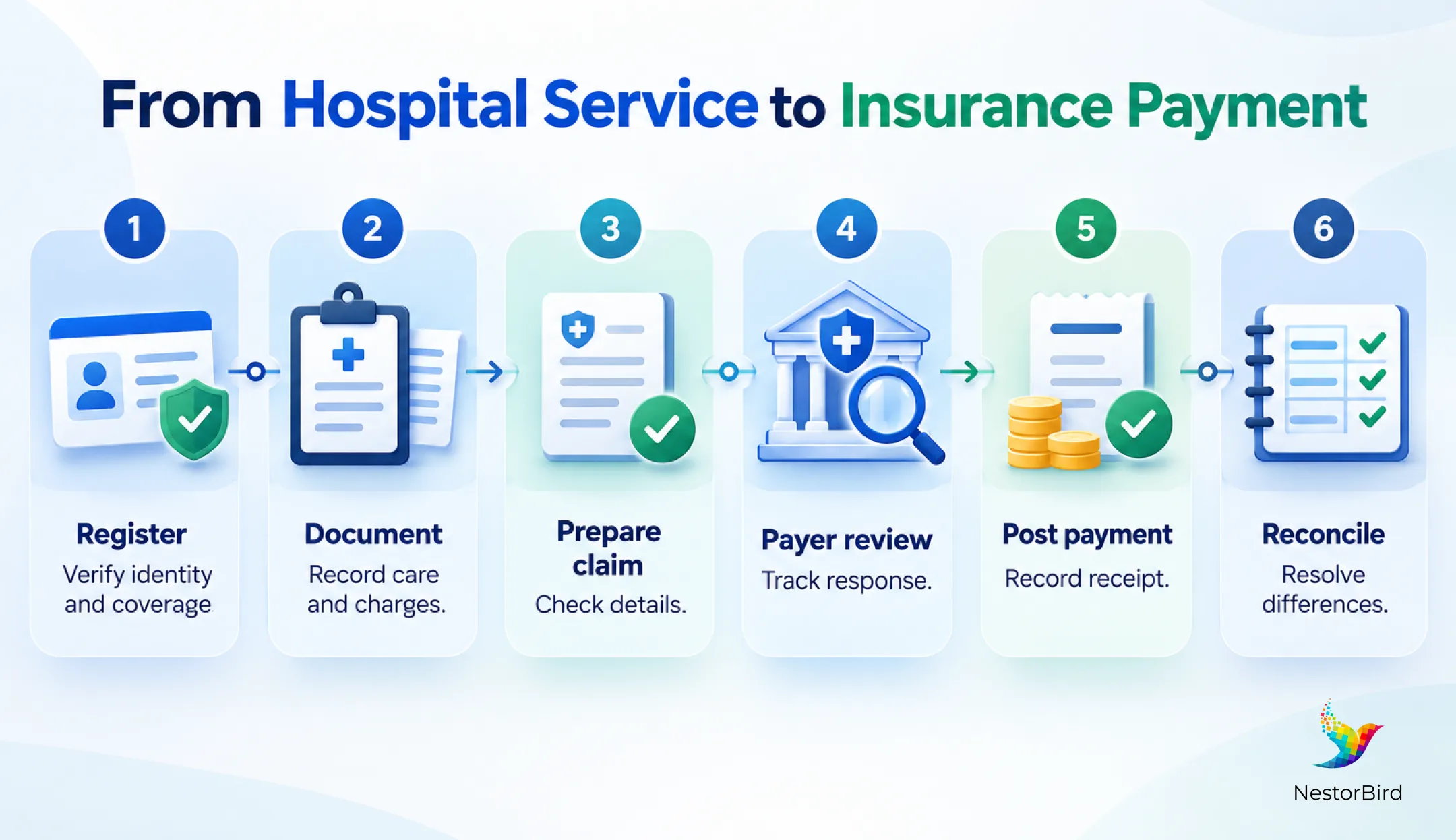
A typical claim process moves through these stages, although payer rules and local requirements vary:
Registration and coverage: verify patient identity, policy details, eligibility and authorisation requirements.
Service documentation: record care delivered, relevant codes and supporting documents.
Claim preparation: validate required fields, charges and payer-specific requirements.
Submission and tracking: send through the supported channel and record acknowledgements and status.
Correction and follow-up: investigate rejections, correct eligible claims and follow up on delays.
Payment posting: record receipts, adjustments and remaining balances.
Assign clear ownership: registration verifies details, clinical teams document care, coding and billing prepare claims, insurance coordinators follow payer responses, and finance posts receipts and monitors balances.
How Medical Claims Processing Software Helps Reduce Errors
Medical Claims Processing Software can check required fields, flag inconsistent records and organise statuses. This helps staff catch problems before submission and focus on claims awaiting action. Repeated rejection reasons, such as missing documents or outdated insurance details, can reveal process gaps. Automated flags support staff review but cannot determine payer outcomes.
Healthcare Payment Reconciliation: Matching Payments With Claims
Healthcare Payment Reconciliation compares claim and remittance details with receipts and financial records. It helps explain whether a balance reflects an adjustment, patient responsibility, partial payment or an unresolved discrepancy.
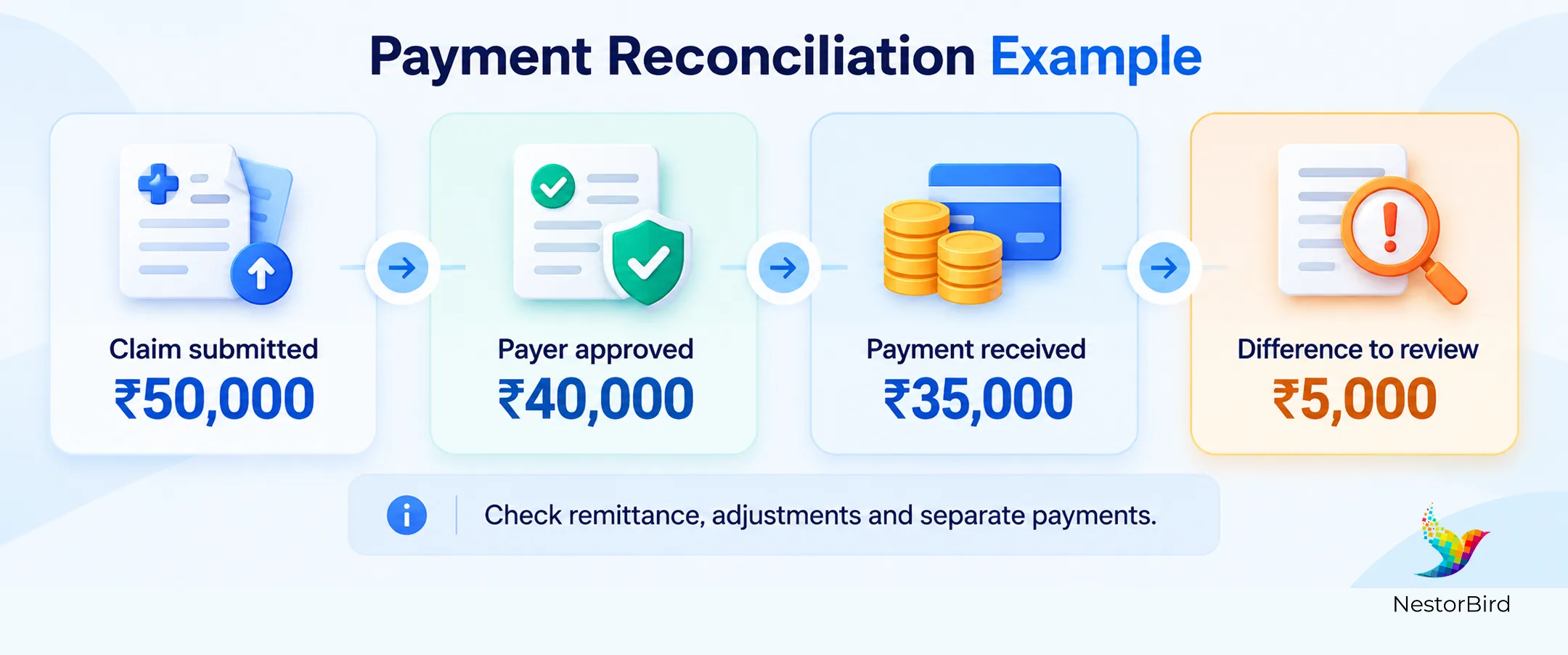
Example: Investigating a Payment Difference
If a hospital claims ₹50,000, receives approval for ₹40,000 and gets ₹35,000, the ₹5,000 gap needs investigation. Check remittance advice, adjustments, separate payments and posting errors before updating the balance; do not automatically label the difference an underpayment.
Improving Healthcare Revenue Cycle Management and Accounts Receivable
Healthcare Revenue Cycle Management spans registration, care, billing, claims, collections and settlement. Tracking claims to final payment shows where money is delayed. Aging reports help prioritise older balances, while denial-pattern reviews and assigned follow-ups improve consistency. Forecasts still depend on data quality and payer timing.
Essential Features to Look for in Healthcare Financial Management Software
Billing and invoicing: clear records of service charges, invoices, payments and adjustments.
Insurance claim tracking: claim identifiers, submission history, payer responses, status and ownership.
Payment reconciliation: matching records, discrepancy queues and documented resolution.
Receivables and reporting: aging balances, overdue claims and useful financial dashboards.
Integration, security and audit trails: assess interoperability, role-based access, data protection and applicable regulatory requirements.
For product-specific needs, review ERPNext for healthcare against your workflows and technical requirements.
How to Choose the Right ERP for Healthcare Billing, Claims and Reconciliation
Map repeated data entry, common errors, delayed claims and current receivables tracking. Then test the system against real scenarios, not just a feature list.
Confirm payer and finance compatibility. Ask which integrations are available, which need custom work and who maintains them.
Test exceptions. Demonstrate a rejected claim, partial payment and unmatched receipt, including how staff investigate and document each case.
Check reporting and usability. Make sure users can find records, identify overdue items and produce the reports they need.
Plan implementation. Agree on data cleansing, migration validation, permissions, training, testing, support and acceptance criteria.
How NestorBird Supports Connected Healthcare Operations
NestorBird offers healthcare ERP solutions and Swanity hospital management software. Ask for a demonstration using your hospital’s workflows and confirm payer connectivity, reconciliation rules, reporting, security, migration and implementation scope directly. Do not assume a feature or integration is included until confirmed.
Explore hospital management software or learn more about an integrated healthcare ERP.
Conclusion
ERP for Healthcare can connect billing, claims, reconciliation and receivables, helping teams trace transactions and focus on unresolved issues. Value depends on accurate data, configuration, payer requirements and clear ownership. Test real workflows, verify integrations and reporting, and agree on implementation responsibilities before choosing a system.

Frequently Asked Questions
ERP for Healthcare is software that connects a healthcare organisation's financial, administrative and operational processes in one system. It can bring together billing, accounts receivable, procurement, inventory, reporting and other workflows so teams have a consistent view of business operations. Unlike an EHR, which primarily manages clinical and patient health information, an ERP focuses on managing the organisation's wider operations and financial processes.
Healthcare billing software is used to create, manage and track bills for healthcare services, payments and outstanding balances. Depending on the system, it can support charge capture, invoice generation, insurance-related billing, payment posting, claim submission and patient balances. The main purpose is to make billing more accurate and easier to track from the service provided through final payment.
An ERP can help manage insurance claims by connecting billing records, claim information, payer responses and financial transactions in a shared workflow. This allows teams to track whether a claim has been prepared, submitted, rejected, denied, paid or still requires follow-up. The exact capabilities depend on the ERP, available payer integrations and system configuration, so organisations should verify supported integrations before implementation.
Healthcare billing software primarily focuses on creating bills, managing charges, processing payments and supporting claim-related billing activities. Healthcare ERP has a broader purpose: it can connect billing with finance, accounts receivable, procurement, inventory, HR and other operational processes. In simple terms, billing software manages a specific financial workflow, while an ERP can connect that workflow with the wider organisation.
Medical claims processing software can reduce errors by validating claim information, identifying missing data and checking records before submission. It may flag issues such as incomplete patient information, missing documentation or inconsistent claim details, allowing staff to correct them earlier. This can reduce avoidable rework and improve claim quality, but software cannot guarantee approval because the payer ultimately applies its own coverage, coding and payment rules.
Healthcare payment reconciliation is the process of comparing expected or approved payments with remittance information, actual receipts and financial records to identify and explain differences. For example, a hospital may receive less than the amount originally billed or approved because of contractual adjustments, patient responsibility, partial payment or another transaction. Reconciliation helps finance teams determine what was paid, what remains outstanding and what needs investigation.
Hospitals can identify partially paid claims by comparing the billed amount, approved amount, remittance details and actual payment received. If these amounts do not match, the finance or billing team should review the explanation of benefits or remittance advice, adjustment codes, patient responsibility, denied line items and any separate or pending payments. Payment posting and reconciliation are important because partial payments can contain both paid and denied amounts within the same claim.
Insurance claim rejections and denials can occur because of incorrect or incomplete information, eligibility issues, coding or documentation problems, missing authorisation, coverage limitations or payer-specific requirements. A rejection generally means the claim or submission failed a processing check and can be corrected and resubmitted. A denial occurs after the claim is processed or adjudicated and payment is refused in whole or in part; the available correction or appeal process depends on the payer and claim type.
An effective insurance claims system should provide claim tracking, validation, workflow management, payer-response tracking, reporting and reconciliation capabilities. Hospitals should also look for clear ownership and follow-up workflows, configurable rules, integration with billing and financial systems, role-based access, audit trails and useful reports for claims, payments, denials and outstanding balances. The right feature set depends on the organisation's payers, workflows, regulatory environment and existing technology stack. Claims-management systems commonly emphasise workflow, investigation, settlement and reporting.