
Quick Summary
Fabric wastage reduction can directly improve profitability for garment manufacturers because fabric is one of the largest components of production cost. With ERP for garment manufacturing, businesses can track fabric consumption, inventory, cutting losses and production requirements from one system. Better visibility helps identify waste patterns, improve utilization and potentially achieve meaningful material cost savings.
Table Of Contents
Introduction
Fabric wastage in garment manufacturing is more than an operational issue — it can quietly reduce margins across every production order. Cutting errors, inaccurate consumption estimates, leftover fabric, poor inventory visibility and production changes can all increase material losses. For manufacturers handling large volumes, even a small improvement in utilization can make a meaningful financial difference. ERP for garment manufacturing provides the data and controls needed to measure fabric usage, identify waste patterns and improve material planning.
Key Takeaways
Fabric wastage reduction can directly improve garment manufacturing margins.
Fabric waste can occur during planning, spreading, cutting, production and inventory handling.
Accurate fabric consumption tracking helps manufacturers identify where material is being lost.
ERP can connect BOMs, inventory, production orders, purchasing and consumption data.
Better fabric inventory management can reduce excess purchasing and material shortages.
Cutting data can help manufacturers identify recurring fabric cutting waste.
ERP creates a stronger foundation for measurable material cost reduction.
Why Fabric Wastage Matters in Garment Manufacturing
Fabric is often one of the most important variable costs in apparel production. When a factory produces thousands of garments, a small percentage of unnecessary fabric consumption can translate into a substantial amount of money over a month or year. This is why fabric wastage reduction should not be treated only as a sustainability initiative; it should be viewed as a direct margin-improvement strategy.
The scale of India’s textile sector makes the issue even more relevant. The Ministry of Textiles reported in July 2026 that India’s textile and apparel exports, including handicrafts, reached ₹3,25,339 crore in FY 2025–26, while ready-made garment exports alone reached ₹1,39,350 crore. As manufacturing and export activity grows, manufacturers need better visibility into how efficiently raw materials are being converted into finished products.
India’s Ministry of Textiles also reported in March 2026 that the country generates approximately 70.73 lakh tonnes of textile waste annually, with 42% originating from pre-consumer sources such as manufacturing waste. This makes fabric waste management relevant from both a financial and operational perspective.
What Causes Fabric Wastage?
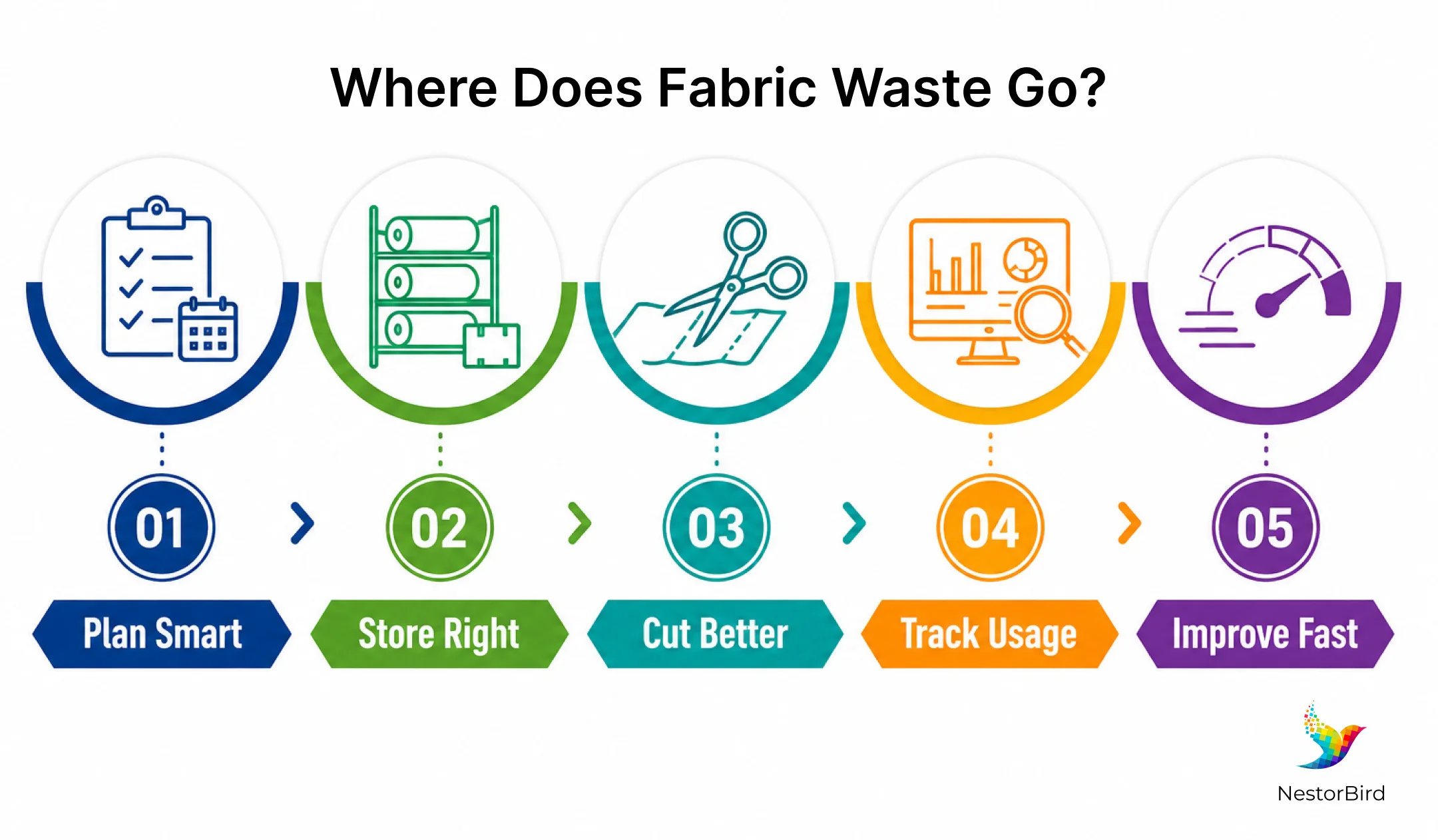
Fabric wastage rarely comes from a single mistake. It usually develops through several small inefficiencies across planning, purchasing, storage and production. A factory may have excellent cutting operators but still experience high material losses because the original consumption estimate was inaccurate.
Where Fabric Losses Usually Begin
Stage | Common Causes of Fabric Waste |
|---|---|
Planning | Inaccurate consumption estimates and outdated BOM standards |
Purchasing | Overstocking and excess fabric ordering |
Storage | Poor storage, incorrect stock records and unidentified remnants |
Spreading | Incorrect spreading and undetected fabric defects |
Cutting | Inefficient marker layouts, inaccurate patterns and cutting errors |
Production | Changes to production specifications and unallocated leftover fabric |
Inventory handling | Limited inventory visibility across warehouses and production locations |
Because these causes are spread across departments, fabric waste management works best when purchasing, stores, cutting and production all report against the same set of numbers.
How to Calculate Fabric Wastage
Before trying to reduce waste, manufacturers need a reliable baseline. Without accurate measurement, it is difficult to determine whether a new cutting method, supplier or production process is actually improving utilization.
Fabric Wastage % = (Fabric Issued − Fabric Used in Finished Production) ÷ Fabric Issued × 100
For example, if a production order receives 1,000 metres of fabric and the manufacturing process consumes 930 metres for the completed output, the difference is 70 metres.
That does not automatically mean all 70 metres are unusable waste. Some may be recoverable remnants, reusable pieces, defects or material that can be allocated to another production order.
ERP-Based Fabric Consumption Tracking
Traditional spreadsheets can record fabric quantities, but they become difficult to manage as production volume increases. Different teams may maintain separate files for purchasing, stores, cutting and production. When these records do not communicate with each other, management may not know the actual material position until after an order has already moved through production.
This is where ERP for garment manufacturing becomes valuable. Fabric consumption tracking inside a single system connects material receipts, stock movements, production issues and actual consumption to individual production orders, so variances become visible while the order is still running.
For manufacturers exploring this approach, NestorBird provides a dedicated manufacturing ERP platform designed to connect manufacturing, inventory and operational workflows.
Fabric Inventory Management
Fabric waste can begin before fabric reaches the cutting table. Overstocking, poor storage, incorrect stock records and unidentified remnants can all create hidden material costs.
Effective fabric inventory management means knowing what fabric is available, where it is stored, how much has been allocated to production and how much remains after an order is completed.
An ERP can help manufacturers maintain a centralized inventory record across warehouses and production locations. This is particularly useful when businesses manage multiple fabric types, colours, widths, compositions and batches.
How to Reduce Fabric Cutting Waste
Cutting is one of the most visible areas of fabric consumption. Once fabric has been cut incorrectly, the opportunity to recover the original material value can be limited.
Fabric cutting waste can result from inefficient marker layouts, inaccurate patterns, fabric defects, incorrect spreading or changes to production specifications.
Manufacturers should compare planned consumption against actual cutting-room consumption for different products, styles and sizes. Over time, this data can reveal patterns. For example, suppose one style consistently consumes 4% more fabric than its approved standard. That could indicate an issue with marker efficiency, pattern design, fabric width or the production process.
How ERP Supports Material Cost Reduction
Reducing fabric consumption does not necessarily mean simply asking workers to “waste less.” The strongest results come from improving the processes that determine how much material gets purchased, issued and consumed.
A connected ERP system can support material cost reduction by linking procurement, inventory, BOMs and production. Upstream, manufacturing ERP for production planning can help connect production planning with material requirements and shop-floor execution.
If historical consumption shows that a product consistently uses less fabric than its original standard, management can review the BOM and update future planning. If another product consistently exceeds its expected consumption, the variance can be investigated.
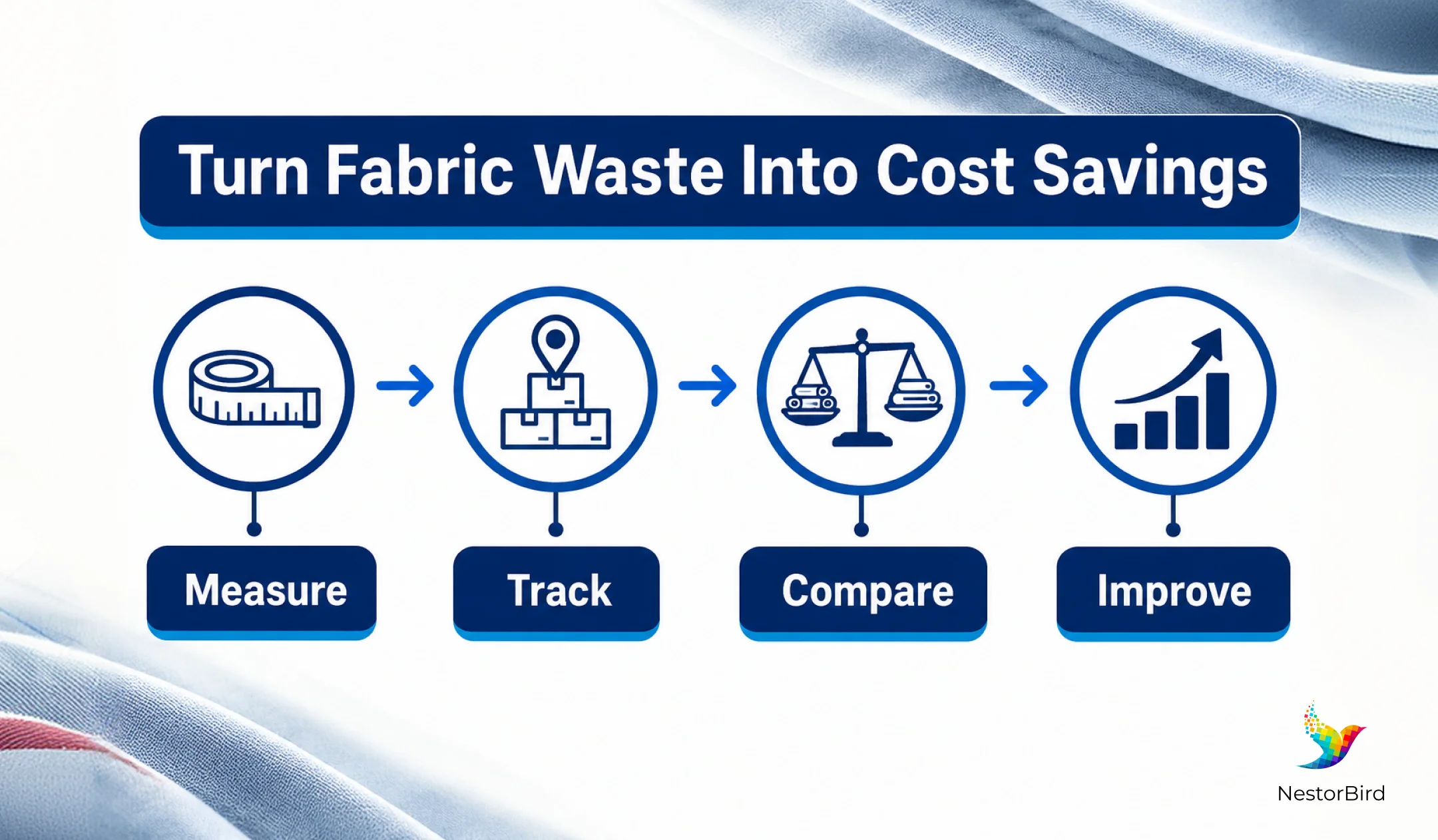
Plan → Issue → Produce → Measure → Compare → Correct → Improve

Benefits of ERP for Garment Manufacturers
Modern garment manufacturing ERP software can bring together the information required to control material usage and production efficiency. For manufacturers evaluating systems, the apparel ERP software approach is particularly relevant because apparel production requires more than generic financial or inventory functionality.
Better Material Planning — ERP helps production teams understand material requirements before production begins, reducing last-minute purchasing and unnecessary inventory.
Improved Production Visibility — Managers can connect material consumption with individual production orders instead of viewing inventory and production as completely separate processes.
More Accurate Costing — When actual material consumption is captured, manufacturers can build a more realistic picture of production costs and margins.
Better Inventory Control — Centralized stock information reduces the possibility of purchasing material that is already available elsewhere in the organization.
Easier Waste Analysis — Production teams can compare planned versus actual consumption and identify recurring material variances.
Building a Data-Driven Fabric Waste Management Process
The goal should not be to eliminate every piece of fabric waste. Some cutting remnants and production losses are unavoidable. The goal is to understand where waste occurs, determine which losses are controllable and continuously improve the process.
Standard consumption: Establish expected fabric usage for each product.
Material issue: Record how much fabric moves from stores to production.
Production consumption: Capture actual usage against the production order.
Waste classification: Separate cutting waste, defects, remnants and other losses.
Variance analysis: Compare standard consumption with actual consumption.
Corrective action: Investigate recurring high-variance products or processes.
Continuous improvement: Update standards when better production data becomes available.
A manufacturing ERP system can provide the digital foundation for this workflow by keeping the relevant information connected.
What to Look for in an ERP
Not every ERP platform will provide the same depth of manufacturing functionality. If fabric control is an important business objective, manufacturers should evaluate the system against their actual production workflow.
Important manufacturing ERP features can include: Bill of Materials, Material Requirements Planning, Production Orders, Work Orders, Inventory Management, Purchase Management, Quality Management, Production Planning, Stock Movement Tracking, Costing and Reporting, Batch and Serial Tracking, and real-time dashboards.
You can also use a structured manufacturing ERP features checklist before comparing ERP vendors.
The best system is not necessarily the one with the largest feature list. It is the one that gives production, stores, procurement and management teams a shared view of what is happening.
Can ERP Really Save 8–12% on Material Costs?
The 8–12% material-cost saving figure should be treated as a target or business case rather than a guaranteed ERP outcome. Actual savings depend on the manufacturer’s starting waste level, product mix, cutting efficiency, inventory practices, fabric prices and implementation quality.
The opportunity is nevertheless significant because even a modest percentage improvement can have a noticeable impact when fabric represents a large portion of production costs.
For example, if a manufacturer spends ₹50 lakh annually on fabric, an 8% reduction in avoidable material cost represents ₹4 lakh in potential savings. At 12%, the potential difference becomes ₹6 lakh.
The real value of ERP is that it makes these improvements measurable and repeatable rather than relying entirely on manual supervision.
The Bigger Opportunity: ERP for the Apparel Industry
Fabric wastage reduction is only one part of a larger manufacturing transformation. The same ERP data used to monitor fabric consumption can support production planning, procurement, inventory, quality, costing and order management.
That makes ERP for apparel industry businesses more than a software upgrade. It can become the operating system that connects the commercial and manufacturing sides of the organization.
India’s policy environment is also increasingly focused on resource efficiency and circularity. In July 2026, the Ministry of Textiles highlighted the Tex-Eco Initiative, aimed at supporting technologies related to textile waste management, recycling, value addition and sustainable textile production.
For garment manufacturers, this means material efficiency is increasingly connected to competitiveness, sustainability and operational resilience. Businesses that can measure material usage accurately will be in a stronger position to identify opportunities for improvement.
Conclusion
Fabric wastage reduction should not be treated as a cutting-room problem alone. It is a business-wide challenge involving purchasing, inventory, production planning, cutting, costing and operational control.
With ERP for garment manufacturing, companies can connect planned fabric consumption with actual usage, monitor inventory, identify production variances and build a measurable approach to material cost reduction.
The goal is not simply to produce more garments with less fabric. It is to build a manufacturing operation where every metre of fabric is planned, tracked and used as efficiently as possible.
For manufacturers looking to understand the wider benefits of manufacturing ERP, ERP can provide the visibility required to move from reactive production management toward a more data-driven manufacturing model.

Frequently Asked Questions
Fabric wastage reduction is the process of minimizing unnecessary fabric losses during planning, storage, spreading, cutting and garment production. It involves measuring actual consumption, identifying waste sources and improving production processes.
ERP can compare planned and actual material consumption, track inventory movements, connect BOMs with production orders and identify material variances. This gives manufacturers better visibility into where fabric is being consumed or lost.
Manufacturers can track fabric through material receipts, inventory records, production issues, actual consumption, returns and waste records. An ERP system can connect these transactions to individual production orders.
Yes. ERP can provide production and consumption data that helps manufacturers identify recurring variances. When combined with efficient marker planning and cutting processes, this data can support continuous improvement in fabric utilization.
No. 8–12% should be considered a potential improvement target, not a guaranteed result. Actual savings depend on existing waste levels, fabric costs, production processes, inventory controls and how effectively the ERP is implemented.