

Quick Summary
A Garment ERP ROI Calculator helps manufacturers determine whether an ERP investment can deliver measurable financial value. Instead of looking only at software pricing, calculate your current operational costs, expected savings, total ERP investment, annual benefits, and payback period. Labor savings, inventory control, reduced waste, fewer errors, better production planning, and improved order visibility can all contribute to garment ERP ROI.
Table Of Contents
Introduction
Before buying garment manufacturing software, there is one question every decision-maker should ask: Will the ERP actually pay for itself?
A Garment ERP ROI Calculator can help answer that question using your own business numbers. Instead of judging an ERP only by its license or subscription price, you can compare the complete investment with measurable improvements in labor, inventory, production, quality, purchasing, and order management.
That gives you a clearer financial picture before committing to an ERP system.
Key Takeaways
ERP ROI compares financial benefits with the total ERP investment.
Software price is only one part of the overall ERP cost.
Implementation, migration, training, customization, and support should be included.
Labor, inventory, production, quality, and purchasing improvements can contribute to ROI.
The ERP payback period shows how quickly the investment can recover its cost.
Use realistic business data instead of relying only on vendor projections.
Compare conservative, realistic, and optimistic ROI scenarios before buying.
What Is Garment ERP ROI and Why Does It Matter?
Garment ERP ROI measures the financial return generated by an ERP system compared with the total cost of the investment.
The basic formula is: ERP ROI = (Financial Benefits − Total ERP Investment) ÷ Total ERP Investment × 100
For example, if your ERP generates ₹12 lakh in measurable annual benefits and your first-year investment is ₹8 lakh, your calculated ROI would be 50%.
Garment manufacturers often deal with multiple operational costs that are difficult to see as one number. Manual data entry, excess inventory, production delays, rework, reporting, and purchasing inefficiencies can each appear small individually. Together, however, they can significantly affect profitability.
A proper ROI calculation brings these costs together. It helps you understand whether the expected operational improvements justify the investment in Garment ERP Software.
Why ROI Matters More Than ERP Price
Comparing ERP systems only by price can lead to the wrong decision. Suppose ERP A costs less than ERP B. If ERP B provides better inventory visibility, reduces administrative work, improves production planning, and prevents costly errors, its higher initial price may still produce a better financial outcome.
That is why manufacturing ROI should focus on the value created by the system, not simply what the software costs.
For manufacturers looking to understand the technology behind these processes, manufacturing ERP software can provide a useful starting point.
What Costs Should You Include in an ERP ROI Calculation?
The software subscription or license is only one part of your ERP investment. A realistic ERP ROI calculation should account for the complete cost of getting the system operational and keeping it running.
Think about the complete ERP journey, from implementation to ongoing usage.
Initial and Ongoing ERP Costs
Cost Category | What to Include |
|---|---|
Software | License or subscription fees |
Implementation | Configuration and deployment |
Data migration | Data cleaning, transfer, and validation |
Customization | Custom workflows, fields, and reports |
Integration | Connections with other business systems |
Training | Employee onboarding and training |
Support | Maintenance and technical assistance |
Expansion | Additional users, modules, or upgrades |
Implementation deserves particular attention because it can influence both your costs and your eventual benefits.
A poorly planned implementation can create delays, adoption problems, and additional expenses. A structured approach to configuration, migration, testing, training, and go-live can make the transition much smoother.
When evaluating this part of the investment, consider the role of ERP implementation services in getting the system configured and adopted effectively.
How to Calculate the Potential ROI of a Garment ERP
A practical ERP ROI Calculator for Manufacturing can be built around three simple steps: establish your current operational costs, estimate realistic ERP-driven savings, and compare those benefits with the total ERP investment.
The important part is using your own numbers. Do not start with a vendor’s promised percentage improvement. Start by identifying what your factory spends today and then determine which costs the ERP could realistically reduce.
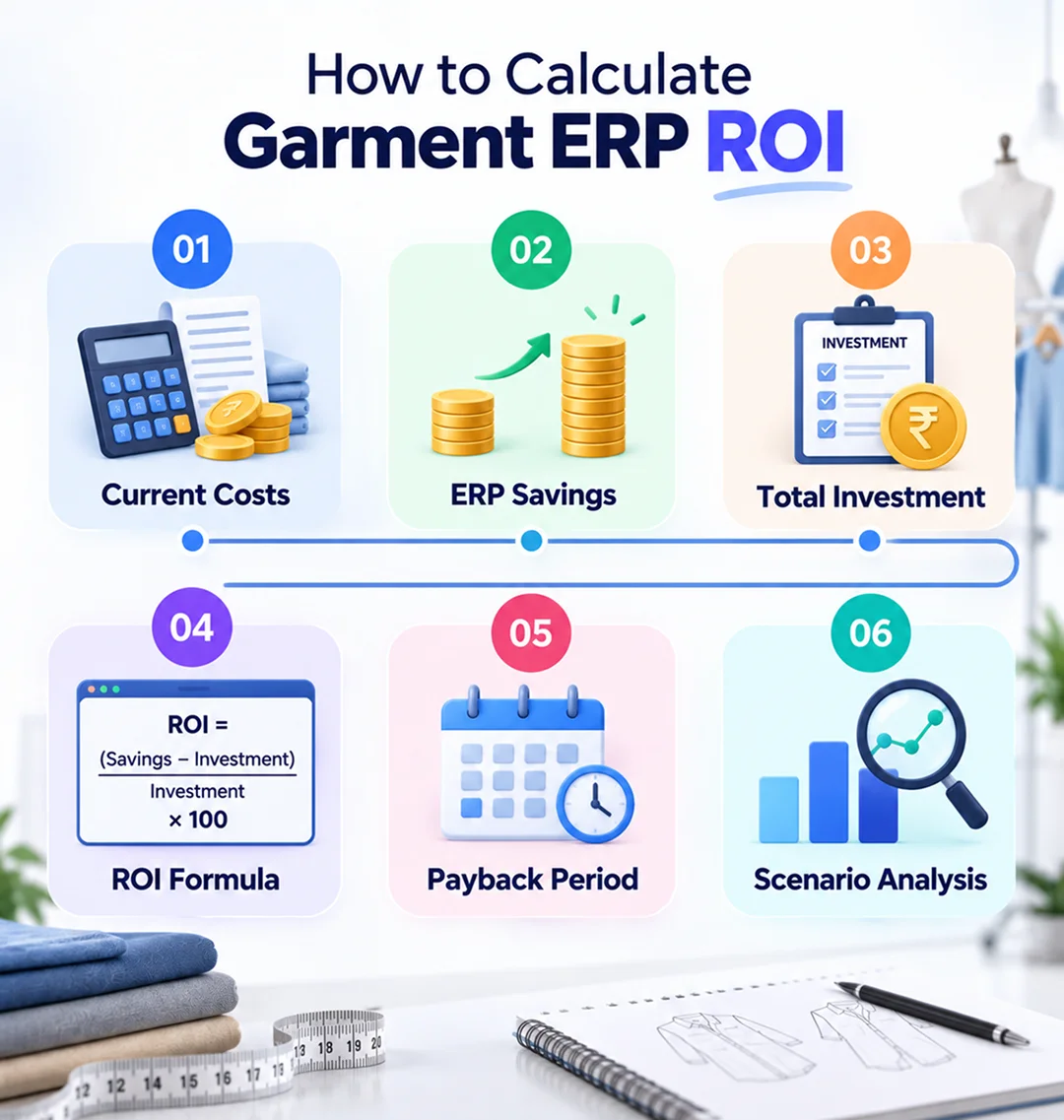
Step 1 — Calculate Your Current Operational Costs
Begin by documenting the costs associated with your current processes. Look at manual data entry, administrative reporting, excess inventory, material wastage, production delays, rework, errors, and poor order visibility.
For example, employees may spend hours every month updating spreadsheets or creating reports manually. That time represents a real labor cost, even if it does not appear as a separate line item on your financial statements.
Inventory can create another significant cost. If your business regularly carries excess fabric, trims, work-in-progress, or finished goods, calculate how much capital is tied up in that inventory.
Your goal is to establish a current-state baseline.
Step 2 — Estimate Expected ERP Savings
Next, estimate how much of those costs the ERP could realistically reduce.
Automated workflows
Better inventory control
Improved production planning
Reduced manual data entry
Faster reporting
Fewer errors
Lower rework
Better order visibility
Be conservative. If manual reporting currently costs ₹10 lakh annually, do not automatically assume the ERP will eliminate all ₹10 lakh. Determine what portion of that workload can realistically be reduced.
It is also useful to create three scenarios:
Scenario | Approach |
|---|---|
Conservative | Lower expected improvement |
Realistic | Most likely improvement |
Optimistic | Strong adoption and higher improvement |
Step 3 — Apply the ERP ROI Formula
Once you have estimated the annual financial benefit, compare it with the total ERP investment.
Annual ERP benefits = ₹12 lakh → First-year ERP investment = ₹8 lakh → ROI = (₹12L − ₹8L) ÷ ₹8L × 100 = 50%
You should also calculate the ERP payback period. The basic formula is: Payback Period = Total ERP Investment ÷ Monthly Financial Benefit
If your investment is ₹8 lakh and your expected monthly financial benefit is ₹1 lakh, your simple payback period would be 8 months.
ROI tells you the potential return. Payback tells you how quickly you may recover the investment.
Which Garment Manufacturing Metrics Can Improve ERP ROI?
ERP ROI becomes easier to understand when you connect it with specific manufacturing metrics. For garment manufacturers, inventory, production, labor, quality, purchasing, and order management can all contribute to the financial case.
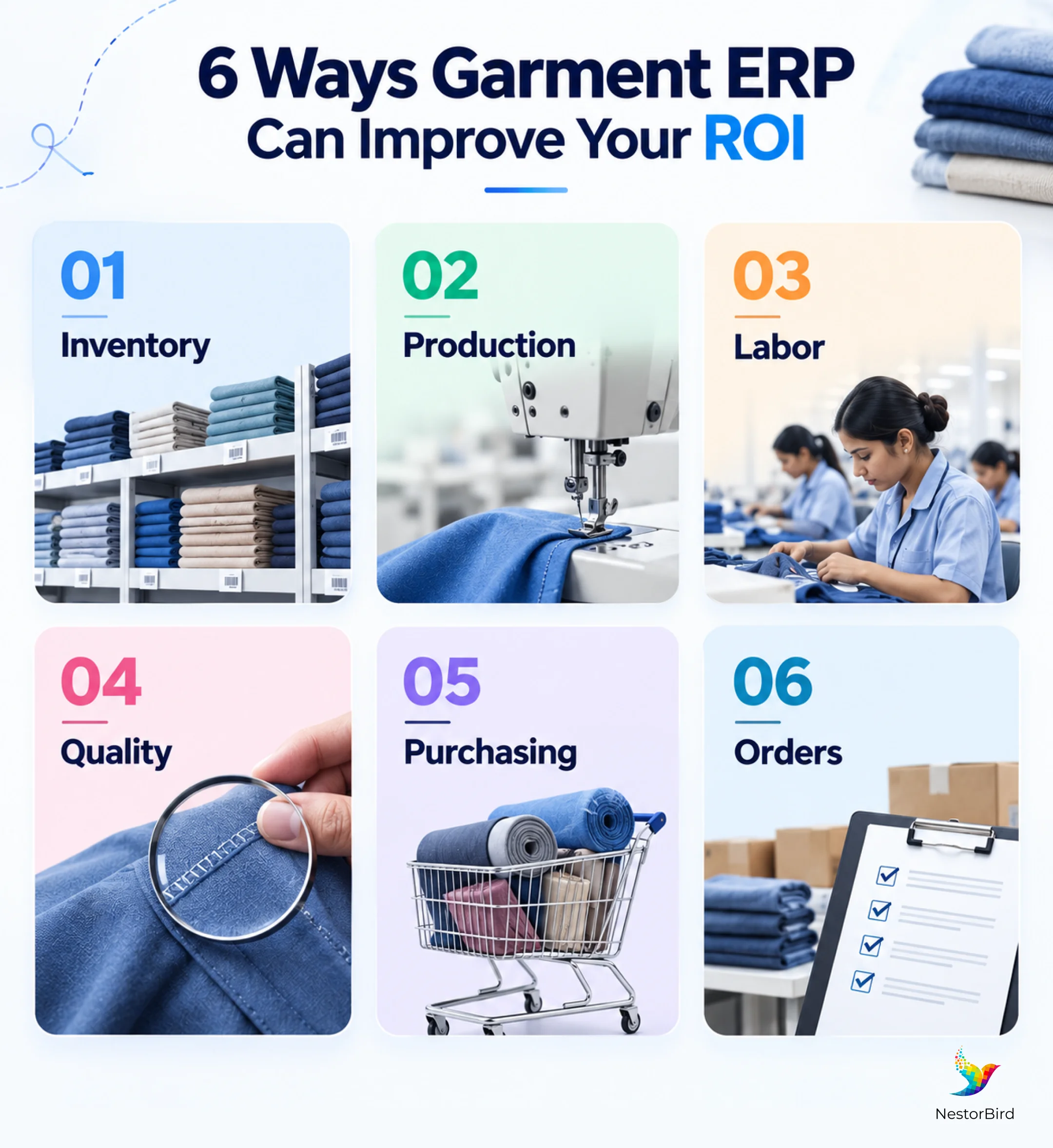
Metric | Current Problem | Potential ERP Impact |
|---|---|---|
Inventory | Excess stock or shortages | Better material visibility |
Production | Delays and planning issues | Improved scheduling |
Labor | Repetitive administration | Workflow automation |
Quality | Rework and rejection | Better tracking |
Purchasing | Reactive procurement | Improved material planning |
Orders | Limited status visibility | Centralized order tracking |
For example, better inventory visibility may help reduce excess stock. Production visibility can help managers identify delays earlier. Similarly, automated workflows can reduce repetitive administrative tasks.
For manufacturers looking at the complete flow from sourcing through billing, the ERP for garment workflow digitisation resource is a natural next step.
ROI Calculator Example: A Garment Manufacturer's Scenario
Consider a garment manufacturer currently using spreadsheets and disconnected processes. The company identifies four major cost areas: manual processing, inventory-related losses, production inefficiency, and rework or errors.
Calculation | Amount |
|---|---|
Annual ERP benefits | ₹12 lakh |
First-year ERP investment | ₹8 lakh |
Net benefit | ₹4 lakh |
ROI | 50% |
Monthly benefit | ₹1 lakh |
Payback period | 8 months |
This is only a hypothetical example. The manufacturer should replace these figures with its actual labor costs, inventory value, production losses, rework costs, implementation expenses, subscription fees, and support costs.
The goal is not to produce the highest possible ROI. The goal is to produce a number that your finance and operations teams can defend with real business data.
How to Use an ERP ROI Calculator Before Buying
Before calculating ROI, collect the information that influences both costs and potential savings.
Annual operating costs
Number of employees and ERP users
Production volume
Inventory value
Wastage and rework costs
Administrative workload
Expected efficiency improvements
ERP implementation cost
Annual software and support cost
Once you have the numbers, calculate three scenarios rather than relying on a single projection. Your conservative scenario should assume modest improvements. The realistic scenario should reflect what you genuinely expect after implementation. The optimistic scenario can show what might happen with strong adoption and successful process improvements.
This makes the ERP buying decision much more practical.
What to Check Beyond ERP ROI
ROI should be an important part of your ERP evaluation, but it should not be the only factor.
First, check whether the platform actually supports your manufacturing requirements. Look at production planning, inventory management, purchasing, order management, quality processes, reporting, and other workflows relevant to your factory.
Then consider scalability and integrations. Will the system support more users, products, locations, or workflows as your business grows? Can it connect with the other systems your business already uses?
Implementation support also matters. A system with an attractive theoretical ROI may deliver poor results if employees struggle to adopt it or the implementation takes longer than expected.
Finally, evaluate security, analytics, customization requirements, vendor support, and overall usability.
If you are moving from ROI analysis toward vendor selection, this guide on how to choose the best ERP for manufacturing can help you evaluate the broader ERP selection criteria.
Conclusion
A Garment ERP ROI Calculator gives manufacturers a practical way to evaluate an ERP before making a major investment.
Instead of looking only at software pricing, calculate your complete ERP investment and compare it with measurable savings from labor, inventory, production, quality, purchasing, and order management.
Then calculate both ROI and payback period. Most importantly, use your own business data.
The right ERP is not necessarily the cheapest system. It is the one whose measurable business benefits justify its total investment and support your manufacturing goals over the long term.

Frequently Asked Questions
Use the formula ROI = (Financial Benefits − Total ERP Investment) ÷ Total ERP Investment × 100. Include measurable benefits such as labor savings, inventory improvements, lower waste, reduced errors, and production efficiency. You should also calculate the payback period to understand how quickly the investment may be recovered.
Include more than the software price. Your calculation should consider implementation, configuration, data migration, customization, integrations, training, support, maintenance, additional users, modules, and upgrades. Including these costs gives you a more realistic view of the total ERP investment.
A Garment Manufacturing ERP Software solution can potentially improve inventory visibility, production planning, purchasing, order management, reporting, labor efficiency, and quality tracking. The actual financial benefit depends on your current processes, implementation, data quality, and employee adoption.
There is no standard payback period for every manufacturer. Calculate it by dividing your total ERP investment by the expected monthly financial benefit. The result should be tested against conservative, realistic, and optimistic scenarios before making a purchasing decision.
ERP can be worthwhile when the system solves measurable operational problems and the expected benefits justify its total cost. Smaller manufacturers should pay particular attention to manual administration, inventory control, production visibility, errors, and scalability when building their business case.
Look beyond ROI percentage. Evaluate manufacturing functionality, scalability, integrations, implementation support, security, reporting, analytics, customization, usability, and vendor support. The best ERP is one that fits your current operations while giving your business room to grow.