

Quick Summary
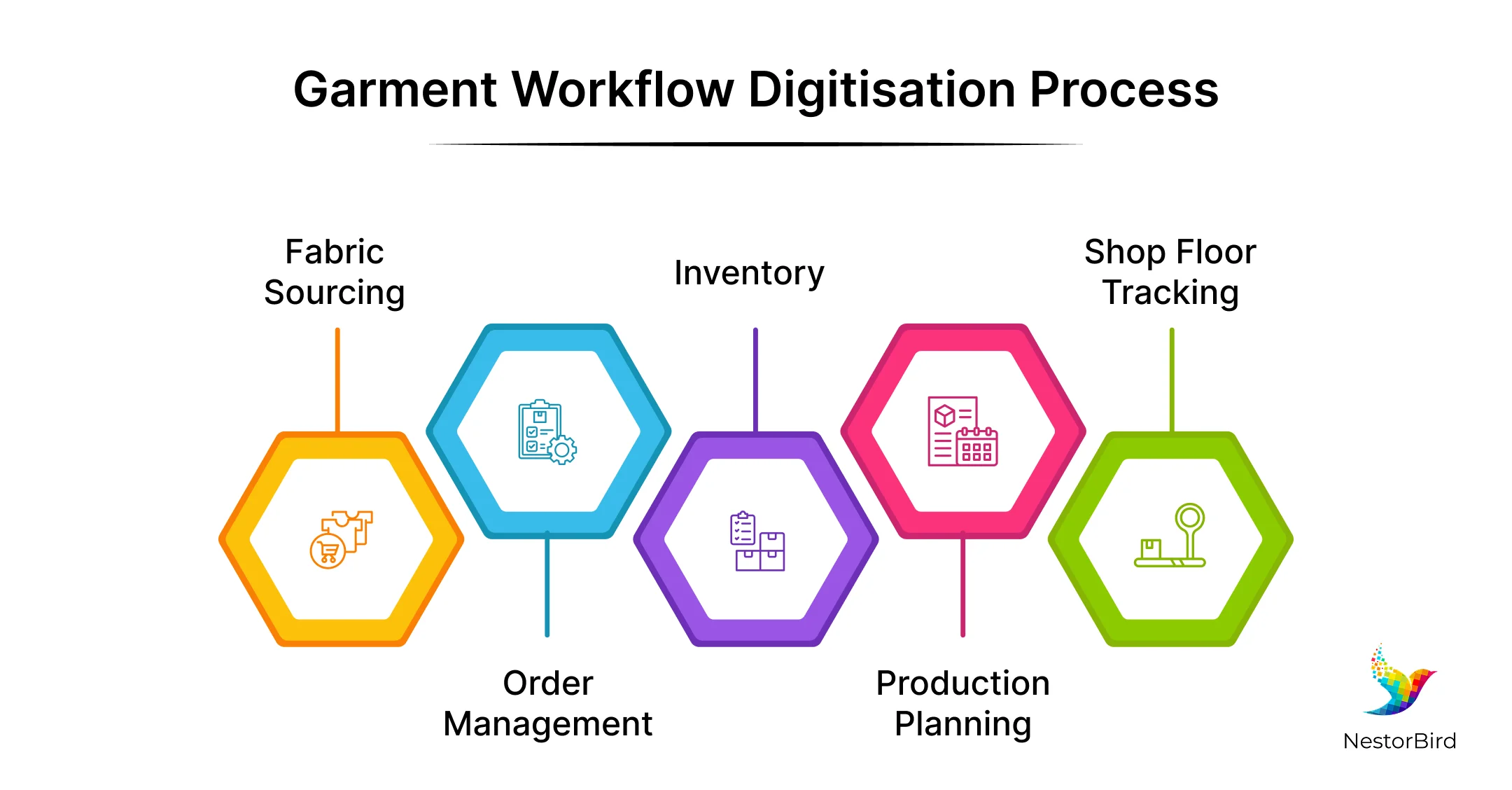
Garment Workflow Digitisation connects fabric sourcing, inventory, production, quality control, order management, dispatch, and GST billing through one integrated system. An ERP for Garment Industry helps manufacturers replace spreadsheets and disconnected processes with real-time information, better production visibility, improved inventory control, and more efficient workflows from raw material to final invoice.
Table Of Contents
Introduction
Garment Workflow Digitisation connects fabric sourcing, inventory, production, quality, dispatch, and billing through one digital system. Instead of depending on spreadsheets, paper records, and disconnected software, an ERP for Garment Industry gives manufacturers better visibility across operations. It can help teams control materials, track production, reduce manual work, and move smoothly from fabric procurement to the final GST invoice.
Key Takeaways
Garment Workflow Digitisation connects manufacturing processes from sourcing to billing.
ERP creates one central source of information across departments.
Real-time production tracking improves visibility into order progress.
Digital inventory management helps control fabrics, trims, and finished goods.
Production planning becomes easier when orders, materials, and capacity are connected.
Integrated GST billing reduces duplicate data entry and improves invoice processing.
Why Garment Workflow Digitisation Matters
Garment manufacturing involves much more than cutting and stitching fabric. A manufacturer may need to coordinate suppliers, fabric, trims, purchase orders, styles, colours, sizes, production lines, quality checks, warehouses, buyers, logistics, and invoices.
When these activities are handled through separate spreadsheets, paper registers, calls, and messages, information becomes fragmented. For example, the sales team may know that an order has entered production but may not know its exact completion status. Similarly, production planners may schedule an order without having real-time visibility into fabric availability.
This is where Garment Manufacturing Digitisation becomes valuable.
Buyer Order → Material Requirement → Procurement → Inventory → Production Planning → Manufacturing → Quality → Packing → Dispatch → GST Invoice
Instead of every department maintaining separate information, data moves through a connected system. This is one of the core objectives of Digital Transformation in Textile Industry operations.
1. Digitise Fabric Sourcing and Procurement
Every garment starts with raw materials. Depending on the product, manufacturers may need fabric, yarn, buttons, zippers, threads, labels, elastic, packaging materials, and other accessories.
With Garment Manufacturing Software, manufacturers can maintain digital supplier records, purchase history, material specifications, prices, lead times, and pending orders.
Connect Material Requirements with Purchase Orders
Suppose a manufacturer receives an order for 10,000 shirts. The system can use the Bill of Materials (BOM) and production requirements to calculate what materials are needed.
Sales Order → Material Requirement → Available Inventory → Purchase Requirement → Purchase Order
This allows the purchasing team to procure materials based on actual production demand rather than assumptions.
2. Manage Fabric and Raw Material Inventory
Inventory management is particularly important in garment manufacturing because fabrics aren’t always tracked by quantity alone. Manufacturers may need visibility by fabric type, colour, shade, lot, roll, width, warehouse, and supplier.
Fabric | Colour | Lot | Quantity |
|---|---|---|---|
Cotton Twill | Navy | L102 | 1,850 m |
Cotton Twill | Black | L108 | 1,420 m |
Cotton Twill | White | L115 | 2,100 m |
Effective Inventory Management helps teams understand what's available, reserved, consumed, or waiting to arrive.
Reserve Material Against Orders
Materials can also be allocated against specific production orders. This prevents fabric reserved for one customer from accidentally being consumed by another order. Better inventory visibility can therefore reduce material shortages and improve production planning.
3. Digitise Garment Order Management
A garment order contains much more information than customer name and quantity. A Garment Order Management System may need to capture buyer, style, SKU, colour, size, quantity, delivery date, fabric specifications, packaging requirements, pricing, and quality requirements.
Consider one shirt available in five sizes and four colours. That’s already 20 SKU combinations. Managing these combinations through spreadsheets becomes increasingly difficult as order volumes grow.
Create One Digital Order Record
With an Apparel Manufacturing ERP, every department can work from the same order information. Sales can enter the order, procurement can view material requirements, production can create work orders, quality teams can track inspections, warehouse teams can prepare finished goods, and finance can generate the invoice.
4. Improve Production Planning and Scheduling
Production planning is where customer demand meets factory capacity. Manufacturers need to consider order deadlines, fabric availability, machine capacity, labour availability, production line capacity, and order priority.
Digital Production Planning connects these factors. Instead of manually scheduling orders through spreadsheets, planners can review material readiness and available capacity before releasing work to production.
Plan vs Actual Production
Order | Planned | Produced | Status |
|---|---|---|---|
ORD-105 | 10,000 | 7,600 | 76% |
ORD-106 | 6,000 | 5,200 | 87% |
ORD-107 | 12,500 | 4,500 | 36% |
This allows managers to identify orders falling behind schedule and helps prevent production from being scheduled when essential materials aren't available.
5. Track Cutting, Stitching and Shop-Floor Production
After planning, the order moves to manufacturing. A typical garment production process may include.
Fabric Issue → Cutting → Bundling → Stitching → Washing → Finishing → Quality → Packing.
Apparel Production Tracking Software can capture progress throughout these stages, including fabric issued, cut quantity, wastage, line, shift, style, work-in-progress, rework, and rejection.
Connecting MES and ERP
A Manufacturing Execution System (MES) focuses on shop-floor execution, while ERP manages broader business processes such as purchasing, inventory, sales, finance, and planning.
An integrated MES and ERP platform can connect production execution with the wider business workflow.
ERP Order → Production Plan → MES Execution → Production Output → ERP Inventory

6. Digitise Quality Control and Finished Goods
Quality problems become more expensive when they’re identified late. Manufacturers can create digital inspection points for fabric inspection, in-line inspection, and final inspection.
Fabric Inspection
Check fabric shade, width, GSM, damage, and consistency.
In-Line Inspection
Monitor stitching, measurements, seams, workmanship, and defects during production.
Final Inspection
Check measurements, appearance, labels, finishing, packaging, and buyer specifications.
A digital quality system also records rejection and rework. Over time, manufacturers can identify whether defects are associated with a particular production line, operation, material batch, or process.
Finished Goods Inventory
Once garments pass inspection, they’re transferred into finished-goods inventory. Products can be tracked using Style + Colour + Size + Batch + Warehouse, giving sales and dispatch teams better visibility into available, reserved, packed, and pending stock.
7. Streamline Dispatch and Garment Export Workflows
After production and quality approval, garments move toward dispatch. Domestic orders may require customer information, packing details, transport information, delivery documents, and invoice references. Export manufacturers may also manage buyer orders, packing lists, shipment details, destination information, commercial documentation, and export invoices.
Digitising these processes also strengthens Supply Chain Management by connecting suppliers, factories, warehouses, logistics partners, and customers through shared information.
8. Automate GST Billing and Invoicing
The manufacturing workflow doesn’t end when garments leave the factory. GST Billing for Garment Industry can be integrated directly with sales and dispatch information.
Instead of entering invoice details again, ERP can use existing customer details, GSTIN, product information, HSN details, quantity, pricing, applicable tax, and dispatch information. This reduces repetitive data entry and improves consistency.
GST Invoice Information
Depending on the transaction, a GST tax invoice can require details including supplier information, GSTIN, invoice number and date, recipient details, HSN code, product description, taxable value, tax rates, and tax amounts. Manufacturers should configure billing according to current GST requirements applicable to their business.
External authority resource: CBIC GST Resources.
E-Invoicing
Businesses covered under India’s e-invoicing requirements may also need to report eligible invoice information through the Invoice Registration Portal. Connecting ERP with the appropriate compliance workflow can reduce manual effort for manufacturers processing large numbers of B2B invoices.
9. Connect the Entire Garment Workflow Through ERP
The real advantage of Digitisation is connecting the complete workflow through Enterprise Resource Planning.
Customer Order → Material Requirement → Purchase & Fabric Inventory → Production Planning → Cutting & Stitching → Quality Control → Finished Goods → Packing & Dispatch → GST Invoice → Financial Reporting
When one department updates information, relevant data becomes available to other authorised teams. ERP can therefore become the central operating platform connecting manufacturing and business operations.
10. How to Start Garment Workflow Digitisation
Step 1: Map Current Processes
Document how purchasing, inventory, production, quality, dispatch, and billing currently work.
Step 2: Identify Major Bottlenecks
Look for duplicate data entry, stock mismatches, production delays, material shortages, excessive work-in-progress, quality rework, and delayed reporting.
Step 3: Standardise Business Data
Clean important records including item codes, supplier details, customer information, styles, colours, sizes, BOMs, warehouses, and HSN information.
Step 4: Select the Right ERP
Choose a system capable of handling manufacturing processes, not simply accounting and sales. Industry-focused Textile Manufacturing ERP can be more suitable when manufacturers require detailed production, material, and quality workflows.
For additional evaluation context, review FlexERP vs Generic ERP and how ERP helps packaging manufacturers scale.
Step 5: Integrate and Train
Connect relevant inventory, production, GST, finance, and shop-floor processes. Then train employees according to their roles.
Step 6: Measure Performance
Track improvements using KPIs such as inventory accuracy, planned vs actual production, material wastage, rejection rate, order cycle time, on-time delivery, and production efficiency.
Conclusion
Garment Workflow Digitisation connects the entire apparel manufacturing journey—from fabric sourcing and inventory to production, quality, dispatch, and GST invoicing.
Instead of relying on separate spreadsheets, paper records, and disconnected applications, an ERP for Garment Industry creates one integrated information flow across departments.
For garment manufacturers looking to scale, the goal isn’t simply to automate individual tasks. It’s to connect materials, orders, people, production, inventory, and finance through one reliable digital ecosystem.
With the right Garment Manufacturing Software, manufacturers can improve visibility, strengthen production control, reduce manual work, and build a more scalable manufacturing operation from the first fabric purchase to the final GST invoice.

Frequently Asked Questions
Garment Workflow Digitisation means converting manual garment manufacturing activities into connected digital processes. It can cover fabric sourcing, purchasing, inventory, production, quality, dispatch, GST billing, and reporting.
An ERP for Garment Industry is software that connects garment manufacturing with purchasing, inventory, sales, production planning, quality, finance, and reporting through one platform.
Garment Manufacturing Software gives manufacturers better visibility into materials, orders, production progress, inventory, quality, and finished goods. This helps teams reduce manual coordination and make faster operational decisions.
Yes. Depending on the ERP, fabrics can be tracked by attributes such as type, colour, shade, lot, roll, warehouse, and quantity. Materials can also be reserved against production orders.
Yes. A properly configured ERP can use customer, product, HSN, tax, sales, and dispatch information to prepare GST invoices. Businesses should ensure their configuration follows current GST requirements.
Apparel Production Tracking Software monitors garment orders through stages such as cutting, stitching, finishing, inspection, and packing. It helps manufacturers compare planned production with actual output.
ERP manages wider business processes such as purchasing, inventory, sales, planning, finance, and reporting. MES focuses primarily on shop-floor manufacturing execution. Integrating both systems connects production activities with broader business operations.