

Quick Summary
Pharma ERP Software connects pharmaceutical production, procurement, inventory, warehouse, quality and financial operations in one system. It can help manufacturers improve batch visibility, coordinate production with material availability and organize inspection records. This guide explains the key features, modules, benefits and implementation approach for a pharmaceutical ERP system. It also explains why configuration, data quality, validation and user training are important when deploying ERP software in a regulated environment.
Table Of Contents
Introduction
Pharma ERP Software helps pharmaceutical companies integrate production, procurement, inventory, quality control, warehouse management and finance into a unified system. It supports batch traceability, material planning, inventory monitoring and organized quality records across manufacturing operations. This guide explores the key features, modules and benefits of a Pharma ERP System, along with practical implementation steps and important considerations for data integrity, system validation and regulatory requirements in pharmaceutical manufacturing.
Key Takeaways
Connect production, inventory, procurement, quality and finance in one system.
Track batches, expiry information and stock movements with structured records.
Use BOMs, production plans, work orders and job cards to organize manufacturing.
Support quality checks with inspection templates and recorded results.
Plan implementation around process mapping, data migration, testing and training.
Treat validation, data integrity and regulatory controls as part of the implementation plan.
What Is Pharma ERP Software?
Pharma ERP Software is an enterprise resource planning solution configured for pharmaceutical operations. It brings production, procurement, inventory, warehouse management, quality, sales and finance into a connected operating environment. Instead of maintaining separate records for every department, teams can work with shared business data.
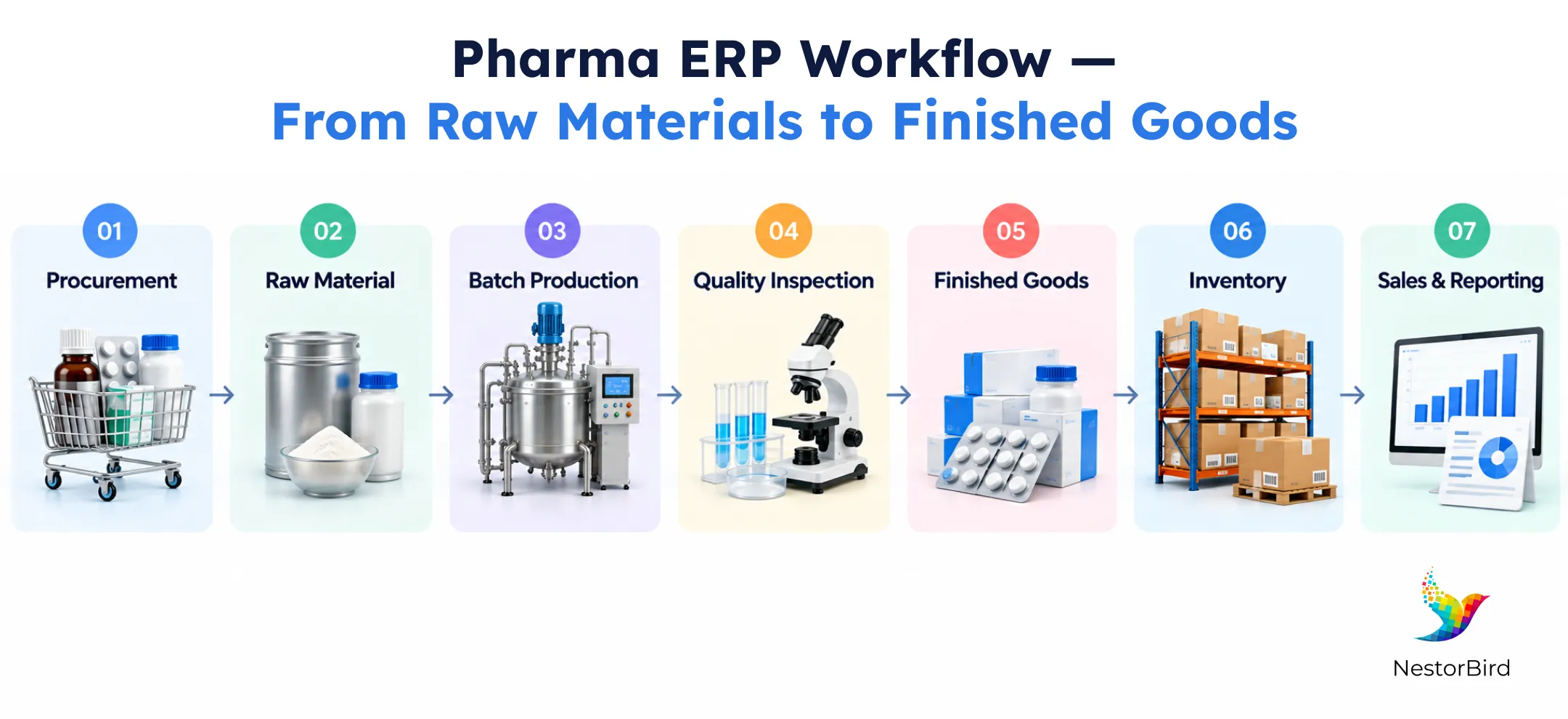
A pharmaceutical batch can pass through many stages before it reaches a customer. Raw materials are purchased and received, materials are inspected, production is planned, the batch is manufactured, quality checks are recorded, finished goods are stored and products are eventually dispatched. A connected Pharma ERP System helps teams manage these stages as one workflow.
The existing Pharma ERPNext resource describes the same core idea: connecting pharmaceutical production, inventory, procurement, quality and financial operations through shared records. Current ERPNext documentation also describes manufacturing as an integrated environment covering BOMs, work orders, job cards, production planning, quality control, inventory and reporting. ERPNext Manufacturing Solution for Pharmaceutical Industry supports this overall model.
How a Pharma ERP System Connects Operations
Think of a pharmaceutical batch as a thread that runs through the business. It begins with procurement and raw materials and continues through receiving, inspection, manufacturing, storage and dispatch. When each department records that thread separately, employees often need to reconcile information before they can make a decision.
A Pharma ERP System can connect those records through common items, batches, warehouses and transactions. ERPNext supports batch numbers for stock transactions and can maintain expiry information for batch-managed items. This is particularly relevant to pharmaceutical inventory because manufacturing and expiry details often need to remain connected to the batch throughout its movement. ERPNext Batch Documentation explains the current batch functionality.
The goal is not simply to digitize paperwork. The goal is to give production, warehouse, quality, procurement and management teams a consistent view of the same operational data.
Why Pharmaceutical Companies Need ERP Software
Pharmaceutical manufacturing involves more than producing a finished product. Teams must coordinate suppliers, raw materials, production activities, quality checks, warehouse movements, finished goods and customer requirements. As the business grows, managing these processes through spreadsheets and disconnected applications can make information harder to find and harder to trust.
ERP Software for Pharmaceutical Industry helps bring these activities together. Production can work with material availability, procurement can work with demand, warehouse teams can see stock movements and quality teams can maintain structured inspection records. Management can then use connected operational and financial information instead of manually combining several reports.
The earlier Pharma ERPNext guide identified clearer batch traceability, better planning, easier quality-record retrieval, reduced duplicate work and faster access to information as key potential benefits. These benefits depend on accurate data, suitable configuration and consistent system use.
Challenges of Managing Pharmaceutical Operations
One common challenge is fragmented information. A production manager may need inventory data from a warehouse team, procurement status from the purchasing team and quality information from another department. If these records sit in different systems, even a simple question can require several calls or spreadsheets.
Another challenge is traceability. Pharmaceutical businesses may need to understand which batch was received, where it was stored, how it was used and where the resulting product was moved. ERPNext supports batch tracking and batch-wise inventory, giving businesses a structured foundation for these activities.
ERP can reduce this information gap, but the system only works as well as the processes and data behind it. Clear master data, defined responsibilities and disciplined transaction entry remain essential.
Key Features of Pharma ERP Software
The value of Pharmaceutical ERP Software comes from connecting related activities. A strong implementation typically covers batch tracking, production planning, inventory, warehouse management, quality, procurement, supplier management, sales, accounting and reporting.
These features should not operate as isolated modules. For example, production planning should reflect material requirements, warehouse records should reflect actual stock, quality checks should be linked to the relevant process and management reports should use the same underlying transactions.
The result is a connected operational environment rather than a collection of separate digital tools.
Batch and Traceability Management
Batch tracking is one of the most important capabilities for pharmaceutical operations. A batch number gives a group of items a unique identity and allows related stock transactions to be associated with that batch.
ERPNext documentation states that batch tracking can require a batch number in stock transactions for batch-managed items. It also supports expiry dates and batch-wise stock reporting.
This creates a useful foundation for traceability. Teams can follow material movements through procurement, storage and delivery while maintaining batch-level visibility.
Pharmaceutical Inventory and Warehouse Management
Pharmaceutical inventory management requires more than knowing how many units are available. Raw materials, packaging materials, work-in-progress and finished goods can have different batches, expiry dates and handling requirements.
Pharmaceutical Warehouse Management becomes easier when warehouse transactions are recorded in one system. Teams can monitor stock movements, batch information and warehouse balances without maintaining separate manual registers for every movement.
ERPNext provides batch-wise stock information and a unified stock ledger for material movements. ERPNext Concepts and Terms describes the stock ledger as a unified record of material movement between warehouses and other stock transactions.
Pharmaceutical Production Planning
Pharmaceutical Production Planning connects demand with manufacturing capacity and material availability. A production team needs to know what must be produced, how much material is required and which manufacturing activities must be completed.
ERPNext’s manufacturing module includes production planning, BOMs, work orders and job cards. Its documentation describes production planning as a way to schedule and optimize production runs while managing resources. ERPNext Manufacturing
A properly configured process can therefore connect planning with procurement and inventory. That helps teams identify material requirements before production is delayed by shortages.
Quality Assurance and Quality Control in Pharmaceutical Manufacturing
Quality should not be treated as a final step after production. Quality checks can be required when materials are received, during manufacturing and before products are delivered. This makes Quality Assurance Software for Pharma an important part of the broader ERP environment.
ERPNext Quality Management includes quality checks, inspection templates, non-conformance management, batch tracking, supplier quality management and reporting capabilities.
For pharmaceutical businesses, these capabilities provide a foundation for structured quality workflows. The exact controls should still be designed around the company’s quality procedures and regulatory requirements.
Quality Inspections and Batch Release
Quality inspections can be placed at important control points in the workflow. For example, a company may require an inspection before receiving certain materials or before delivering a finished product.
ERPNext allows inspection requirements to be configured for items and supports quality inspection templates with defined criteria.
These features can help organize quality records, but they should not be presented as automatic proof of pharmaceutical compliance. Quality release, approvals, validation and other controls depend on the intended use and the organization’s procedures.
Pharmaceutical ERP Software Modules
A pharmaceutical business does not necessarily need every ERP module on day one. A better approach is to identify the workflows that need shared information and implement the modules that support those workflows.
The earlier source identified Manufacturing, Stock & Inventory, Quality, Buying, Selling, Accounting, CRM and HR & Payroll as common ERPNext modules for pharmaceutical businesses.
The core combination for many manufacturers is Manufacturing + Inventory + Quality + Buying. Sales and Accounting can then connect commercial and financial activity to the same operational records.
Manufacturing and Batch Management
The manufacturing module provides the structure for turning raw materials into finished products. It can organize Bills of Materials, production plans, work orders, operations and job cards.
ERPNext describes a BOM as the list of materials and operations required to manufacture an item. BOMs are used to create other manufacturing documents such as Work Orders and Job Cards.
For pharmaceutical manufacturers, this provides a useful foundation for batch production and material consumption. The implementation team should carefully configure items, units, BOMs, operations, warehouses and quality requirements before production goes live.
Procurement and Supplier Management
Production cannot run smoothly when procurement operates separately from manufacturing. Production plans depend on material availability, while purchasing depends on demand, stock levels, supplier lead times and purchasing requirements.
A connected ERP can link supplier records, purchase orders, receipts and inventory. This gives procurement teams better visibility into what has been ordered, what has arrived and what is still required.
Supplier information can also support broader Pharmaceutical Supply Chain Management. The aim is to make purchasing decisions using shared operational information rather than disconnected spreadsheets.
Raw Material and Finished Goods Management
Raw materials and finished goods sit at different points in the manufacturing cycle, but both require accurate control. Teams need to know which materials were received, which batches are available, what quantities were consumed and which finished batches are ready for storage.
ERPNext supports batch-managed inventory and records stock movements through its inventory transactions.
This creates a foundation for Raw Material and Finished Goods Management. Additional workflows can then be configured around quality status, approvals, storage requirements and the company’s operating procedures.
Pharmaceutical Supply Chain Management
The pharmaceutical supply chain starts with suppliers and continues through procurement, receiving, storage, production, quality control, finished goods and distribution. When these processes are disconnected, management sees individual pieces of the supply chain instead of the complete picture.
Pharmaceutical Supply Chain Management becomes more effective when ERP connects these activities. Procurement can work from production requirements, warehouses can work from current stock and production can work from available materials.
This connected view can help teams make decisions earlier. It can also reduce the amount of manual reconciliation required between departments.
Benefits of ERP Software for Pharmaceutical Industry
The biggest benefit of ERP Software for Pharmaceutical Industry is visibility. When procurement, inventory, production, quality and finance use connected records, employees spend less time searching for information and more time acting on it.
Another benefit is consistency. A common system can reduce duplicate data entry and provide a clearer transaction history. This can be especially useful when a business manages several warehouses, production batches or product lines.
The actual benefits depend on implementation quality. Clean master data, clear workflows, permissions, training and consistent usage are just as important as the software itself.
How to Implement a Pharma ERP System
A successful Pharma ERP System implementation should begin with business processes rather than software screens. The company should document how procurement, receiving, quality, production, warehousing, sales and finance work today.
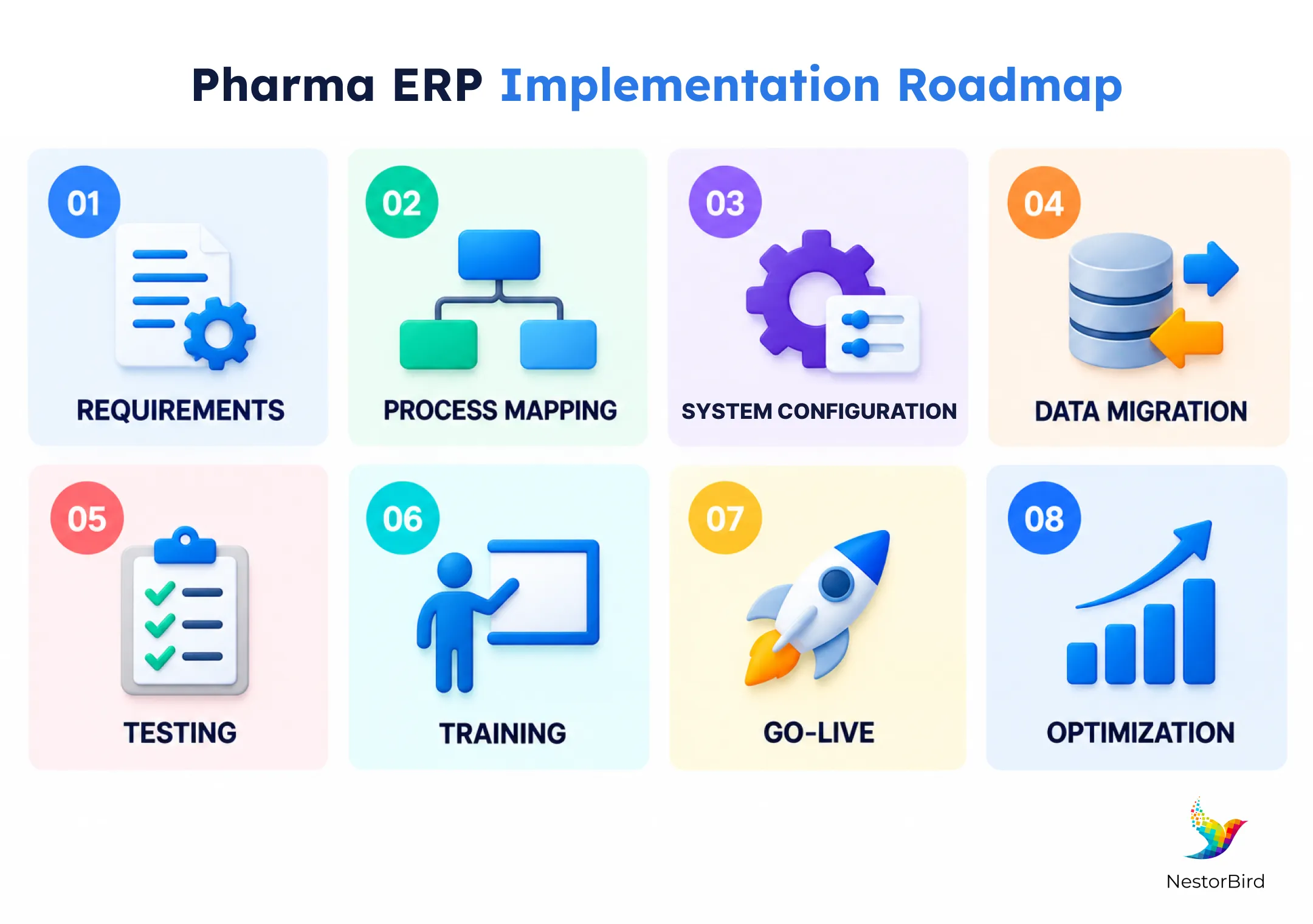
The existing guide recommends five broad stages: assess requirements and map processes, configure ERPNext, migrate and validate data, test and train users, and then go live and optimize.
A practical rollout can include requirements assessment, process mapping, system configuration, data migration, testing, user training, controlled go-live and post-launch optimization. Each stage should have clear owners and acceptance criteria.
Compliance, Validation and Data Integrity
Pharmaceutical companies need to distinguish between software capability and regulatory compliance. ERP software can provide structured records, permissions, workflows, inspection information and traceability, but installing an ERP does not automatically make a business compliant.
FDA guidance emphasizes reliable and accurate data and risk-based controls for data integrity in drug CGMP environments. It also discusses controls around computerized systems, changes, records and data protection.
FDA guidance on computerized systems also emphasizes documented changes, testing and maintaining systems in a validated state where applicable. FDA Q7A GMP Guidance
ERP projects should therefore consider validation, access control, change management, data integrity, backup and record retention according to the company’s intended use and jurisdiction.
Is Pharma ERP Software Right for Your Business?
Pharma ERP Software may be a good fit for manufacturers that have outgrown spreadsheets or disconnected applications. It can also be useful for businesses managing multiple batches, warehouses, production activities or quality checkpoints.
The existing source highlights multiple production batches and warehouse locations, coordinated procurement and production, structured inspection records and shared operational and financial data as indicators of potential suitability.
Before choosing a system, evaluate production complexity, batch requirements, inventory structure, quality processes, integrations, reporting needs, user roles and regulatory obligations. The best ERP is the one that supports the workflows the business actually needs. Businesses evaluating a purpose-built solution can explore ERP for pharmaceutical manufacturing.
Pharma ERP Software vs Disconnected Systems
The difference between an integrated ERP and disconnected systems becomes obvious when employees need information quickly. In a fragmented setup, a manager may need to check an Excel file for stock, ask production about a batch, search email for a purchase order and contact quality for inspection results.
With Pharmaceutical ERP Software, these activities can be represented through linked records. ERPNext’s manufacturing and inventory documentation describes an integrated approach across production, inventory and quality.
ERP does not remove the need for people or procedures. It gives those people a structured information system so they can work with more consistent data.
Conclusion
Pharma ERP Software can give pharmaceutical manufacturers a connected foundation for production, procurement, inventory, warehouse management, quality, sales and finance. The biggest opportunity is to connect processes that previously operated separately.
A strong Pharma ERP System can improve batch visibility, support Pharmaceutical Inventory Management, organize Pharmaceutical Production Planning and create more structured quality workflows. ERPNext provides manufacturing capabilities around BOMs, work orders, job cards, production planning, quality and inventory, while its batch functionality supports batch and expiry tracking.
The implementation approach matters just as much as the software. Process mapping, clean data, configuration, testing, training and appropriate validation should be part of the project from the beginning.
Most importantly, pharmaceutical ERP should be positioned as an operational system that supports the organization’s quality and regulatory framework. It should not be presented as an automatic compliance solution.

Frequently Asked Questions
Pharma ERP Software is an ERP solution configured for pharmaceutical operations such as procurement, batch manufacturing, inventory, quality, warehouse management, sales and finance. It connects these functions through shared business records.
ERPNext provides manufacturing, inventory, batch tracking and quality capabilities that can support pharmaceutical operations. Suitability depends on production complexity, required controls, integrations, customization and applicable regulatory requirements.
A Pharma ERP System can manage raw materials, work-in-progress and finished goods through item, warehouse and batch records. ERPNext supports batch numbers, expiry information and batch-wise inventory reporting.
Yes. ERPNext supports quality inspection records, inspection criteria and quality inspection templates. Pharmaceutical businesses may still require additional configuration, procedures, integrations and validation based on their quality system.
No. Software can support traceability, structured records, workflows and quality processes, but compliance also depends on procedures, validation where applicable, data integrity, access controls, training, documentation and change management.