

Quick Summary
US apparel reshoring requires more than relocating machines, workers, and production orders. Manufacturers also need connected software to manage production planning, MRP, inventory, BOMs, purchasing, shop-floor activity, quality, and costs. An integrated apparel ERP can replace disconnected spreadsheets, improve visibility, and help teams coordinate domestic production more efficiently.
Table Of Contents
Introduction
When apparel production moves back to the U.S., manufacturers need more than physical production capacity. They need software that connects planning, materials, purchasing, production, inventory, quality, and costs. That becomes especially important when domestic production involves shorter lead times, tighter capacity, changing demand, and closer coordination with suppliers and customers. For many businesses, an integrated ERP provides the operational layer needed to manage that transition.
Key Takeaways
US apparel reshoring creates a stronger need for real-time production and material visibility.
An apparel ERP can connect BOMs, MRP, inventory, purchasing, production, quality, and costing.
Production planning software helps teams balance capacity, work orders, labor, and delivery dates.
Inventory and MRP capabilities can reduce material shortages and unnecessary stock.
Shop-floor tracking and quality tools improve production visibility and manufacturing traceability.
The best system should integrate with accounting, sales, procurement, and other business tools.
Why US Apparel Reshoring Creates New Software Needs
Reshoring changes how an apparel business plans and executes production. Offshore models may rely on long lead times, larger production runs, and extended transportation windows. Domestic production can support faster response, but it also means the factory may need to react quickly to order changes, material delays, and capacity constraints. When decisions depend on separate spreadsheets and manual updates, that speed advantage can disappear.
The main software challenge is connecting materials, capacity, production, inventory, and costs in one operating environment. Production managers need current information about work orders. Procurement teams need accurate material requirements. Finance needs reliable production costs. Management needs a clear view of capacity and profitability. A connected system helps these teams work from the same data instead of creating separate versions of the truth.
From Global Sourcing to Domestic Production
A reshoring strategy can introduce more frequent production cycles, closer supplier coordination, and greater pressure on domestic capacity. That makes planning discipline increasingly important. If fabric arrives late, the impact can quickly reach cutting or sewing. If one workstation becomes a bottleneck, the production schedule may need to change. Software should make those dependencies visible so managers can respond before a small delay becomes a missed delivery.
What Software Do Apparel Manufacturers Need When Reshoring?
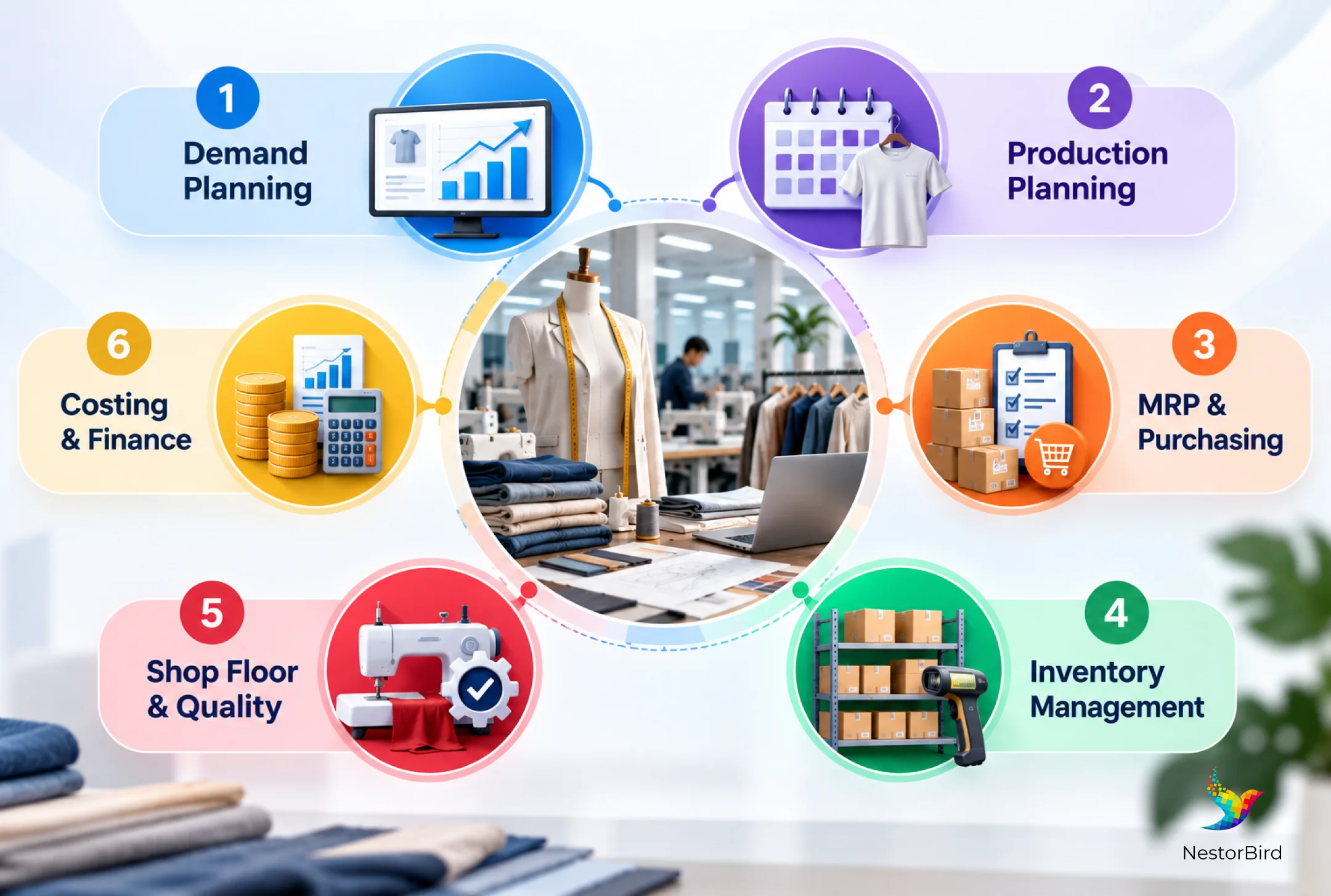
Most apparel manufacturers do not need a collection of disconnected tools. They need a connected software stack with an ERP at its center. The most important capabilities are production planning, MRP, inventory, BOM management, purchasing, shop-floor tracking, quality control, costing, and business reporting. Each capability supports a different part of the reshoring workflow, but the real value comes when those functions share data.
1. Production Planning and Scheduling
Domestic capacity has to be planned carefully because machines, workstations, skilled operators, and production time are limited resources. Production planning software can help teams organize production orders, create work orders, schedule activities, and identify bottlenecks. Instead of relying on a static spreadsheet, planners can work with a more connected view of what needs to be produced and what the factory can realistically handle.
For reshoring, this capability is especially useful when customers expect shorter lead times. A factory may gain a competitive advantage by being closer to the market, but that advantage depends on its ability to deliver consistently. Better production scheduling can help managers balance capacity with customer commitments.
2. MRP and Inventory Management
Material requirements planning helps translate production demand into material requirements. In apparel, that can include fabrics, trims, labels, packaging, accessories, and other components. MRP software should work with inventory data so teams can see what is already available, what is committed, and what needs to be purchased.
This matters during reshoring because supplier networks may be changing at the same time as production locations. A connected inventory management and purchasing process can reduce the risk of discovering a shortage only after a production order reaches the shop floor.
3. BOM and Garment Product Management
A Bill of Materials defines what is required to make a product. Apparel products can become complex because a single style may have different colors, sizes, fabrics, trims, and packaging requirements. Accurate BOM management supports purchasing, MRP, production, inventory, and product costing. This is where apparel ERP software differs from generic manufacturing tools, because it is built around style, color, and size variants.
BOM data is also important when evaluating the economics of reshoring. If a garment was previously produced offshore, the manufacturer needs to understand how materials, labor, production steps, and other costs change when the same product is made domestically.
4. Shop-Floor and Quality Tracking
A production schedule only tells managers what should happen. Shop-floor tracking helps show what is actually happening. Teams can use work-order progress, workstation activity, production status, and job tracking to identify delays earlier.
Quality control software adds another layer. Inspection results, defects, rework, and traceability information can help manufacturers understand where problems occur and which production orders are affected. That visibility becomes valuable when domestic production is expected to compete on quality and responsiveness.
5. Cost and Business Management
Reshoring must make financial sense as well as operational sense. U.S. production can involve different labor, material, overhead, and capacity costs than offshore production. Software that connects purchasing, inventory, production, sales, and accounting can give managers a clearer view of product costs and margins.
The Reshoring Initiative and its Total Cost of Ownership approach also highlight why businesses should look beyond a simple unit-price comparison when evaluating domestic and offshore sourcing. A connected ERP can provide the internal cost and operational data needed to support those decisions.

How an Integrated ERP Supports the Reshoring Transition
An integrated manufacturing ERP software can act as the operational backbone of a reshoring strategy. It centralizes production and inventory data, links sales demand with production planning, and tracks materials from purchasing through production. Managers gain real-time supply chain visibility, finance gets tighter cost control, and every department works from the same records instead of separate files.
This connected approach also reduces dependence on manual spreadsheet updates. An ERP for garment manufacturing can connect apparel-specific workflows and help teams work from shared operational information. Manufacturers already planning to digitize the garment workflow from sourcing through production to billing will find the same system supports the reshoring transition.
What to Look for When Choosing Apparel Manufacturing Software
The best system is not necessarily the one with the longest feature list. It is the one that fits the actual workflow of the apparel business. During evaluation, manufacturers should test the system using real scenarios: create a product, define its BOM, check material availability, plan production, create work orders, record output, capture quality information, update inventory, and review costs.
Apparel-Specific Production Workflows: The system should treat styles, variants, cutting, stitching, and finishing as standard processes.
MRP and Inventory Management: Material planning should work directly with live stock, committed quantities, and purchase plans.
Production and Capacity Planning: Look for production scheduling, work orders, and clear bottleneck visibility.
BOM and Costing: Multi-level BOMs and variant-level costing are essential for apparel products.
Purchasing and Supplier Coordination: Domestic supplier networks need purchase orders, lead times, and vendor performance in one place.
Quality and Traceability: Inspections, defect records, and manufacturing traceability should be built in, not added later.
Accounting and CRM Integrations: Production data should flow into finance and sales without duplicate entry.
Cloud Accessibility: Teams across factories, offices, and suppliers need access from anywhere.
Scalability and Support: Consider customization, implementation timelines, and ongoing support before you commit.
For a closer look at these evaluation criteria, see our guide on how to choose manufacturing ERP software.
Why ERP Is More Practical Than Managing Reshoring With Spreadsheets
Spreadsheets can be useful for analysis, but they become difficult to manage when several departments maintain different versions of production schedules, inventory files, purchase requirements, and cost calculations. A small change in one spreadsheet may not reach the people who need it. That creates delays, duplicate work, and data accuracy risks.
For reshoring manufacturers, ERP is generally more scalable than spreadsheets because production, inventory, purchasing, and financial data can operate from the same system. The benefit is not simply replacing spreadsheets. It is creating connected workflows that give managers a clearer operational picture.
Conclusion
Successful US apparel reshoring depends on operational visibility as much as physical production capacity. Manufacturers should prioritize ERP, MRP, production planning, inventory, BOMs, quality, shop-floor tracking, costing, and financial integration. The right platform should match the reshoring workflow rather than forcing the business into a generic process.
With connected data and clear production visibility, manufacturers can make faster decisions and build a stronger foundation for domestic production. NestorBird’s ERP implementation services help apparel businesses map that workflow, configure the system, and go live with confidence.

Frequently Asked Questions
An integrated ERP with MRP, production planning, inventory, BOM, purchasing, quality, work-order, costing, and accounting capabilities can support the core reshoring workflow.
ERP connects production demand with materials, purchasing, inventory, capacity, work orders, quality, and financial data. This gives teams better visibility into what is available, what is delayed, and what each production decision costs.
Key capabilities include production planning, MRP, inventory, BOM management, purchasing, work orders, shop-floor tracking, quality control, traceability, costing, reporting, and business-system integrations.
Yes. ERP can connect material, purchasing, production, inventory, and financial data so manufacturers can identify waste, review capacity utilization, understand product margins, and make better pricing decisions.
For a growing manufacturer, ERP is generally more scalable because connected production, inventory, purchasing, BOM, work-order, and financial information can be managed in one environment. Spreadsheets can still support analysis and temporary planning.