
Quick Summary
Garment ERP vs Tally comes down to business scope. Tally is primarily built around accounting and business management, while garment ERP connects finance with production, inventory, purchasing, orders, quality, and factory operations. For manufacturers managing styles, sizes, colours, materials, and production stages, ERP provides the operational visibility needed beyond accounting.
Table Of Contents
Introduction
Garment ERP vs Tally is an important comparison for manufacturers that have outgrown basic accounting processes. While Tally can support accounting, taxation, inventory and business administration, garment manufacturing involves production planning, fabric consumption, styles, sizes, colours, quality and shop-floor operations. An ERP software for garment industry connects these activities, giving manufacturers broader operational control from material procurement to finished goods.
Key Takeaways
Tally and garment ERP solve different levels of business requirements.
Garment ERP integrates production, inventory, purchasing, sales, and finance.
Apparel manufacturers need visibility into styles, colours, sizes, materials, and work-in-progress.
ERP provides stronger production planning and shop-floor visibility.
A garment ERP can become a Tally alternative for manufacturing businesses requiring end-to-end operational management.
Manufacturers should choose software based on operational complexity rather than accounting requirements alone.
Garment ERP vs Tally: The Fundamental Difference
The biggest difference between Tally and garment ERP is scope. Tally is widely used by businesses for accounting, GST, inventory, banking, payroll, and financial management. These capabilities can be valuable for manufacturers, particularly when the primary requirement is financial administration. However, running a garment factory requires more than recording financial transactions.
Fabric → Procurement → Inventory → Production Planning → Cutting → Stitching → Quality → Finished Goods → Dispatch → Finance
This is where Garment ERP software becomes relevant. Instead of focusing primarily on what has been purchased, sold, or financially recorded, manufacturing ERP connects transactions with the processes responsible for producing the finished product.
Accounting Records What Happened
What did we purchase?
What did we sell?
How much does a customer owe?
What GST is applicable?
What are our expenses?
ERP Helps Manage What's Happening
Is enough fabric available for an order?
Which production orders are delayed?
How much material has been consumed?
What's currently in cutting or stitching?
What's the work-in-progress quantity?
Which finished goods are ready for dispatch?
That’s the core distinction in the Garment ERP vs Tally comparison.
Why Accounting Software Isn't Enough for Garment Manufacturers
A garment factory contains interconnected processes. Consider an order for 5,000 shirts across five sizes and four colours. That’s potentially 20 SKU combinations before considering fabric lots, production batches, trims, labels, packing requirements, or quality specifications.
Accounting software may record the purchase and sale transactions, but manufacturers need deeper operational control.

1. Style, Size and Colour Management
Garment manufacturers don’t simply manage shirts or trousers. They manage combinations such as Style 101 → Navy → Medium, Style 101 → Navy → Large, and Style 101 → Black → Medium.
An apparel erp software can organise these product variations within connected inventory and production workflows.
2. Bill of Materials and Fabric Consumption
Every garment requires specific materials. For example, one shirt might require fabric, buttons, thread, labels, interlining, and packaging. A garment manufacturing system can connect the Bill of Materials (BOM) with production orders so teams know what’s required before manufacturing begins.
3. Production Planning
Knowing that fabric has been purchased isn’t enough. Manufacturers need to know when an order should enter production, which line will handle it, whether materials are available, and when production should finish. This requires apparel production management software, not just accounting records.
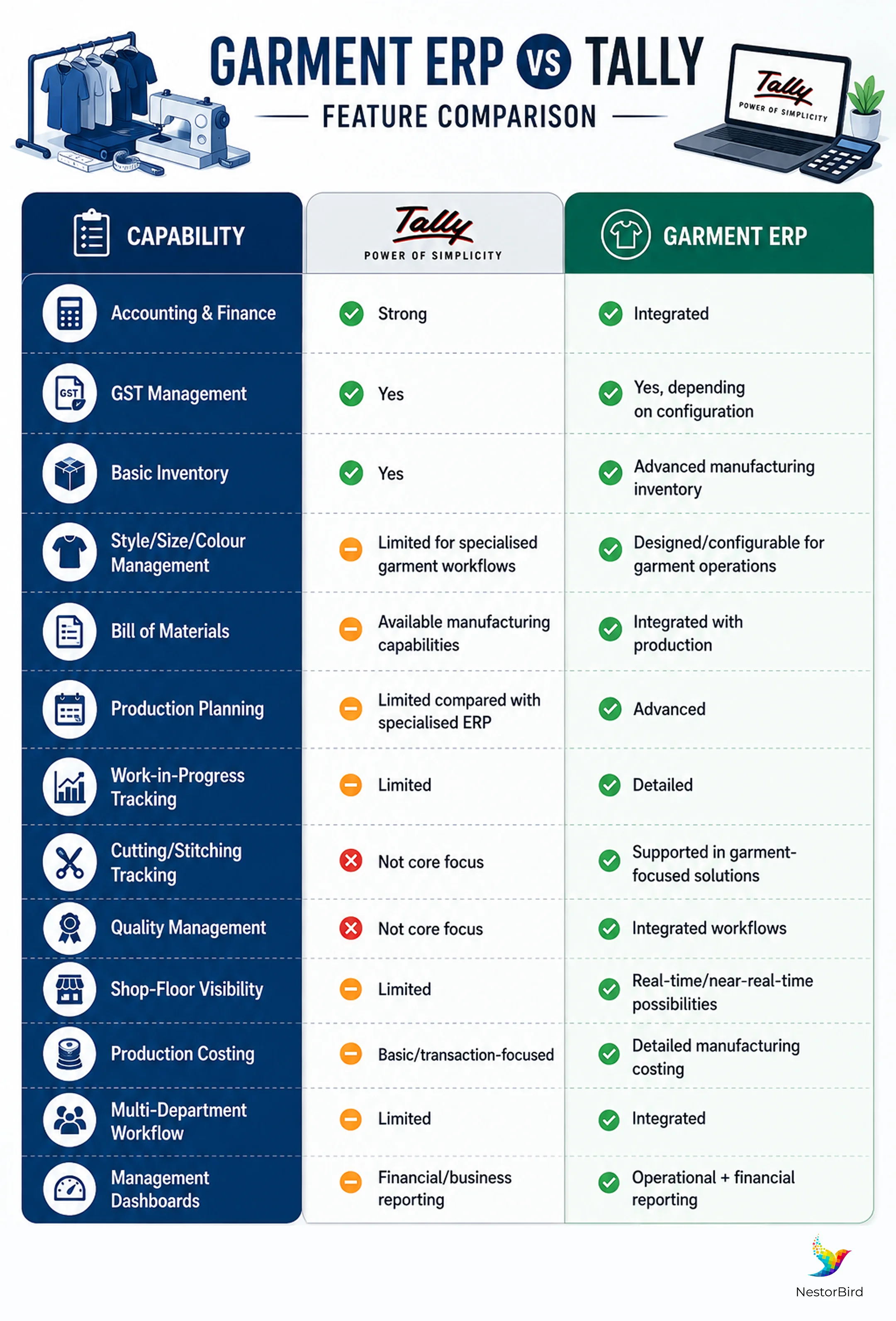
Important: Exact capabilities depend on the Tally edition, integrations, customisation, and the garment ERP being evaluated. Manufacturers should compare software against their actual workflow before making a decision.
Where Garment ERP Makes the Difference
The strongest argument for an ERP software for garment industry is connectivity.
Inventory and Material Control
Garment factories may need to track fabric by type, colour, shade, lot, roll, warehouse, and order allocation. A textile ERP software can connect this inventory information with purchasing and production.
Production Tracking
Once materials enter production, managers need visibility into stages such as Cutting → Stitching → Washing → Finishing → Quality → Packing. A garment factory management software provides production teams with a central view of planned and actual progress.
Quality Control
Garment quality may need to be checked at fabric inspection, during production, and before packing. ERP can record inspections, defects, rejections, rework, and quality status, creating stronger traceability across production.
Production and Finance in One System
The objective isn’t to replace accounting with production software. It’s to connect operational and financial information. NestorBird’s Manufacturing ERP vs. Traditional ERP comparison explains why manufacturing businesses require capabilities beyond standard enterprise administration.
When Should a Manufacturer Move Beyond Tally?
Not every small manufacturer needs a complex ERP from day one. However, the need for a Tally alternative for manufacturing becomes stronger when spreadsheets and manual coordination start filling operational gaps.
Production is managed through multiple spreadsheets.
Inventory doesn't reflect real-time material availability.
Teams struggle to track work-in-progress.
Production delays are discovered too late.
Multiple styles, sizes, and colours are difficult to manage.
Material consumption isn't clearly linked with production.
Management lacks one view across departments.
Multiple factories or warehouses are becoming difficult to coordinate.
At this stage, the question changes from “Can our accounting software record this?” to “Can our system manage the entire manufacturing process?” That is when garment manufacturing software becomes strategically important.
Choosing the Right Garment ERP Software
Moving from accounting-led operations to ERP is an important decision. Manufacturers should evaluate the system against actual factory processes.
Look for Garment-Specific Capabilities
Style, size and colour variants
BOM management
Fabric and trim inventory
Purchase management
Production planning
Work orders
Work-in-progress
Quality management
Finished goods
Sales and dispatch
Financial integration
Reporting and dashboards
Compare Different ERP Approaches
There’s no single ERP platform that’s ideal for every manufacturer. NestorBird’s FlexERP vs Generic ERP comparison explores specialised versus general ERP approaches.
Manufacturers evaluating established enterprise platforms can also review Odoo vs. NetSuite and Oracle ERP vs. SAP.
Another useful comparison is NetSuite Vs Dynamics 365, particularly for organisations evaluating broader cloud ERP ecosystems.
Understand ERP vs MRP
ERP and MRP are frequently confused. MRP primarily focuses on material requirements and production planning, while ERP connects those manufacturing requirements with broader business processes. Read NestorBird’s ERP vs MRP guide for a detailed explanation.
What Should a Garment ERP Connect?
The value of ERP increases when information flows between departments. A connected garment workflow can look like:
Customer Order → Material Requirement → Purchasing → Fabric & Trim Inventory → Production Planning → Cutting & Stitching → Quality Control → Finished Goods → Dispatch → Finance & GST
This is the key advantage of moving toward an integrated garment manufacturing software environment. Instead of maintaining separate operational records, manufacturers create one connected information flow.
For manufacturers looking to digitise these processes, NestorBird’s Garment ERP software provides a foundation for connecting manufacturing operations with wider business management.
External Authority Reference
For current information about Tally and its product capabilities, refer to Tally Solutions official website.
Conclusion
The Garment ERP vs Tally comparison isn’t about declaring one software universally better than the other. The two solutions address different levels of business complexity.
Tally can be highly useful for accounting, GST, inventory, and financial administration. But as garment manufacturers grow, they may need deeper control over fabric, styles, BOMs, production planning, work-in-progress, quality, and factory operations.
That’s where ERP software for garment industry becomes important. A connected Garment ERP software brings production and business information together, helping manufacturers move from accounting-focused management toward complete operational visibility.
For growing garment factories, the question isn’t simply whether accounting software works. It’s whether the software can manage what happens before the final invoice is created.

Frequently Asked Questions
The main difference is scope. Tally focuses strongly on accounting, taxation, inventory, and business administration, while garment ERP extends into production planning, material requirements, work-in-progress, quality, shop-floor processes, and manufacturing management.
Yes. Garment manufacturers can use Tally for accounting, GST, inventory, payroll, and related business processes. However, manufacturers with complex production requirements may require specialised ERP capabilities or integrations.
Garment ERP software is an integrated system designed to manage apparel manufacturing processes such as purchasing, fabric inventory, styles, BOMs, production, quality, finished goods, sales, and finance.
A manufacturer should consider broader manufacturing software when production relies heavily on spreadsheets, work-in-progress is difficult to track, material planning becomes complex, or management lacks real-time operational visibility.
No. ERP can also benefit growing manufacturers. The right solution depends on production complexity, number of users, order volume, locations, and the level of process integration required.
Many garment ERP platforms provide financial management capabilities or integrate with accounting and taxation systems. Exact GST capabilities depend on the ERP and its configuration.