

Quick Summary
Garment export ERP software India is becoming an important opportunity as Indian apparel exports scale and manufacturers face increasing pressure on cost, production visibility, inventory and delivery timelines. Modern ERP can connect procurement, production, inventory, quality, costing and finance in one system, helping exporters reduce operational gaps and build a more responsive, data-driven garment manufacturing business.
Table Of Contents
Introduction
India’s apparel export sector is entering a new phase where garment export ERP software India can become a competitive advantage rather than simply another technology investment. Government data shows that India’s ready-made garment exports reached ₹139,349.6 crore in FY 2025–26, up 2.9% year over year. At the same time, manufacturers are dealing with tighter margins, complex production schedules, raw-material dependencies and demanding international buyers.
Key Takeaways
India's ready-made garment exports reached ₹139,349.6 crore in FY 2025–26.
Export growth is increasing the need for stronger production and supply-chain visibility.
Garment export ERP software India can connect inventory, procurement, production, costing and finance.
SME textile digitization can help manufacturers move beyond spreadsheets and disconnected applications.
Cloud ERP can make enterprise-grade operational visibility more accessible to growing manufacturers.
Tier 2 and Tier 3 manufacturers represent a significant digital transformation opportunity.
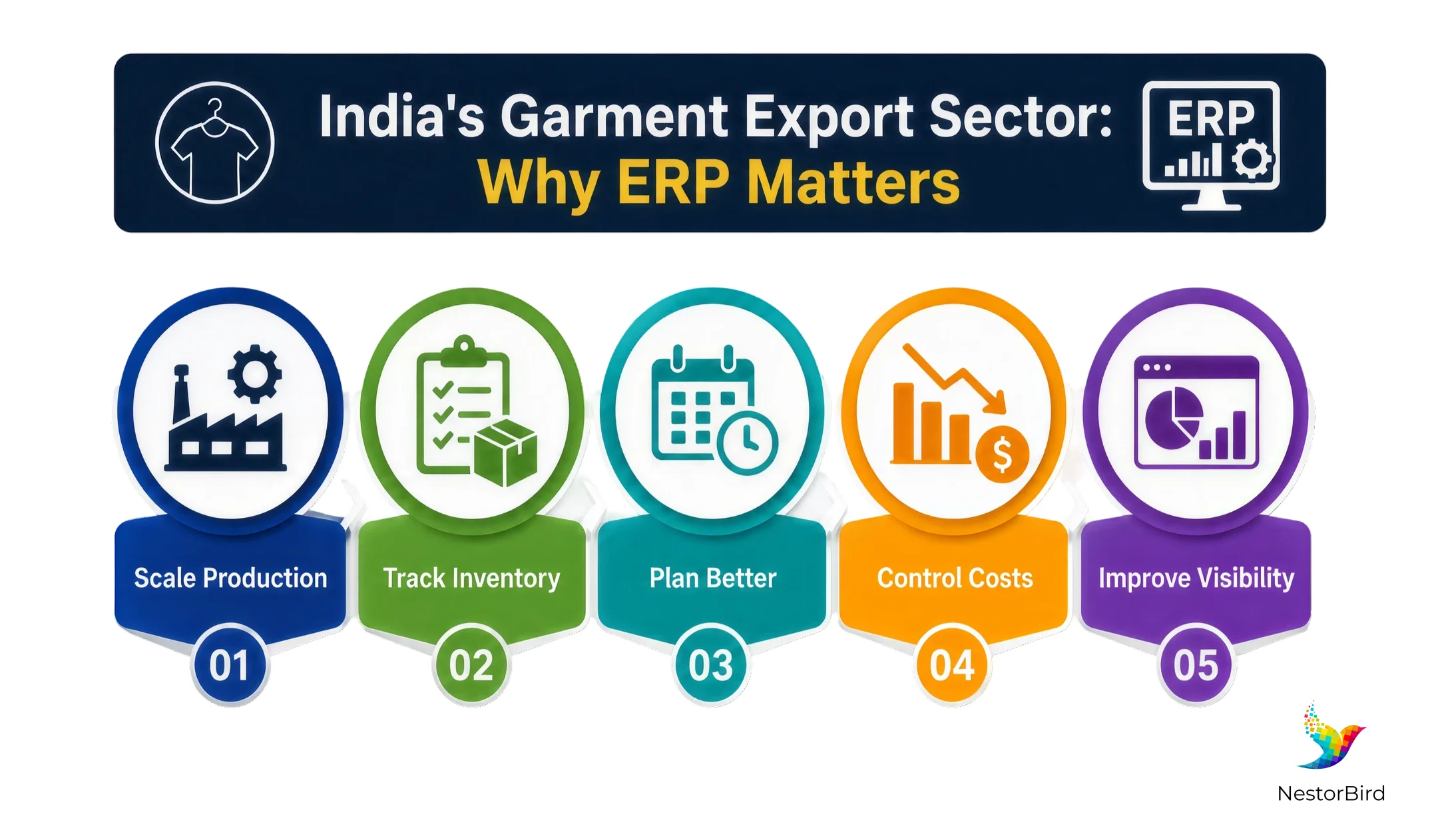
Why India's Garment Export Opportunity Is Bigger Than It Looks
India’s textile and apparel sector is already a major contributor to international trade. According to the Ministry of Textiles, India’s textile and apparel exports, including handicrafts, reached ₹3,25,339 crore in FY 2025–26, compared with ₹2,97,004 crore in FY 2023–24. Ready-made garments alone contributed ₹139,350 crore in FY 2025–26.
That scale changes the ERP conversation. When an apparel manufacturer handles hundreds of styles, multiple sizes and colours, several raw-material suppliers, production stages, subcontractors and international customer deadlines, a basic accounting system cannot provide the complete operational picture. The factory may know how much it sold, but the bigger question is whether management knows what is being produced, what is delayed, where materials are stuck, how much each order actually costs and whether the promised shipment date is realistic.
India's Export Numbers Signal a Bigger Manufacturing Opportunity
India’s export market is also geographically diversified. Government data shows exports to more than 100 countries during FY 2025–26, while the USA, UK, Germany, Netherlands, Spain, France and other international markets remain important destinations.
For exporters, diversification creates complexity. Different buyers can have different specifications, order quantities, quality requirements, packaging standards and delivery schedules. Managing that complexity manually is like trying to conduct an orchestra where every musician is reading a different sheet of music. A connected garment production management system gives management one operational view instead.
Where the Textile Industry Technology Gap Exists
The biggest ERP opportunity may not be among India’s largest textile corporations. It may exist among manufacturers that have already reached meaningful production scale but still operate with disconnected tools.
Why Spreadsheets and Disconnected Systems Still Survive
Spreadsheets are attractive because they are familiar, inexpensive and flexible. The problem appears when the business grows. One spreadsheet tracks raw material, another tracks production, another tracks purchase orders and someone else maintains the final costing sheet. Soon, the organization has multiple versions of the truth.
A connected ERP replaces that fragmented model with a centralized system where purchasing, inventory, production, sales and finance can work from connected information. NestorBird’s manufacturing ERP system offering includes capabilities around BOMs, work orders, production planning, inventory, procurement, quality inspection, batch and serial tracking and forecasting.
The Case for SME Textile Digitization
SME textile digitization does not necessarily mean building a giant enterprise technology stack. The better approach is to digitize the workflows that directly influence profitability.
What Garment Export ERP Software India Can Actually Solve
A specialized ERP can connect the complete journey from customer order to finished shipment. Instead of treating production, inventory and finance as separate departments, it creates a common operational workflow.
Production Planning and Garment Factory Inventory Management
Production planning is one of the most important areas for exporters because a delay in one operation can affect the entire shipment. Fabric availability, cutting capacity, stitching capacity, finishing, quality checks and packing all have to move together. Connected manufacturing ERP for production planning keeps those stages aligned with material requirements and shop-floor execution.
A garment factory inventory management system can provide visibility into raw materials, work-in-progress and finished goods. With real-time inventory information, production teams can make decisions based on actual availability instead of relying on yesterday’s spreadsheet.
Apparel Supply Chain and Procurement Visibility
The apparel supply chain has many moving parts. Fabric, buttons, zippers, labels, thread, packaging and other components may come from different vendors and arrive at different times. Without centralized information, procurement teams often discover shortages only when production is about to start.
ERP for Apparel Exporters Is More Than Accounting Software
Calling ERP simply an accounting system undersells its value for manufacturing. Accounting is one component. The real value comes from connecting financial information with physical operations.
From BOM and Work Orders to Costing and Quality
A Bill of Materials (BOM) defines the materials and components required for a product. In apparel manufacturing, this becomes especially important because material consumption can vary by style, size, fabric and production requirements. Work orders then translate the requirement into executable production activity. Job cards can help track operational progress, while quality inspection creates a structured checkpoint before goods move forward.
Customer Order → BOM → Procurement → Inventory → Production → Quality → Costing → Finished Goods → Shipment
Cloud ERP for Textile Manufacturing
Cloud ERP can make this transformation more practical for growing manufacturers because teams can access centralized information without maintaining a large on-premise technology infrastructure. It can also support collaboration between management, procurement, production, warehouse and finance teams.

The Business Case for India Garment Industry Digital Transformation
The case for India garment industry digital transformation is not simply about becoming ‘more digital.’ It is about protecting margins while increasing operational scale. When material costs rise, management needs accurate consumption and costing information. When customer orders increase, production teams need better planning. When delivery windows become tighter, managers need real-time visibility into bottlenecks.
Why Tier 2 and Tier 3 Manufacturers Should Pay Attention
The next major wave of SME textile digitization can come from Tier 2 and Tier 3 manufacturing clusters. These businesses may not need an enormous enterprise platform, but they increasingly need the same basic visibility expected from larger manufacturers. A practical ERP implementation can help them centralize production, inventory, procurement and financial information while creating a foundation for future automation.
This is particularly relevant as India competes globally on speed, quality, reliability and manufacturing scale. Government initiatives such as PM MITRA, PLI for textiles and export-support measures are also aimed at strengthening the competitiveness of India’s textile and apparel ecosystem, and garment export ERP software India gives manufacturers the operational base required to take advantage of them.
Choosing the Right ERP for a Garment Export Business
The right ERP should fit the manufacturer’s workflow rather than forcing the manufacturer to completely redesign its business around software.
Before selecting a system, exporters should evaluate whether it supports production planning and scheduling, BOM and material requirements, raw-material and finished-goods inventory, purchase and supplier management, work orders and job cards, quality inspection, cost calculation, forecasting and reporting, multi-location operations, and cloud access and integrations.
Manufacturers comparing solutions can also review NestorBird’s guide to apparel manufacturing software India to understand the broader capabilities expected from modern apparel ERP platforms. The important point is not to choose software because it has the longest feature list. Choose it because it solves the operational bottlenecks that are costing the business time, inventory and margin.
Conclusion
India’s garment export sector is already operating at significant global scale, with ready-made garment exports reaching approximately ₹139,350 crore in FY 2025–26. The next competitive advantage may not come only from cheaper manufacturing or larger capacity. It may come from better operational visibility.
That is the ERP opportunity nobody is talking about enough.
For exporters, ERP can connect customer orders, BOMs, procurement, inventory, production, quality, costing and finance into one operating system. For Tier 2 and Tier 3 manufacturers, this creates an opportunity to replace fragmented processes with scalable digital infrastructure.
The future of Indian garment manufacturing will not simply be about producing more garments. It will be about producing them with greater visibility, precision, speed and control. For exporters evaluating the wider benefits of manufacturing ERP, that shift is where the long-term return sits.

Frequently Asked Questions
Garment export ERP software India refers to enterprise resource planning software designed to manage manufacturing, inventory, procurement, production, costing, quality and financial operations for garment exporters and manufacturers.
Garment exporters manage complex production schedules, raw materials, suppliers, quality checks and delivery deadlines. ERP connects these processes and provides real-time operational visibility.
Yes. ERP can track raw materials, work-in-progress and finished goods while connecting inventory availability with procurement and production requirements.
Yes. Cloud ERP can provide centralized access to business information while reducing the need for manufacturers to maintain extensive on-premise infrastructure. The right solution should still be evaluated for security, integrations, scalability and manufacturing functionality.
Absolutely. Smaller and mid-sized manufacturers can use ERP to replace fragmented spreadsheets, improve production visibility and establish scalable processes without necessarily adopting an enterprise-scale technology stack.