
Quick Summary
Healthcare ERP helps hospitals connect medicine demand with procurement by bringing prescription and dispensing patterns, consumption, stock, pending orders, and supplier lead times into a shared operational view. This helps pharmacy and procurement teams make more informed replenishment decisions, monitor expiry risk, and respond when patient demand changes instead of relying only on older estimates.
Table Of Contents
Introduction
Keeping essential medicines available while controlling purchasing costs is a daily balancing act for hospitals. When pharmacy, procurement, and patient-activity data sit in spreadsheets or disconnected systems, purchase orders can reflect yesterday’s demand instead of current requirements. A Healthcare ERP can connect patient-related activity with pharmacy inventory, purchasing, supplier information, and finance workflows. That connection gives teams a clearer basis for demand planning: what is being consumed, what is already available, what is on order, and what may be needed next. This article explains how that connection can support Hospital Pharmacy Inventory Management, pharmaceutical demand forecasting, and more practical procurement planning. To understand the wider connection between clinical and administrative processes, see connected hospital workflows.
Key Takeaways
Actual medicine consumption can provide a stronger procurement signal than historical estimates alone.
Healthcare ERP can connect pharmacy, procurement, inventory, finance, and relevant patient-activity data.
Batch, expiry, stock, and reorder visibility can support more controlled medicine inventory management.
Forecasts should consider patient demand, usable stock, pending orders, and supplier lead times.
Comparing forecast demand with actual consumption helps teams adjust future purchasing decisions.
Why Does Pharmacy Procurement Often Fall Out of Sync With Patient Demand?
Pharmacy procurement can drift away from patient demand when procurement teams do not have timely access to consumption and stock information. A monthly spreadsheet may show what was used last month but miss what is happening this week. Teams may also lack a complete view of stock held in another location, pending orders, or changing treatment patterns.
That creates two common problems: frequently prescribed medicines can run short, while slow-moving products may be over-purchased and remain unused long enough to create expiry risk.
Consider a hospital that orders antibiotics using the previous month’s consumption. A seasonal rise in respiratory infections increases prescriptions during the current month. If dispensing data is not visible to procurement quickly, the original order may no longer match actual requirements.
The World Health Organization identifies consumption data as an important input for medicine quantification and also highlights factors such as stock on hand, expected deliveries, expiry or damage, and seasonal variation. The lesson is straightforward: procurement works better when it uses current operational information, not historical estimates alone.
For a closer look at how hospitals can coordinate purchasing and inventory, explore hospital inventory and procurement management.
The World Health Organization’s guidance on medicine procurement also provides useful context for effective medicine purchasing and supply management.
How Can Healthcare ERP Connect Patient Demand With Procurement Planning?
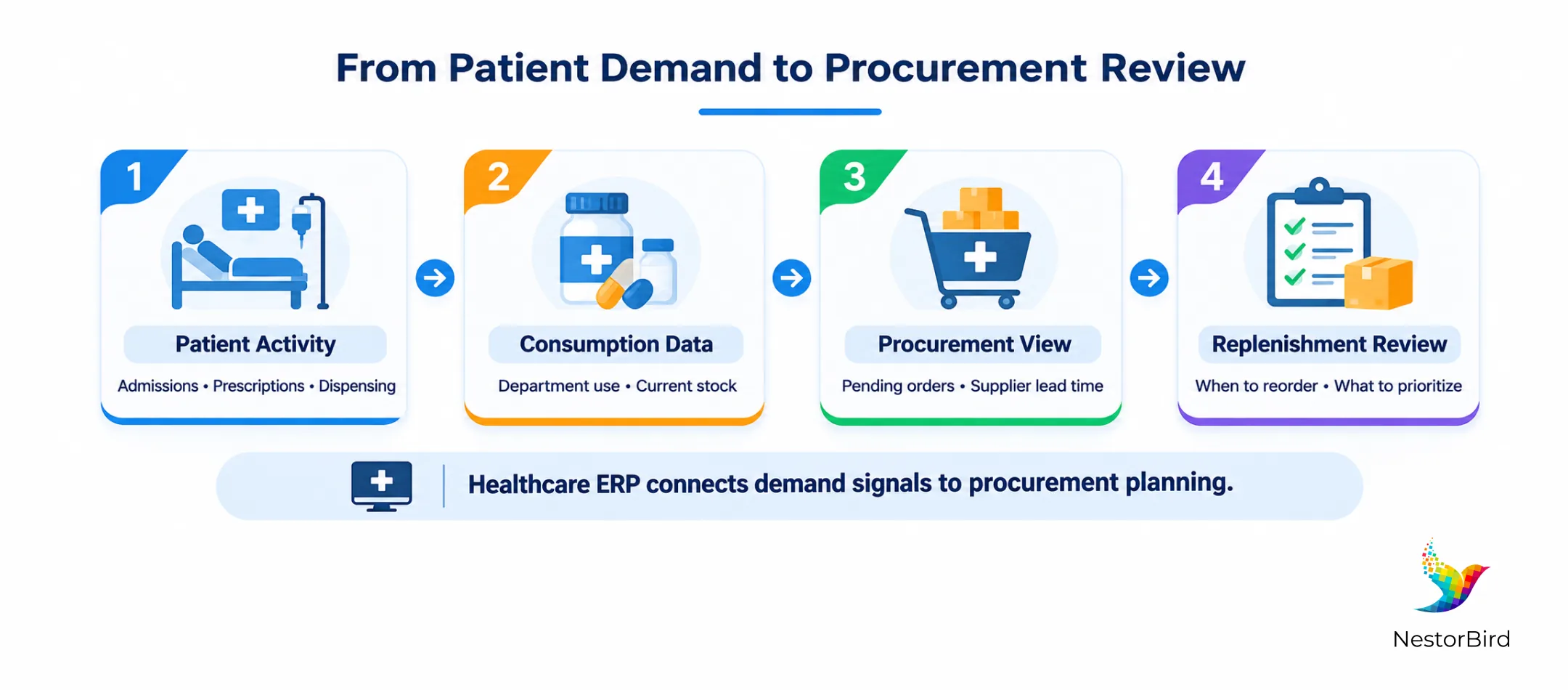
A Healthcare ERP can connect the activities that create medicine demand with the teams responsible for replenishment. Instead of reconciling separate files, pharmacy, procurement, inventory, and finance teams can work from related information.
Useful inputs include:
Patient volumes and admission patterns.
Prescription and dispensing records.
Medicine consumption by department.
Seasonal changes and treatment requirements.
Current usable stock.
Pending purchase orders and expected deliveries.
Supplier lead times.
For example, a hospital can review medicine consumption across the emergency department, outpatient pharmacy, and inpatient wards before preparing its next purchase order. Procurement can then consider current stock and incoming quantities rather than relying only on a historical total.
The value is not perfect forecasting. It is a better information base for decisions. When consumption changes, the next replenishment review can reflect that change instead of waiting for a manual reconciliation cycle.
How Does a Hospital Inventory Management System Support Pharmacy Operations?
A connected Hospital Inventory Management System gives pharmacy teams a clearer view of stock movement and availability.
Key capabilities include:
Centralized stock visibility across pharmacy stores and hospital locations.
Batch-wise inventory and expiry tracking to support stock rotation.
Reorder levels that flag items needing review.
Departmental coordination between pharmacy, procurement, and finance.
Stock reconciliation between system records and physical counts.
A Hospital Pharmacy Management System is more pharmacy-specific, covering dispensing, prescriptions, and pharmacy stock workflows. Healthcare ERP is broader because it can connect those activities with procurement, finance, inventory, and other hospital operations.
For example, if one store has usable stock while another is running low, the team can assess whether an internal transfer or a new purchase is more appropriate. The system supports the decision; it does not replace operational judgment.
Hospitals can also explore how pharmacy inventory and expiry tracking supports better medicine stock visibility, batch monitoring, and inventory control.
How Does Pharmaceutical Demand Forecasting Improve Replenishment Decisions?
Pharmaceutical demand forecasting estimates future medicine requirements using relevant historical and current information. It is not an exact prediction. Its purpose is to give procurement teams a stronger basis for replenishment decisions.
Four useful inputs are:
Historical consumption.
Current usable stock.
Supplier lead times.
Changes in patient demand.
If a supplier needs two weeks to deliver a frequently used medicine, procurement should consider expected consumption during those two weeks, usable stock, committed quantities, and pending deliveries before deciding when to reorder.
Forecasts should then be compared with actual consumption. If demand changes sharply, the next planning cycle should be adjusted. This creates a feedback loop: estimate demand, plan replenishment, observe actual use, and improve the next decision.
Healthcare organizations can also review pharmaceutical ERP capabilities to understand how connected inventory, purchasing, and operational data support medicine supply management.
What Operational Benefits Can Hospitals Expect from Connected Pharmacy Procurement?
Connected pharmacy procurement can improve operational visibility across teams.
Potential benefits include:
Medicine availability: Teams can identify potential shortages earlier when stock and upcoming requirements are visible.
Lower expiry-related losses: Batch and expiry monitoring helps staff identify stock that needs attention.
Better working capital use: More informed purchasing can reduce unnecessary accumulation of slow-moving medicines.
More informed procurement planning: Consumption, stock, pending orders, and supplier data support better purchase decisions.
Stronger Healthcare Supply Chain Management: Pharmacy, stores, procurement, and finance teams can coordinate using related information.
These benefits depend on data quality. Delayed dispensing entries, inaccurate item masters, or differences between physical and recorded stock can weaken the value of the system. Technology supports the process; it does not replace inventory discipline.
What Should Hospitals Consider When Implementing Healthcare ERP for Pharmacy Procurement?
Implementation should begin with real hospital workflows rather than software features alone. Before go-live, teams should agree on how medicine data will be maintained, how stock movements will be recorded, and who approves replenishment.
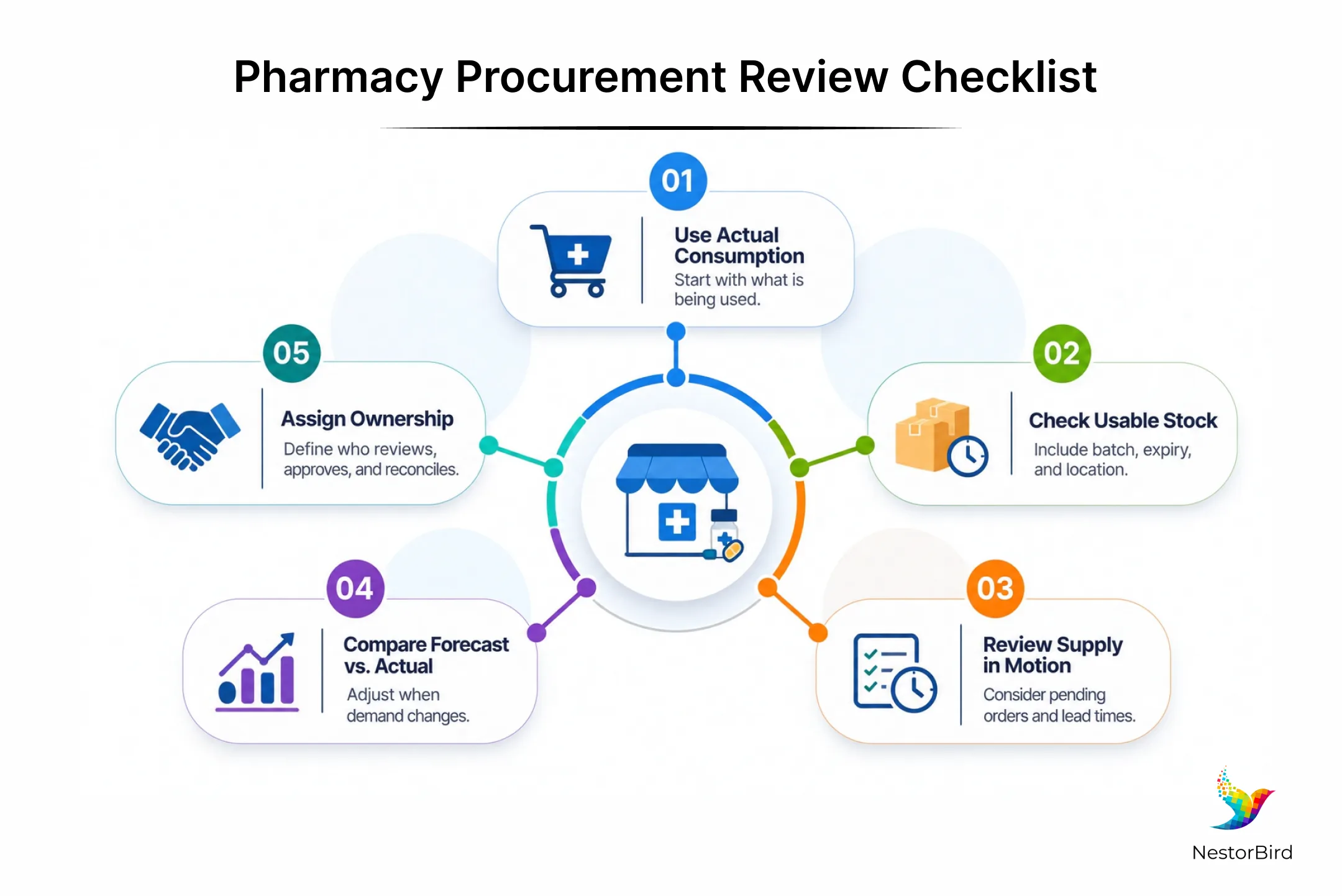
Hospitals should focus on:
Data accuracy for medicine, batch, stock, and consumption records.
Workflow integration across patient, pharmacy, procurement, inventory, and finance processes.
Supplier visibility for lead times, delivery reliability, and pending orders.
Forecast review by comparing expected demand with actual consumption.
Clear ownership for reconciliation, reorder approvals, and expiry reviews.
A Healthcare ERP implementation is therefore both a technology and process project. Reliable data, suitable workflows, trained users, and regular review remain essential.
For practical implementation considerations, explore ERPNext implementation for healthcare and how integrated workflows can support hospital operations.
Conclusion
Healthcare ERP can help hospitals connect actual patient demand with pharmacy procurement by linking consumption, stock, purchasing, supplier lead times, and related operational information. That connection supports more informed replenishment decisions, stronger inventory control, earlier visibility into potential shortages, and better attention to expiry risk. The quality of the outcome still depends on accurate data, clear workflows, and regular review. For hospitals evaluating an integrated approach, NestorBird’s healthcare ERP solution can help connect pharmacy procurement with wider hospital operations.

Frequently Asked Questions
Healthcare ERP connects pharmacy inventory, procurement, finance, and other hospital workflows through shared information. It can help authorized teams coordinate medicine purchasing and stock decisions with broader hospital activity.
It connects consumption, current stock, pending orders, and supplier information so procurement teams can estimate requirements using more current information instead of relying only on older spreadsheets or historical averages.
Use historical consumption together with current patient volumes, prescription patterns, seasonal changes, usable stock, pending deliveries, and supplier lead times. Review the forecast against actual usage and adjust future planning.
It provides visibility into stock levels, committed quantities, reorder thresholds, and incoming orders. This can help teams identify items that need review earlier and plan replenishment before available stock becomes critical.
A Hospital Pharmacy Management System focuses on pharmacy-specific activities such as prescriptions, dispensing, and stock. Healthcare ERP has a wider scope and can connect pharmacy with procurement, finance, inventory, and other hospital workflows.
Track batches and expiry dates, review slow-moving stock, rotate suitable inventory, monitor consumption, and align purchase quantities with expected demand. Better visibility helps teams identify stock that needs attention earlier.
Useful inputs include historical consumption, current usable stock, patient demand patterns, prescription and dispensing activity, pending purchase orders, expected deliveries, and supplier lead times.
Connect dispensing and consumption records with procurement planning, review current stock and incoming supplies, and compare forecast demand with actual use regularly. This creates a feedback loop for better purchasing decisions.