

Quick Summary
A fragmented hospital information system forces staff to juggle multiple disconnected tools daily. This creates data silos, billing errors, and slow workflows. Fixing integration issues helps hospitals run smoother, protect revenue, and reduce employee frustration without investing in completely new software.
Table Of Contents
Introduction
In modern healthcare, though there are many tools and software systems to take care of the daily operations and functions, it is common for these systems to work in isolation. This creates a hidden problem that silently affects patient care and the hospital’s bottom line. When different departments use separate tools that do not share data smoothly, daily tasks become slower and more prone to errors. This reality often goes unnoticed by outsiders but is felt deeply by hospital staff every day. In this blog post, we will explore how a fragmented hospital information system directly damages hospital workflow and why fixing this issue is no longer optional for modern healthcare institutions.
Key Takeaways
Disconnected systems force duplicate data entry.
Billing errors increase without smooth data flow.
Fragmented setups hide critical patient information.
Revenue leaks happen from poor data integration.
Fixing integration reduces staff burnout.
When Many Software Tools Create More Confusion
Many hospitals use and work on multiple software solutions to run their daily activities. There is a common belief that having more tools means the hospital is fully digital and modern.
But in reality, this approach often creates separate silos where different departments cannot see or share data with each other. This happens because hospitals frequently combine older legacy systems with newer tools, resulting in a setup where staff must log in and out of various applications just to finish one single task.
This fragmented structure directly affects daily hospital workflow processes. For example, when a lab result needs to reach the billing department, staff often have to enter the same data manually into two different systems. This increases the mental load on employees and leaves room for typing errors.
Furthermore, because data remains trapped inside individual software silos, the hospital cannot access real-time information to make quick decisions. It is important to understand that simply using more Healthcare technology does not guarantee better connectivity or smoother operations.
Know more about Hospital Management Software.

How Workflow Inefficiencies Drain Revenue Due To Silos
When businesses use and implement the right and best suitable ERP Systems for their functions, specific operational problems get solved directly.
When there are numerous inefficiencies in the operations and business functions, the financial health of a hospital starts to suffer directly. Leaders in healthcare today pay close attention to metrics like “first-pass success,” which measures how many insurance claims are accepted the first time they are submitted.
A fragmented hospital information system disrupts this metric significantly. When patient data is entered incorrectly at one point or does not flow properly to the billing department, claims get rejected. This forces staff to redo work, increases administrative costs, and causes revenue to leak out of the organization.
Choose the best Healthcare ERP.
A small error during patient registration, such as a misspelled name or wrong insurance code, creates a ripple effect. Later in the revenue cycle, this small mistake turns into a denied claim, which then requires hours of manual work to fix. This wastes valuable staff time and delays payment to the hospital.
Additionally, poor integration affects inventory management. Without a connected view, the hospital management software cannot track supplies accurately. This leads to situations where essential items expire unused or run out unexpectedly, forcing expensive last-minute purchases. Implementing proper clinical process automation helps reduce these manual touches, ensuring data flows correctly from the start and protecting the hospital’s revenue.
Choose from these Healthcare ERP Software in 2025.
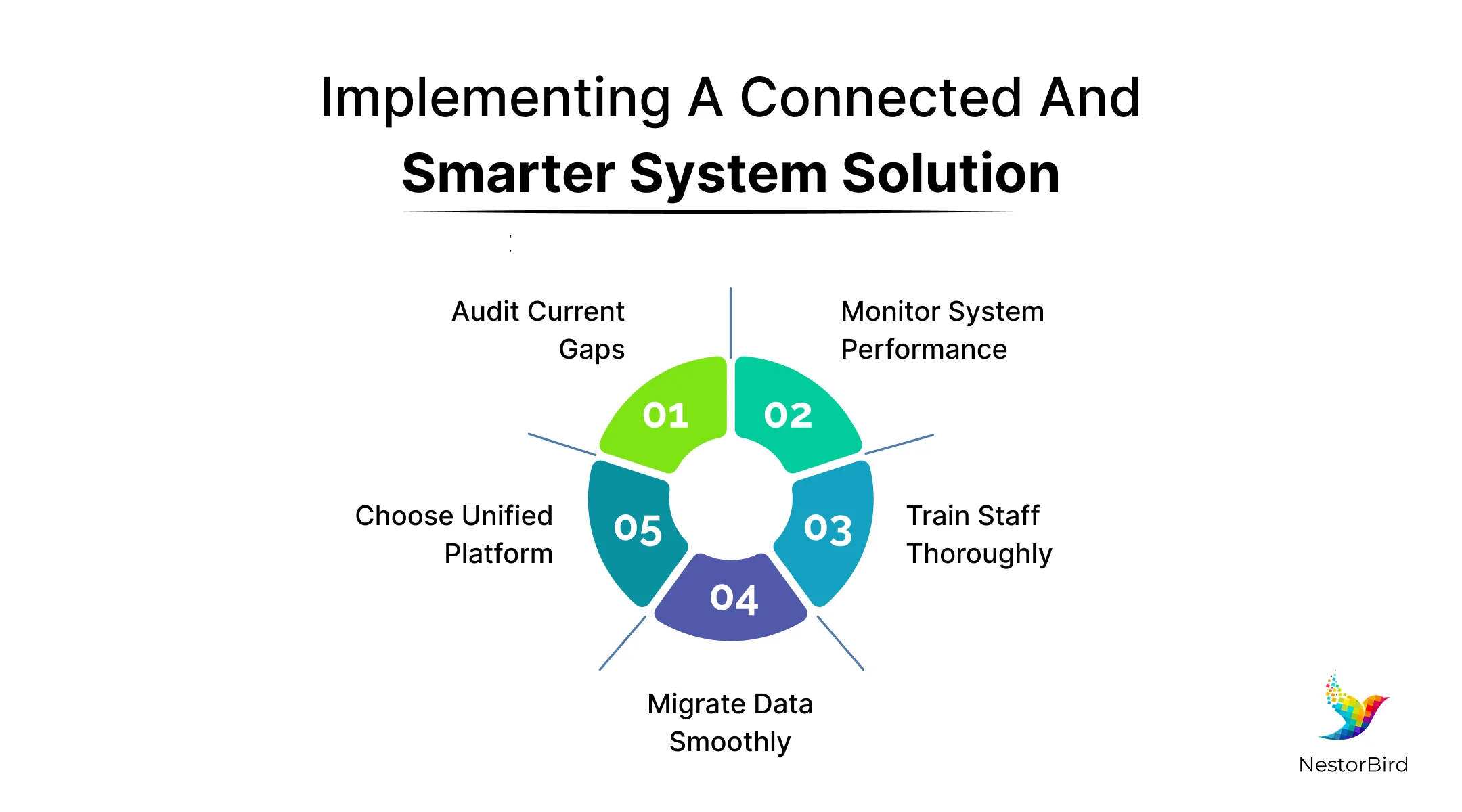
Implementing A Connected And Smarter System Solution
There is a simple yet effective solution for hospitals stuck with disconnected systems. The market is now shifting toward platforms that put connectivity first. Instead of buying many separate tools that do not work well together, hospitals are choosing unified systems that cover electronic health records, revenue cycle management, and data analytics in one place. This approach removes the need for staff to jump between different software applications throughout the day.
When a hospital adopts a unified hospital information management system, it directly solves many common clinical software challenges. Doctors and nurses get a single source of truth for patient information. They no longer have to search through multiple screens to find lab results or medication histories. This reduces mental fatigue and allows them to focus more on patient care rather than struggling with technology.
Thats why resolving fragmentation offers various benefits for hospital operations:
With clean and connected data, hospitals can use predictive analytics to identify patients at risk of returning after discharge. This allows care teams to intervene early and prevent readmissions.
When data flows smoothly, clinical process automation becomes possible. Tasks like prior authorization and referral management happen automatically, freeing staff from paperwork.
A well-integrated system simplifies daily hospital workflow for everyone. Technology fades into the background, and staff spend less time fixing data errors and more time on meaningful work.
This change from different scattered tools to a smart, integrated platform equips hospitals to tackle upcoming challenges while ensuring smoother operations now.
This is why healthcare organizations need an ERP.
Conclusion
The reality is that a disconnected hospital information system directly affects the money the hospital earns, the time staff wastes, and the quality of care patients receive. When systems do not share data smoothly, small errors grow into big losses. Fixing this fragmentation should be a top priority for every hospital that wants to run efficiently today and be ready for tomorrow. By choosing solutions that prioritize connectivity, hospitals can simplify daily work and protect their revenue. This is exactly why you should consider solutions from NestorBird. Our approach focuses on connecting every part of hospital operations smoothly, so data flows where it needs to go without manual effort or errors.

Frequently Asked Questions
When systems are not connected, doctors may lack a complete patient history. This can lead to delayed treatment decisions, repeated tests, and a higher chance of medical errors.
Common signs include staff logging into many different software applications daily, manual data entry between departments, trouble finding patient records, and long waiting times for lab results.
It is technology that handles repetitive manual tasks automatically, such as sending referrals or checking insurance. It reduces the administrative burden on staff and speeds up daily workflows.