
Quick Summary
The Ludhiana hosiery industry is increasingly evaluating digital systems to connect inventory, production, purchasing and order management. An ERP implementation can replace fragmented records with one operational view, helping teams plan materials, track production and monitor work in progress. This case study explains the implementation journey, expected operational improvements and the KPIs manufacturers can use after go-live.
Table Of Contents
Introduction
The Ludhiana hosiery industry operates across connected activities such as material procurement, inventory, production, quality, orders and dispatch. As these workflows become harder to coordinate manually, ERP can provide a shared digital system for manufacturers and management teams. This case study examines Ludhiana hosiery industry ERP implementation through operational gaps, implementation steps and measurable outcomes.
For manufacturers evaluating manufacturing ERP software, the important question is whether the system can connect the information needed to plan, produce, control inventory and fulfil orders.
Key Takeaways
ERP can connect inventory, purchasing, production, orders and reporting in one system.
Disconnected records can reduce visibility into stock, WIP and production status.
Implementation should begin with process mapping and clean business data.
Production planning works better when material availability and capacity are visible together.
KPIs should measure inventory accuracy, WIP, production lead time and fulfilment time.
ERP should be treated as an operational transformation project, not only as a software installation.
Why Ludhiana's Hosiery Industry Needs Digital Transformation
Hosiery manufacturing involves decisions that depend on one another. Production teams need to know what has been ordered, which materials are available, what is already in production and what still needs to be purchased. When these details sit in separate spreadsheets, registers or applications, teams can spend time reconciling information before making routine decisions.
The main challenge for growing hosiery manufacturers is connecting inventory, production, purchasing and ordering data in one system. Digital transformation therefore means more than replacing paper. It means creating a reliable information flow from material procurement to production and finished goods to dispatch.
Common Operational Challenges for Hosiery Manufacturers
Challenge | Operational Impact |
|---|---|
Manual inventory records | Uncertainty about available stock |
Disconnected production data | Limited WIP visibility |
Manual planning | Delays and bottlenecks |
Separate order records | Difficult order tracking |
Procurement gaps | Material shortages or delayed purchasing |
Limited reporting | Slower decisions |
The right ERP depends on the factory's processes, scale and complexity. The starting point should be identifying where disconnected information creates delays, duplicate work or weak visibility.
ERP Implementation for a Ludhiana Hosiery Manufacturer: The Case Study
A useful ERP implementation case study should focus on the operational journey rather than a list of features. For a Ludhiana hosiery manufacturer, the journey can follow the order lifecycle: requirement, material planning, purchasing, inventory, production, quality, finished goods and dispatch.
The objective is to create one connected flow of information. Instead of collecting separate updates from multiple teams, management can use the ERP as a common operational record.
Before ERP: Where the Gaps Existed
A manufacturer may already use accounting software, spreadsheets, messaging applications or standalone registers. The problem is not necessarily a lack of technology; it is the lack of connection between systems.
A purchase record may show that material was ordered while a production sheet shows what is required. Unless these records are connected, the planner still needs to confirm actual stock before scheduling work. Similar gaps can occur between customer orders, production progress and dispatch planning.
ERP Implementation Approach
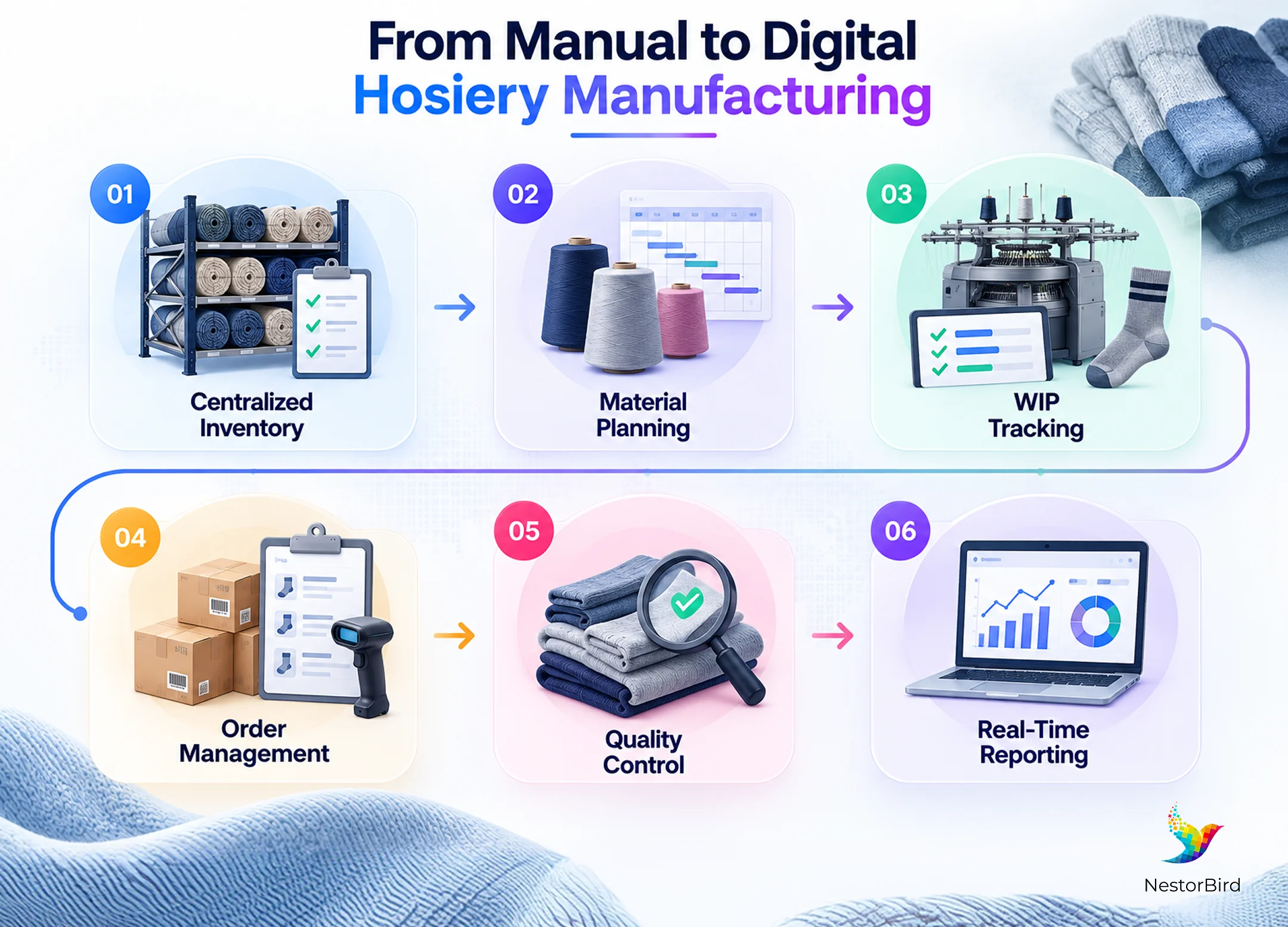
Implementation should begin with process mapping. Teams document current workflows, configure the ERP around validated processes, migrate data, integrate modules, train users, test the system and then move to go-live and support.
Process mapping → ERP configuration → Data migration → Module integration → User training → Testing → Go-live → Support
When evaluating ERPNext manufacturing software, the same principle applies: assess the system against actual workflows such as production planning, inventory, work orders, BOMs and reporting. A controlled pilot can help identify data or workflow issues before full deployment.
How ERP Transformed Hosiery Manufacturing Operations
ERP creates value when information moves between departments without repeated manual reconciliation. An order can inform production planning, production planning can reference material requirements, inventory can reflect material movement and completed production can update finished-goods availability.
This connection matters because a material shortage can affect production, a production delay can affect dispatch and a quality issue can change available finished goods.
Inventory and Raw-Material Management
Inventory is critical because production depends on timely material availability. ERP can centralize raw-material, WIP and finished-goods information while supporting structured records for stock movement and consumption.
The system can connect material requirements with production planning, helping teams review availability and identify purchasing needs before production begins. The workflow can be viewed as:
Material requirement → Purchase → Receipt → Inventory → Production issue → Consumption → Finished goods
Production Planning and WIP Tracking
Production planning becomes difficult when planners cannot see material availability, order priority and current WIP together. ERP can connect these inputs so schedules are based on more complete information.
For hosiery operations, this can include production plans, work orders and stage-level updates. Managers can compare planned production with actual output and identify orders that are falling behind.
Order and Supply Chain Management
A manufacturing order is connected to procurement and inventory. If the required material has not been received, the production and delivery plan can be affected.
ERP can connect order information with material planning, purchasing, inventory and production. Once production and quality status are recorded, finished-goods availability can support packing and dispatch planning. For a wider workflow view, digitise the garment workflow covers sourcing, inventory, production, quality, dispatch and billing.
Reporting and Decision-Making
ERP reporting becomes useful when the underlying data is connected and consistently maintained. Management can review inventory, production status, material consumption, WIP and orders from a shared dataset.
Useful management questions include: Which orders are delayed? Which materials need attention? What is planned versus produced? How much WIP is active? Which production stage is creating a bottleneck?
Measuring the Impact of ERP Implementation
ERP implementation should be measured through operational KPIs rather than broad claims about digital transformation. Baselines and targets should be defined before go-live so performance can be compared over time.
KPI | What to Measure |
|---|---|
Inventory accuracy | System stock vs. physical stock |
Production planning efficiency | Planned vs. actual output |
Order fulfilment time | Order confirmation to dispatch |
Material consumption | Planned/BOM vs. actual |
WIP visibility | Quantity and current stage |
Production lead time | Time required to complete production |
Reporting time | Time required to prepare reports |
The supplied case-study requirements do not provide verified client-specific improvement percentages, so no invented ROI or efficiency figure should be published. Manufacturers should establish their own baseline and compare it with post-go-live results.
What Ludhiana Hosiery Manufacturers Can Learn from the ERP Journey
First, map existing workflows before implementation. ERP should support real procurement, inventory, production, and dispatch processes rather than being selected only because it has many features.
Second, select ERP around manufacturing requirements, not only accounting. The current garment ERP vs Tally comparison explains the difference through inventory, production, purchasing, orders, and finance.
Third, involve production teams and train users according to their responsibilities. The people recording material receipts, production, WIP and order status directly influence data quality.
Finally, continue measuring KPIs after go-live. ERP is not a one-time technology project; workflows and reports may need to evolve as products, suppliers, volumes and customer requirements change.
Conclusion
Ludhiana hosiery industry ERP implementation is about connecting information across the manufacturing lifecycle. When inventory, purchasing, production, orders and reporting work through a shared system, teams can spend less time reconciling disconnected records and more time managing operations.
For hosiery manufacturers, the practical value of ERP lies in visibility. Production teams can work with clearer material information, managers can monitor WIP and orders more consistently, and decision-makers can use connected reports to understand performance.
Digital transformation is not simply about replacing spreadsheets. It is about creating connected, real-time visibility across the manufacturing operation. Manufacturers considering ERP should begin by mapping workflows, defining measurable KPIs and selecting a system that fits the way their factory actually works.

Frequently Asked Questions
ERP implementation in the hosiery industry means configuring an integrated system to manage purchasing, inventory, production, orders and reporting. It normally includes process mapping, data migration, configuration, testing, training, go-live and support.
ERP can connect inventory, production, purchasing and order information in one system. This can improve visibility into material availability, production progress, WIP, finished goods and order status.
ERP for hosiery manufacturing should be evaluated for inventory, BOMs, purchasing, production planning, work orders, WIP, quality, finished goods, order management and reporting. The final feature set should match the manufacturer's workflow.
ERP can connect production plans with orders, material availability and manufacturing data. This gives planners a clearer basis for scheduling work and helps managers compare planned output with actual production.
Key benefits can include centralized data, better inventory visibility, connected production planning, stronger order tracking, faster reporting and improved workflow coordination. Actual improvements should be measured against pre-implementation KPIs.