
Quick Summary
Embroidery ERP software helps Surat embroidery businesses manage job orders, subcontractors, production, inventory, material movement, and billing from one system. It replaces scattered registers, spreadsheets, and messages with a connected workflow. This gives owners better visibility into pending jobs, material movement, production status, subcontractor performance, and order delivery.
Table Of Contents
Introduction
Surat’s embroidery industry works through a complex network of customers, production units, job workers, subcontractors, suppliers, and traders. This makes tracking every order, material movement, production stage, and delivery challenging. An ERP for embroidery business brings these activities into one connected system. Instead of depending on registers, spreadsheets, phone calls, and WhatsApp messages, businesses can manage orders, job work, production, inventory, subcontractors, and billing from a single platform.
Key Takeaways
Embroidery ERP software connects orders, production, inventory, job work, and accounts.
ERP can help businesses track materials sent to subcontractors.
Job work management software makes pending and completed jobs easier to monitor.
Businesses can track production against planned quantities and delivery dates.
ERP improves visibility into textile inventory management across locations.
Subcontractor performance can be measured using delivery, quantity, and quality data.
A centralized system reduces dependence on manual registers and spreadsheets.
The right ERP should match the actual workflow of the embroidery business.
Why Surat Embroidery Businesses Need ERP
Surat has a large and interconnected textile ecosystem. Embroidery is an important part of this ecosystem, with businesses working across manufacturing, processing, trading, job work, and value-added textile activities. The problem is not the availability of business activity. The problem is managing the complexity created by that activity.
At Every Stage, Someone Needs to Know
What quantity was received?
How much material was issued?
Who is currently working on the job?
How much production is completed?
How much material is pending?
What quantity has been returned?
Is there any wastage?
Is the job still on schedule?
A typical embroidery order may move through several stages: Customer → Material → Production → Subcontractor → Quality Check → Finished Goods → Dispatch. When this information is stored across multiple systems, getting one accurate answer becomes difficult. That is where ERP becomes useful.
Common Job Work Challenges in Surat's Embroidery Industry
Embroidery businesses frequently send materials outside their main premises. Fabric may be received at the warehouse, a portion may be issued to an embroidery unit, processed material may move to another job worker, finished material may return to the main warehouse, and some quantity may be sent for additional processing.
1. Material Is Moving Between Multiple Locations
The inventory still belongs to the business. However, it may not physically be inside the business. Without proper tracking, this creates stock visibility problems.
2. Subcontractor Tracking Becomes Difficult
As the number of subcontractors increases, manual tracking becomes unreliable. A manager may have to check:
WhatsApp messages
Job-work challans
Excel sheets
Paper registers
Phone calls
Accounting records
Just to answer one question: "Which subcontractor currently has this material?" A centralized ERP provides the answer from the job record itself.
3. Pending Jobs Are Difficult to Identify
A job may be not started, in production, partially completed, waiting for material, with a subcontractor, waiting for quality approval, completed, or ready for dispatch. If every stage is tracked manually, pending jobs can easily get missed. This becomes particularly risky when several customer orders have similar delivery dates.
4. Production and Inventory Become Disconnected
Production needs material. Inventory controls the material. Accounts handle the financial transactions. Sales manages the customer. When these teams work with different information, small discrepancies become larger problems. ERP connects these functions.
How ERP Simplifies Embroidery Job Work
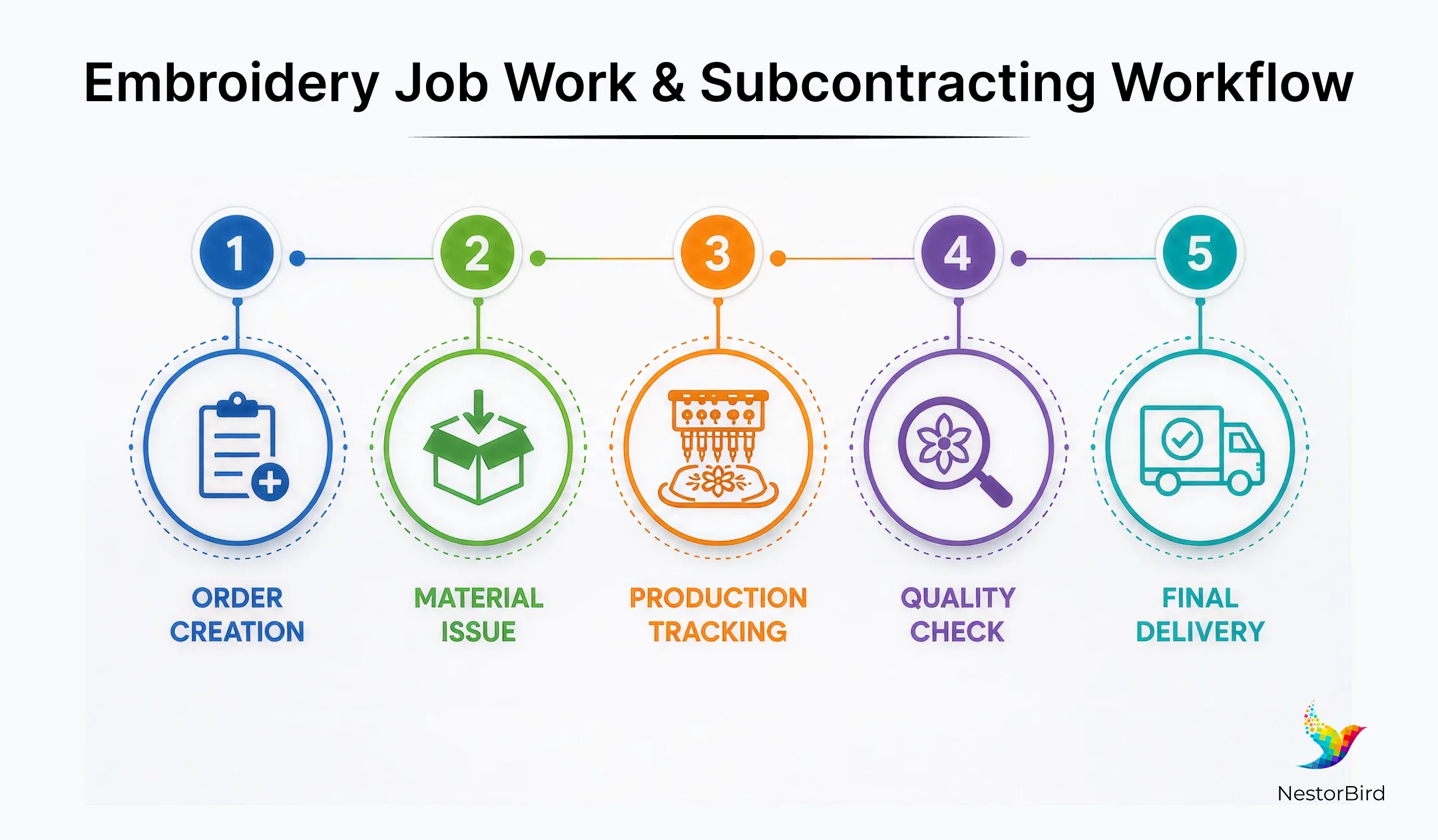
The biggest advantage of job work management software is that it creates a structured workflow for every job. Instead of recording only the final transaction, ERP can track the entire journey.
A typical ERP job-work workflow includes:
What Should an Embroidery Job Card Include?
Customer name, job number, and design or style
Material type and required quantity
Production quantity and delivery date
Machine or production unit
Subcontractor
Material issued and material received
Wastage and quality status
Pending quantity and job-work rate
This gives management a clear digital trail and creates one reference point for everyone involved in the job. Instead of asking different employees for updates, the manager can check the job status directly.
Managing Subcontractors With ERP
Subcontracting is one of the most important areas for a Surat embroidery business. A business may have several external partners handling different processes, for example: Embroidery → Stitching → Finishing → Printing → Packing. Each external process creates another layer of tracking. This is where subcontracting management software can make a major difference.
Track Subcontractor Performance
ERP can also help businesses evaluate subcontractors based on actual performance. Useful indicators include:
Performance Area | What to Track |
|---|---|
Delivery | On-time vs delayed jobs |
Quantity | Issued vs received |
Quality | Accepted vs rejected |
Productivity | Completed quantity |
Pending Work | Open jobs |
Cost | Job-work charges |
Material | Material currently held |
This creates a data-driven approach to subcontractor management in ERP. Instead of relying only on personal relationships, businesses can use actual performance history when allocating future work.
Tracking Material Sent to Subcontractors
Suppose an embroidery business receives 20,000 metres of fabric. It sends 8,000 metres to Subcontractor A, and the ERP records the movement. Later, the subcontractor returns 7,800 metres. The system can show the difference of 200 metres.
Management Can Then Investigate Whether the Difference Is
Approved wastage
Processing loss
Damaged material
Short receipt
Pending material or another operational variance
Without such tracking, the difference may simply appear as a stock adjustment. The ERPNext subcontracting documentation can also be used to understand how subcontracting workflows are handled.

Embroidery Order Tracking
Customer orders are the starting point of the entire production process. If order information is incomplete, everything downstream becomes harder. Embroidery order tracking helps businesses maintain visibility from order booking to final delivery. A good ERP should allow teams to quickly identify new orders, orders in production, delayed orders, completed orders, partially completed orders, orders waiting for material, orders waiting for quality approval, and orders ready for dispatch.
Imagine that three customers have orders due within the same week. Without proper tracking, production may prioritize jobs based on whichever request appears most urgent at the moment. ERP allows the business to view delivery dates alongside production status. This helps production teams prioritize work logically, and the result is better coordination between sales, production, inventory, subcontractors, and dispatch.
Embroidery Production Management
Production planning becomes difficult when businesses manage multiple machines, designs, operators, and subcontractors. An ERP for production planning can provide a clearer view of production capacity. Managers can identify available machines, current machine utilization, planned production, actual production, pending production, delayed jobs, subcontracted work, and upcoming deadlines. This makes embroidery production management more structured.
One of the simplest but most useful ERP reports is planned versus actual production.
Job | Planned | Completed | Pending |
|---|---|---|---|
JOB-101 | 10,000 | 8,000 | 2,000 |
JOB-102 | 15,000 | 15,000 | 0 |
JOB-103 | 12,000 | 7,500 | 4,500 |
This immediately tells the production manager where attention is needed. ERP can also help identify delays before they become customer complaints, such as unavailable material delaying production, a pending quality check delaying dispatch, or a delayed subcontractor return blocking the next process. When these dependencies are visible, managers can act earlier. That is the real value of production visibility.
Textile Inventory Management
Inventory is another major challenge in embroidery and textile businesses. Stock may exist as raw fabric, processed fabric, work-in-progress, finished goods, accessories, embroidery material, material with subcontractors, rejected material, and returned material. A simple warehouse balance may not provide enough information. Businesses need to know where the material is and what stage it is currently in.
Consider a business with a main warehouse, a production floor, a finished-goods warehouse, and three subcontractors. The total stock number alone is not enough. ERP can help answer “How much stock do we have?” but also “Where is that stock?” That distinction is extremely important for textile businesses.
Control Wastage and Material Variance
Material wastage directly affects profitability, so ERP can compare expected consumption against actual consumption. Possible reasons for a variance may include:
Production process
Cutting loss
Machine-related issues
Damaged material
Quality rejection
Subcontractor variance
Incorrect material issue
The objective is not to eliminate every form of wastage. The objective is to identify unexplained wastage and control avoidable losses.
Key ERP Features for Embroidery Businesses
When evaluating an ERP, embroidery businesses should focus on practical workflows rather than simply counting software features.
ERP Feature | Business Value |
|---|---|
Job Order Management | Keeps customer and job information organized |
Job Cards | Provides structured production instructions |
Material Issue | Records material sent for processing |
Material Receipt | Tracks returned material |
Subcontractor Management | Tracks external production partners |
Production Tracking | Shows planned vs actual production |
Inventory Management | Provides stock visibility |
Wastage Tracking | Helps identify material variances |
Order Tracking | Shows current order status |
Machine Tracking | Helps monitor production capacity |
Quality Management | Records inspection and rejection |
Billing Integration | Connects operations with accounts |
Dashboards and Reports | Gives management real-time visibility |
Job work, subcontracting, order tracking, production, inventory, and vendor tracking remain the core areas an embroidery business should verify before committing to any platform.
Benefits of ERP for Textile Businesses
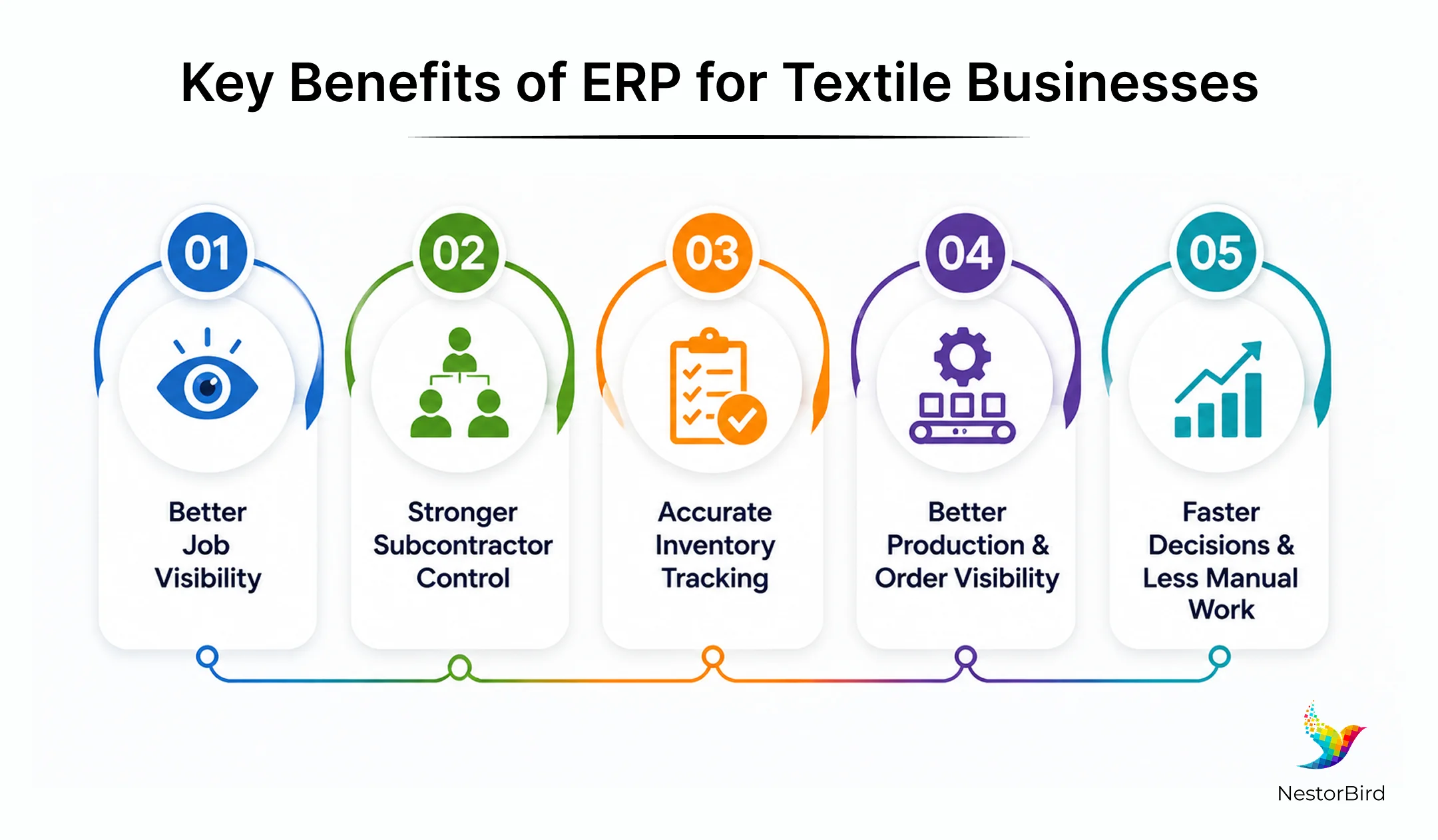
Operational Gains You Can Measure
Better job visibility: managers can quickly identify what is running, pending, delayed, and completed.
Better subcontractor control: track material issued, material returned, pending quantities, delivery performance, and job-work charges.
Better inventory accuracy: a clearer view of stock across warehouses, production locations, and subcontractors.
Faster decision-making: management can access operational information from dashboards and reports.
Reduced manual work: employees spend less time searching through registers, Excel files, challans, and messages.
Better production planning: teams can prioritize by delivery dates, pending quantities, machine capacity, and material availability.
Where ERP Creates the Biggest Difference
More customers
More machines
More subcontractors
Multiple warehouses
Higher order volumes and more production stages
More employees
ERP becomes particularly valuable when the business reaches a point where the owner cannot personally track every transaction. It allows the owner to move from "I need to call someone to find out" to "I can check the status in the system." That is a major operational shift, and this ERPNext manufacturing implementation case study shows how it plays out in practice.
How to Choose the Right ERP for an Embroidery Business
Not every ERP is automatically suitable for embroidery. A system may have hundreds of features and still fail to handle your actual job-work workflow. The best approach is to test the software using a real business scenario. Ask the vendor to demonstrate this workflow: Customer Order → Material Receipt → Job Creation → Material Issue → Production → Subcontracting → Material Return → Quality Check → Finished Goods → Billing.
Check These Areas Before Buying
Job work: can the system track material and production against each job?
Subcontracting: can it show which subcontractor has which material?
Inventory: can it track stock by warehouse and location?
Production: can it compare planned and actual output?
Orders: can sales and production teams see the same order status?
Reporting: can management identify delays, wastage, and pending work?
Scalability: can the system support additional machines, users, locations, and processes?
This is why businesses should evaluate a proper manufacturing ERP software solution when production and job work become complex.
For businesses already considering ERPNext, ERPNext manufacturing software can also be evaluated as part of the technology selection process. The ERPNext subcontracting documentation can also be used to understand how subcontracting workflows are handled.
ERP Implementation Tips for Embroidery Businesses
Start With the Most Important Processes
Avoid implementing every module on day one. Start with sales and orders, inventory, job work, subcontracting, production, and accounts. Then expand the system based on business requirements.
Train Employees With Real Examples
Employees learn faster when training uses actual jobs. Instead of explaining “this is the material issue module,” show them “this is the fabric received for Customer A. Now issue 5,000 metres to Subcontractor B against Job 105.” Practical training makes adoption easier.
Create Standard Processes
ERP works best when the business has clear rules. No material should leave the warehouse without an ERP transaction, and every subcontractor job must have a job number.
Record Returns Against the Original Issue
Returned material must be recorded against the original issue so that quantity reconciliation stays accurate over time.
Update Production Regularly
Production quantities must be updated regularly. These simple rules can significantly improve data accuracy.
Buying software is only the first step. The system needs to match the way employees actually work, and disciplined data entry is what turns an ERP into a reliable source of truth.
Conclusion
Surat’s embroidery ecosystem depends on speed, coordination, and efficient job-work management. But when orders, materials, machines, subcontractors, and production stages increase, manual tracking becomes difficult to maintain.
Embroidery ERP software provides a centralized way to manage these moving parts. It can connect orders, inventory, job work, production, subcontracting, quality, and billing. The result is better visibility and stronger control over daily operations. For growing businesses, the goal should not simply be to digitize paperwork. The goal should be to create a system where every important transaction has a clear digital trail.
Businesses can also evaluate ERP manufacturing features when comparing platforms and identifying the capabilities needed for their production environment. For embroidery units that are part of a broader apparel operation, apparel ERP software may also be worth evaluating when embroidery, garment production, inventory, and order management need to work together. The right ERP ultimately becomes more than software. It becomes the control center for the business.

Frequently Asked Questions
Embroidery ERP software is a business management system designed to connect embroidery orders, production, inventory, job work, subcontractors, billing, and reporting. It gives businesses a centralized view of their operations instead of relying on multiple disconnected systems.
ERP can track the complete job-work cycle, including job creation, material issue, production, subcontracting, material receipt, quantity reconciliation, wastage, and billing. This makes it easier to identify pending work and material differences.
Yes. A suitable ERP can record material issued to a subcontractor against a specific job. When the processed material comes back, the business can record the receipt against the original issue. This creates better visibility into external stock.
Yes, particularly when the business is growing. A small business may initially manage operations through spreadsheets and registers. However, as orders, machines, employees, and subcontractors increase, centralized ERP can help reduce manual coordination.
Focus on your actual workflow. Check whether the system can manage job work, subcontractors, inventory, production, order tracking, material movement, wastage, quality, billing, and reporting. Most importantly, ask the vendor to demonstrate the complete workflow using a real embroidery job.