


Quick Summary
Small hospitals lose money when patients wait for beds because different software systems do not connect. A hospital workflow management system puts all departments on one screen. It reduces discharge delays, frees up beds faster, and increases daily revenue. SMB hospitals that adopt unified flow now will outpace competitors still using old disconnected tools.
Table Of Contents
Introduction
Even small and medium sized hospitals deal with patient data, management of beds, and staff schedules across different systems. This broken setup causes long wait times and lost revenue. A hospital management system fixes this by connecting every department into one clear view. Hospital patient flow optimization is now the main way smaller hospitals can compete with larger chains. This blog post explains why waiting to fix your flow means losing patients and money. You do not need a large budget. You need one integrated hospital operations platform to move patients faster, reduce errors, and improve daily operations starting today.
Key Takeaways
Old systems block beds and reduce revenue.
A hospital workflow management system connects all departments.
Small hospitals can afford unified flow software.
Morning huddles plus software fix delays faster.
Unified operations beat disconnected competitors.
Why Old Hospital Systems Create Daily Problems
When hospitals use the traditional systems for admissions, labs, and bed tracking that do not talk to each other, data gets stuck. A nurse cannot see if a bed is clean. A doctor cannot find a lab result quickly. This creates a challenge where every department works alone. The old systems force staff to make phone calls and walk between floors just to find a patient’s status, which wastes hours in every shift.
For an SMB hospital, buying a full hospital management system seems expensive. But staying with old systems costs more in lost patients and overtime pay. A hospital workflow management system connects admissions, beds, and labs into one simple screen.
Also, recent hospital data shows that breaking down silos reduces the time patients wait for a bed by over two hours per visit. Small hospitals cannot afford to lose patients to the larger hospital down the road simply because their software is too slow. See the TOP Hospital Management Software in India 2026.
Quantifying the ROI: From Bottlenecks to Revenue
These challenges discussed above also affect the revenue and ROI for hospitals as blocked beds and slow discharges directly reduce income. When a patient waits six hours for an inpatient bed, the hospital loses money on that empty bed downstairs. Every hour of delay adds cost without adding care.
How Blocked Beds Reduce Your Hospital Income
A bed that stays occupied by a patient who is ready to leave cannot accept a new paying patient, which is the main source of revenue loss for SMB hospitals. This is how revenue leaks happen:
A patient ready for discharge at 10 AM actually leaves at 4 PM. Six hours of lost bed availability.
The ED holds admitted patients in hallways while inpatient beds sit blocked.
Staff spends hours on phone calls finding empty beds instead of treating patients.
What fixes this: When you install proper hospital workflow management software, staff can see exactly which patients are ready for discharge and which beds are being cleaned. This hospital patient flow optimization and visibility reduces discharge delays by several hours each day.
The ROI numbers: For a 50-bed hospital, freeing just four extra beds per day adds up to significant monthly revenue. The hospital management system ROI becomes visible within the first few months of use. Small hospitals get their investment back by simply moving patients through the system faster, without adding new rooms or hiring extra staff.
Find the major Indian hospital software gaps.
Practical Implementation: Simple Steps & Low Cost Changes That Fix Patient Flow
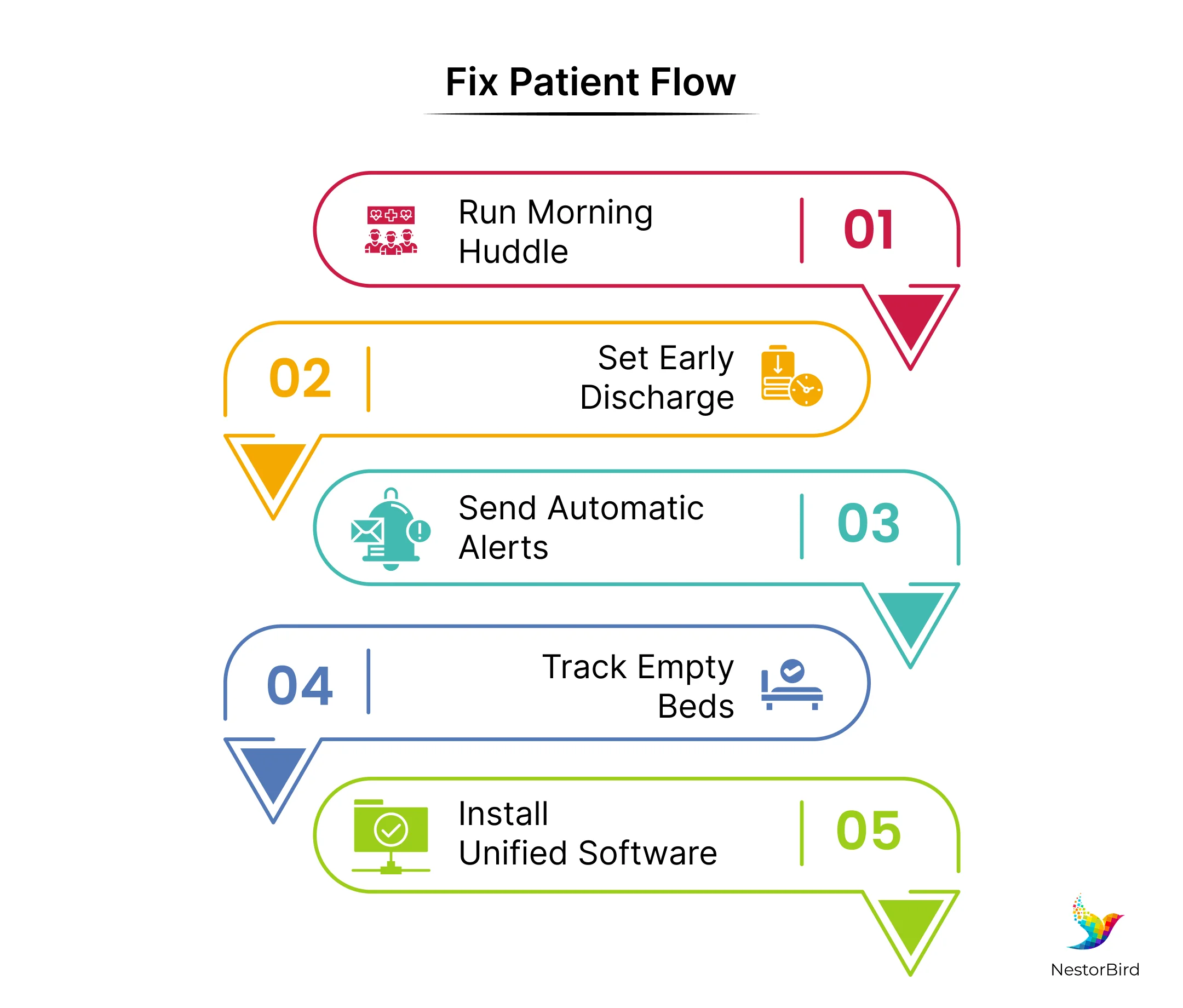
Let us now see how you can easily and efficiently implement these changes without spending a lot on software or systems. A virtual setup works better for SMB hospitals.
Step one - Change daily team routines
Hold a 10-minute meeting every morning at 9 AM.
Review which patients are ready to leave.
Set a target that 50 percent of discharges happen before 11 AM.
Step two - Add the right software
A hospital workflow management system automates bed cleaning alerts and transport requests. When a nurse clicks “discharge,” housekeeping gets an instant notification on their phone. This way, the transport staff sees the exact room number and priority level.
Step three - Track one number only
You can now watch your “discharge before noon” rate. When this number goes up, your revenue goes up. This approach works because you are using hospital software for small hospitals that fits your budget and staff size, not an enterprise solution built for large chains.
NestorBird Pro tip: Before purchasing any hospital workflow management software, map your current discharge process on paper first. Identify the three biggest delays, then match software features to solve only those specific delays.

Making Different Software Connect for Small Hospitals
Small hospitals often run one system for inpatient beds and another for outpatient clinics. These systems do not share data. When a patient moves from the clinic to a bed, someone must re-enter all information manually. A hospital management software solves this by connecting both systems. A discharge from the inpatient floor automatically tells the emergency department that a bed is now open.
For rural facilities, hospital software for small hospitals must also work with low internet bandwidth and smaller IT teams. Look for a hospital workflow management system like, Swanity healthcare ERP system that uses modern connections, not old add-ons that break during updates. This setup protects your revenue as you add new services like oncology or orthopedics.
Conclusion
Small and medium hospitals cannot afford to keep using old, disconnected systems. A hospital workflow management system fixes these daily problems by connecting every department into one clear view. The hospital management system ROI is clear within months, not years. You do not need a large budget or new construction. You need the right software built for your size. Solutions designed for small hospitals, like those offered by NestorBird and Swanity, focus specifically on patient flow and bed management without needing expensive unused modules.

Frequently Asked Questions
Most SMB hospitals see improvements in discharge times and bed turnover within two to four weeks after the system goes live.
Small hospitals typically achieve positive ROI within 6 to 12 months through faster bed turnover, reduced wait times, and lower administrative costs.
No. A good hospital workflow management system integrates with your current EHR and other software using modern API connections.
It reduces manual errors in bed assignments, ensures clean beds are ready before transport, and gives nurses instant access to patient status updates.
An EHR stores clinical records. A hospital management system handles operations like beds, admissions, billing, and staff coordination across departments.