
Quick Summary
Manufacturing ERP helps teams compare planned production costs with actual expenses across materials, labor, overhead, wastage, and rework. Connected production, inventory, purchasing, and accounting records make it easier to spot differences, investigate causes, and take corrective action. Results depend on accurate data, consistent costing rules, and regular review.
Table Of Contents
Introduction
Production costs can drift from the original plan when material prices change, workers need overtime, machines stop unexpectedly, or products require rework. If production, inventory, purchasing, and finance records are disconnected, teams may struggle to understand where the difference came from. Manufacturing ERP can bring these records together so managers can compare planned and actual costs using a consistent view.
Key Takeaways
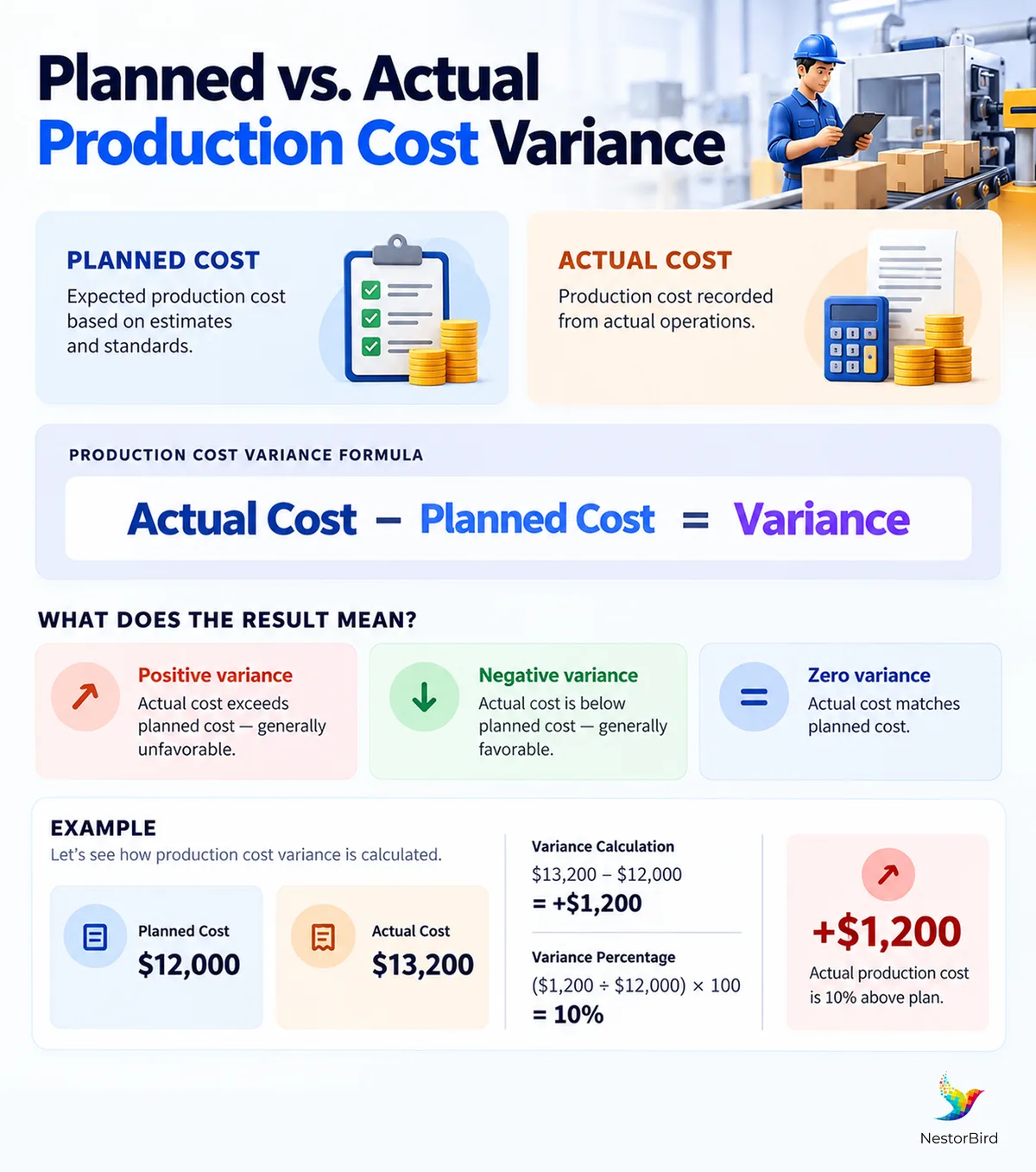
Production cost variance is actual cost minus planned or standard cost for the same production scope.
Material prices, excess consumption, labor, downtime, scrap, rework, and overhead can cause variances.
ERP reports are only useful when bills of materials, transactions, and costing rules are reliable.
Investigate significant differences, assign corrective actions, and review later results.
What Is Production Cost Variance in Manufacturing?
Production cost variance is the difference between the expected cost of a production run and the cost actually recorded. The planned figure may come from a budget, standard cost, or production estimate. A positive variance usually means actual cost exceeded plan; a negative variance usually means it came in below plan. Interpret the result alongside output, quality, and delivery requirements—a lower cost is not automatically better if production targets were missed.
For example, if the planned cost was $12,000 and the actual cost was $13,200, the variance is +$1,200, or 10% above plan.
Planned vs. Actual Production Costs: What Manufacturers Need to Compare
Manufacturers compare planned production costs with actual spending to understand whether a production order stays within budget. This involves reviewing four key areas: raw materials, direct labor, production overhead, and wastage or rework.
Planned cost: What the manufacturer expected to spend on production.
Actual cost: What the manufacturer really spent to complete the production order.
Cost variance: The difference between planned and actual costs, showing how much the budget was exceeded or underspent and which areas need investigation.
Cost Category | Planned Cost | Actual Cost | Variance | Possible Reason |
|---|---|---|---|---|
Raw Materials | $10,000 | $11,200 | +$1,200 | Price increase or excess consumption |
Direct Labor | $4,000 | $4,500 | +$500 | Overtime or lower productivity |
Production Overhead | $3,000 | $3,200 | +$200 | Higher operating expenses |
Wastage and Rework | $1,000 | $1,400 | +$400 | Scrap or quality issues |
Total | $18,000 | $20,300 | +$2,300 | Unfavorable variance |
As shown in the infographic, a manufacturer may plan to spend $18,000 but end up spending $20,300. This results in a $2,300 unfavorable variance.
Raw materials account for the largest difference in this example, followed by labor and wastage. Reviewing material consumption, labor hours, operating expenses, and quality records helps manufacturers identify the causes and decide where corrective action is needed.
Next, let’s explore the common causes of production cost variance.
Common Causes of Production Cost Variance
Raw material price and usage: Supplier price changes, inaccurate estimates, excess consumption, or stock-record differences can increase costs. Compare purchase prices with standards and check material issue records.
Labor and overtime: Unplanned overtime, uneven workloads, training needs, and lower-than-expected output can raise labor cost per unit. Review hours alongside completed output.
Downtime and delays: Breakdowns and idle time can extend shifts and spread costs across fewer finished units. Review maintenance, downtime, and production schedules together.
Scrap, wastage, and rework: Defects and repeated work consume materials and labor without producing saleable output. Track quantities and reasons to identify recurring problems.
Volume, specifications, and overhead: Changes in order size, product mix, energy prices, maintenance, or tooling can make comparisons misleading. Confirm the scope and costing assumptions before interpreting a variance.
How Manufacturing ERP Helps Track Planned vs. Actual Costs
Production planning and standard costs: Production plans, bills of materials, routings, and expected resource needs establish the baseline for planned cost. Outdated records can create misleading comparisons.
Production and inventory tracking: Material issues, stock movements, labor entries, and completed output help teams compare actual activity with the plan. Investigate differences between recorded and physical consumption.
Cost accounting and reporting: Connecting production expenses with accounting records supports consistent classification and overhead allocation. Depending on modules and configuration, reports may compare costs by order, product, batch, or category.
Earlier visibility: Consistent records can help teams identify unusual differences sooner and prioritize investigation. ERP does not automatically prevent overruns; its value depends on reliable data and follow-through.

How to Perform Production Cost Variance Analysis
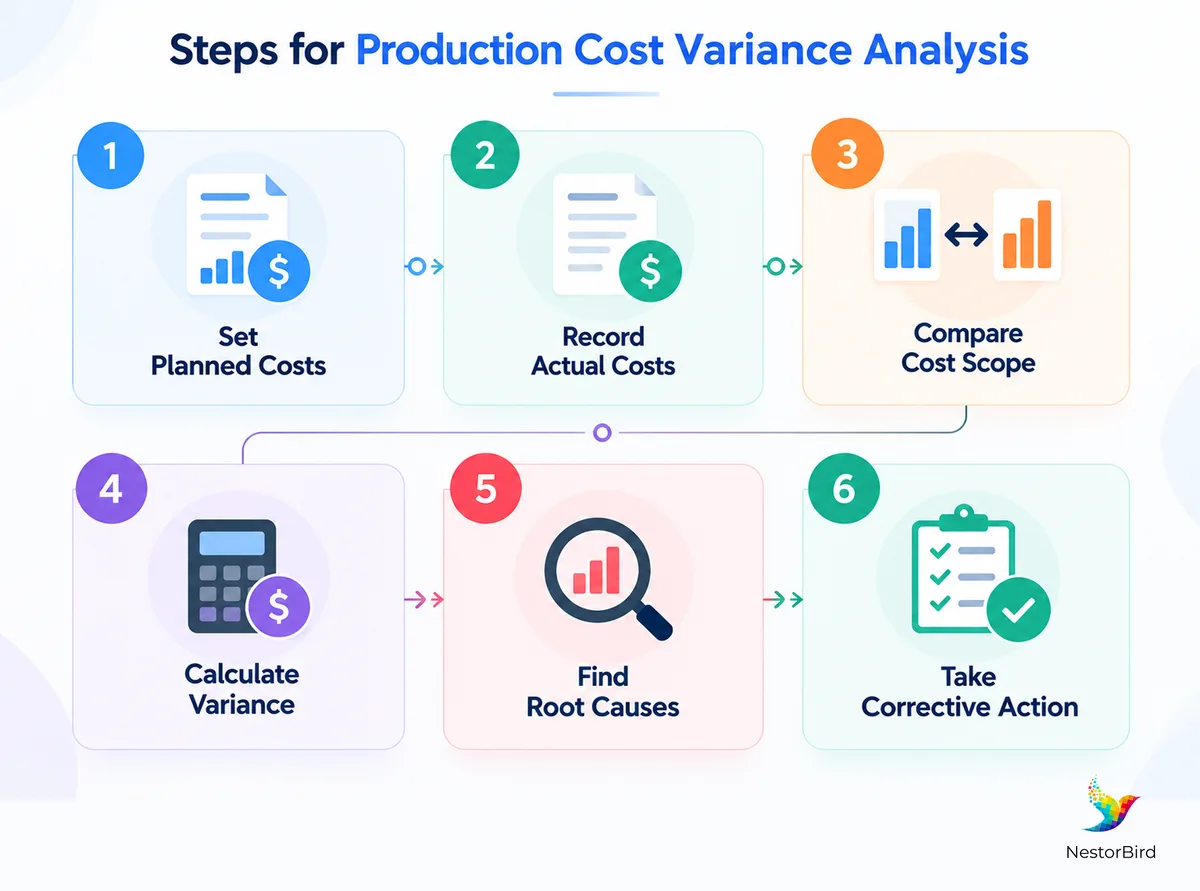
Use the same repeatable workflow for each comparable production run.
Set Planned Costs: Estimate material, labor, and overhead expenses.
Record Actual Costs: Track actual production expenses.
Compare Costs: Ensure both figures cover the same production scope.
Calculate Variance: Use the formula: Actual Cost − Planned Cost.
Identify Causes: Investigate material usage, overtime, downtime, and wastage.
Take Corrective Action: Address issues and monitor future results.
How Manufacturing ERP Improves Manufacturing Cost Control
A connected ERP setup can help teams identify cost increases, monitor material use and rework, review labor and overhead, compare production orders, and coordinate decisions across production, purchasing, inventory, and finance. It does not guarantee savings. Teams must maintain accurate records and act on what the reports reveal.
Best Practices for Managing Production Cost Variance
Maintain accurate bills of materials, routings, and resource requirements.
Review standard costs when supplier prices or production methods change.
Record material consumption, labor, output, scrap, and rework consistently.
Review significant differences by order, product, batch, or cost category.
Use consistent cost-allocation rules across teams.
Assign owners to corrective actions and check results in a later comparable run.
How to Choose Manufacturing ERP Software for Production Cost Tracking
Ask vendors to demonstrate your own production and costing workflows. Check for planned-versus-actual reporting, work order management, bills of materials, material consumption tracking, inventory and purchasing integration, labor and overhead allocation, manufacturing cost accounting, configurable reports, and integration with finance systems. Ask how the system handles changing quantities, material substitutions, scrap, rework, and overhead allocation, and confirm which capabilities require configuration or integration.
Conclusion
Comparing planned and actual production costs helps manufacturers understand where spending differs from expectations. Variances may stem from materials, labor, downtime, scrap, rework, overhead, or planning assumptions. Manufacturing ERP can connect the information needed for analysis, but accurate data and clear follow-up remain essential. Investigate the largest differences first, document corrective actions, and review whether they improve later production results.

Frequently Asked Questions
Production cost variance is the difference between the actual cost of manufacturing and the planned or standard cost for the same production output. It helps manufacturers identify whether production is costing more or less than expected.
Formula: Production Cost Variance = Actual Production Cost − Planned Production Cost
A positive result means actual costs are higher than planned and indicates an unfavorable variance. A negative result means actual costs are lower than planned and indicates a favorable variance.
To calculate total production cost variance, subtract the planned production cost from the actual production cost:
Production Cost Variance = Actual Cost − Planned Cost
For example, if the planned production cost is $18,000 and the actual cost is $20,300:
$20,300 − $18,000 = +$2,300
The result is a $2,300 unfavorable variance, meaning production cost was higher than planned.
For detailed variance analysis, manufacturers can further break the difference into material price, material usage, labor rate, labor efficiency, and overhead variances.
Planned production cost is the expected cost of producing a defined quantity of goods based on factors such as standard material requirements, labor hours, production methods, and expected overhead.
Actual production cost is what the manufacturer actually incurs during production.
The comparison shows whether production stayed within the expected cost level. However, the comparison should use the same production scope or an appropriate target quantity. Otherwise, a change in production volume can make the variance misleading. ERP costing systems may adjust target costs to the actual quantity when performing target-versus-actual analysis.
Manufacturing ERP connects BOMs, production orders, material usage, labor, purchasing, inventory, and financial data. This helps manufacturers compare planned and actual costs and identify variances faster.
Manufacturers should monitor raw materials, direct labor, production overhead, scrap, wastage, and rework. Tracking these costs helps identify the main causes of production cost variance.
Manufacturers can reduce unfavorable variances by checking cost data, identifying root causes, prioritizing major variances, and taking corrective action. Regular variance reviews help prevent the same issues from recurring.