
Quick Summary
Most hospitals struggle because their many separate systems don't connect. This fragmentation creates errors and delays. The solution is a unified patient journey. It uses one connected hospital management system to make information flow smoothly. This makes care faster, safer, and less frustrating for both patients and staff.
Table Of Contents
Introduction
Hospitals already have to deal with a large scale of patients, doctors, staff, different departments, and equipment. Often, their old computer systems are not usually connected. This hospital system fragmentation causes delays, errors, and frustration for everyone. In this blog post, we will explain why most hospital management system setups break down. More importantly, we will show how creating a unified patient journey with modern, connected software can fix these problems, making care smoother and safer for all.
Key Takeaways
Hospital delays and errors are often caused by disconnected computer systems.
A single, unified platform replaces dozens of separate, outdated programs.
This gives every doctor and nurse instant access to the same patient information.
It automates manual tasks, saving staff time and reducing mistakes.
The result is a smoother, safer, and faster experience for everyone.
Why Hospital Systems Break Down
Let us understand why these systems break. There are four main, connected reasons.
First Reason: Outdated Technology That Can't Connect
Hospitals often run on very old computer systems. These legacy hospital systems were created decades ago. They were not built to connect with new software, modern medical devices, or online patient portals. This fundamental technical gap is the biggest barrier to healthcare system interoperability. When your core technology cannot communicate, true integration becomes impossible from the start.
Second Reason: Separate Data for Every Department
In most hospitals, each department uses its own isolated software. The emergency room, the laboratory, and the finance office all operate on different programs. These programs do not share data automatically. This creates information silos. Because of these silos, there is no single source of truth healthcare for a patient. A doctor may not see a critical test result from another department, which delays care and can lead to medical errors.
Learn more about Hospital Management Software.
Third Reason: Manual Work That Creates Errors
When computer systems do not talk to each other, hospital staff must bridge the gaps by hand. Nurses print and fax orders, clerks re-enter the same patient data into multiple systems, and teams rely on phone calls to share updates. These broken hospital workflows are inefficient and risky. Manually transferring information is slow and is a major source of mistakes in patient records, medication lists, and appointment scheduling.
Fourth Reason: Too Many Software Vendors
Hospitals typically use software from many different companies, one for scheduling, another for billing, a different one for electronic health records. Each integrated hospital software vendor has a unique system. Managing a dozen different contracts, logins, and updates is incredibly complex and expensive. Without a unified strategy, this patchwork of solutions makes the entire hospital operations management more difficult, costly, and fragile.
Check out the best Healthcare ERP Software in 2025.

How a Cohesive Patient Journey Fixes Everything
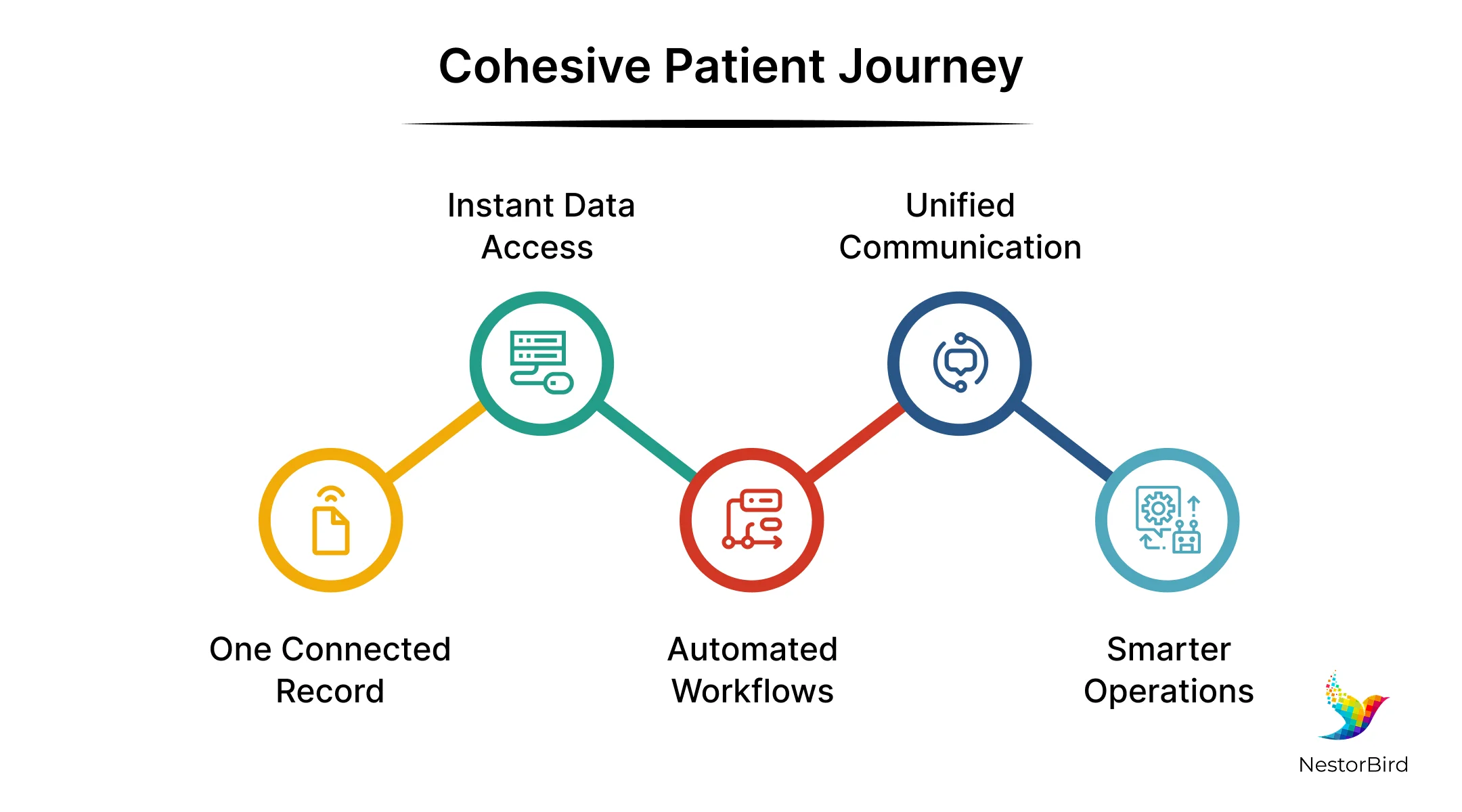
When hospitals implement a unified platform, they fix these core problems. This creates a smooth unified patient journey. Here is how it works.
Solution 1: One Connected System Instead of Many
The answer is a single, connected unified healthcare platform. Think of it as one main system for the entire hospital. It replaces dozens of separate programs. All patient information flows into one unified patient record. Whether a patient is in the emergency room, the lab, or a clinic, every authorized doctor or nurse sees the same complete, up-to-date file. This ends the confusion of data silos.
Solution 2: Instant Information for Better Decisions
With all data connected, the platform creates a single source of truth healthcare. This means lab results, doctor’s notes, and medication lists are combined and updated instantly. Doctors and nurses get real-time clinical data at the bedside. They no longer have to wait for faxes or search through different computers. This speeds up diagnosis and treatment, making care safer and faster.
Check out the benefits of ERP in the healthcare industry.
Solution 3: Less Manual Work, Fewer Errors
A unified system automates routine tasks. This is clinical workflow automation. For example, when a doctor orders a lab test, the system can automatically send the order to the lab and schedule it. It can also populate the result directly into the patient’s chart. This eliminates manual data entry and phone calls. It streamlines hospital operations management, reduces staff workload, and cuts down on human errors.
This is why healthcare organizations need an ERP.
Solution 4: A Modern, Flexible Technology Base
Modern platforms are often built as cloud-based hospital software. Unlike old legacy hospital systems, cloud software is easier to update, secure, and scale. The hospital does not need to maintain large server rooms. This modern approach is the practical engine for a successful hospital IT transformation solution, allowing the hospital to adapt and grow without constant technical headaches.
End Note
In the end, broken systems cause delays, errors, and frustration for everyone. The solution is clear: moving to a unified patient journey managed by a single, modern hospital management system. This approach connects all departments and information, creating smoother, safer, and more efficient care for patients and staff.
To achieve this, you need a reliable partner, NestorBird specializes in creating these connected unified healthcare platforms. Our solutions are designed to fix hospital system fragmentation directly, helping your hospital operate as one cohesive unit.

Frequently Asked Questions
It is a smooth care experience where all patient information flows seamlessly between departments using one connected software system, eliminating repeats and delays for everyone involved.
It is likely built from many old, separate systems that cannot share data. This forces staff to do manual work, creating bottlenecks and errors that slow everything down.
The biggest benefit is having a single source of truth. Every doctor and nurse sees the same real-time patient data, leading to faster, safer decisions and less wasted time.
It reduces dangerous manual errors. Automated workflows and instant access to full medical history help prevent mistakes in medication, test orders, and treatment plans.
Yes, reputable cloud platforms use advanced, enterprise-grade security like encryption that is often stronger and more consistently updated than what old on-site servers can provide.