

Quick Summary
Garment production planning helps apparel manufacturers decide what to produce, how much to produce, when to produce it, and which resources are required. A master production schedule turns customer demand into an executable production plan, while MRP checks material requirements and capacity planning validates factory resources. Moving these activities from disconnected Excel sheets into ERP can improve visibility, coordination, and production control.
Table Of Contents
Introduction
Garment factories rarely struggle because they do not know what they need to produce. The bigger challenge is knowing when, where, and how every order should move through cutting, sewing, finishing, quality, and packing without creating delays. That is where garment production planning becomes critical. As orders, materials, workers, sewing lines, subcontractors, and delivery dates change, spreadsheet-based planning can quickly become difficult to maintain. Modern garment manufacturing ERP connects demand, materials, capacity, production schedules, and work orders in a single operational view.
Key Takeaways
Garment production planning converts customer orders and demand into practical manufacturing activities.
A master production schedule (MPS) determines what should be produced, in what quantity, and during which production period.
MPS works more effectively when connected with Material Requirements Planning (MRP) and capacity planning.
Excel can work for simple operations, but complex garment factories often need a centralized system for changing orders, material availability, WIP, and capacity.
Sewing-line capacity should be checked before production commitments are finalized.
BOM accuracy is essential because fabric, trims, labels, accessories, and packaging requirements depend on product specifications.
ERP can connect production planning and control with inventory, procurement, work orders, quality, and dispatch.
What Is Garment Production Planning?
Garment production planning is the process of deciding how a factory will convert confirmed orders or expected demand into finished garments within the required delivery timeline. It involves much more than creating a production calendar. A planner has to consider order quantities, style and size combinations, fabric availability, trims, BOMs, machine and sewing-line capacity, workforce availability, production lead time, quality requirements, subcontracting, and buyer deadlines. In other words, production planning acts like the factory’s roadmap: it tells different teams what needs to happen, when it needs to happen, and what resources must be ready before production can move forward.
The challenge becomes more obvious in apparel manufacturing because production rarely follows a perfectly straight path. One order may require fabric inspection before cutting, another may require printing or embroidery, while another may depend on external washing or finishing. At the same time, several buyer orders may compete for the same sewing line. Current apparel ERP software approaches increasingly connect order-driven planning with production planning and scheduling, material requirements, and sewing capacity so that production commitments are based on available resources rather than assumptions.
Why Excel Becomes Difficult to Manage
Excel is not inherently bad. In fact, it can be extremely useful when a factory is small, production is relatively stable, and only a limited number of people update the schedule. The problem begins when the production plan becomes a living document that changes throughout the day. A buyer revises an order, fabric arrives late, one sewing line loses capacity, a subcontractor misses a return date, or a high-priority order suddenly moves forward. Each change can force planners to update multiple sheets and communicate the revised plan manually.
That is where spreadsheet planning starts behaving like a map that everyone edits separately. One person may have the latest production quantity, another may have the updated material status, while the production supervisor may still be working from yesterday’s schedule. Research and industry guidance on ERP production planning emphasize the value of connecting demand, BOMs, inventory, capacity, work centers, and work orders rather than maintaining these planning inputs separately.
What Is a Master Production Schedule in Garment Manufacturing?
A master production schedule (MPS) is the plan that translates demand into specific production requirements over defined periods. Instead of simply saying, “We need to manufacture 20,000 garments this month,” an MPS can break that demand into styles, quantities, dates, and production periods. It provides the bridge between higher-level demand and the detailed activities required on the factory floor.
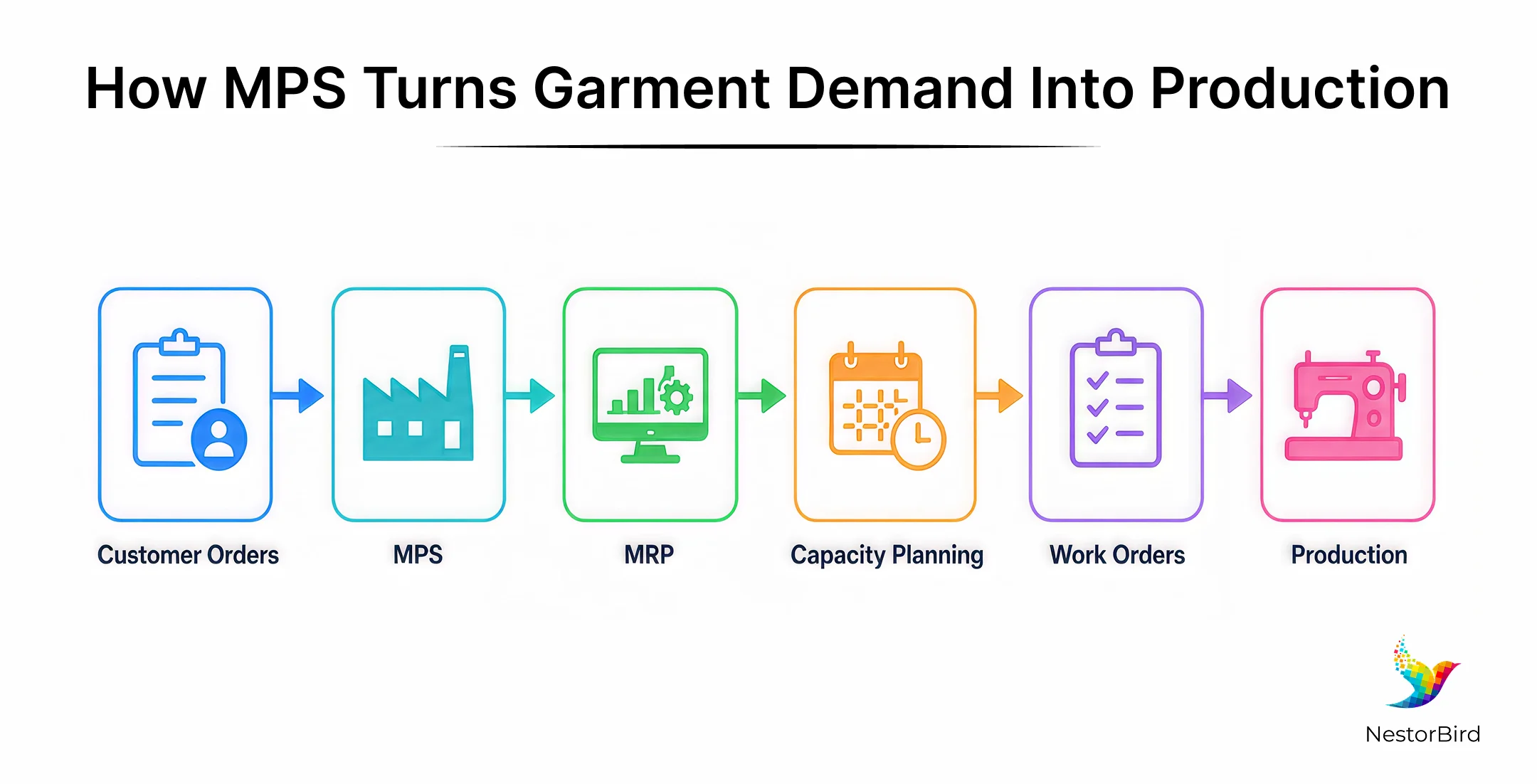
Think of MPS as the factory’s central production promise. If the sales team confirms an order for 10,000 shirts with a specific delivery date, the MPS helps determine how that quantity should be distributed across the available production periods. The next question becomes whether fabric, trims, labor, sewing capacity, and other resources can support the proposed schedule. In a connected planning environment, MPS feeds downstream planning activities such as MRP and detailed scheduling.
How MPS Connects Demand With Production
The real value of an MPS is not the schedule itself. It is the coordination that happens around it. Once demand is translated into planned production quantities, the organization can evaluate whether materials will be available, whether capacity is sufficient, and whether production dates are realistic.
Order | Quantity | Delivery Requirement | Main Production Concern |
|---|---|---|---|
Polo Shirts | 8,000 | Week 3 | Sewing-line capacity |
Formal Shirts | 5,000 | Week 4 | Fabric and trims |
Kidswear | 6,000 | Week 4 | Embroidery capacity |
Without a structured MPS, all three orders may simply appear as rows in an Excel sheet. With an MPS-based process, planners can evaluate production timing, material readiness, capacity requirements, and competing priorities before releasing work to the floor. This is particularly important when several styles share the same production resources.
Why Garment Factories Struggle With Manual Planning
Manual planning becomes difficult because garment manufacturing contains multiple moving parts that influence one another. A production manager may have enough operators but insufficient fabric. Procurement may have ordered the fabric, but the supplier’s delivery date may not match the planned cutting date. Cutting may finish on time, but the sewing line may already be occupied with another urgent order. The factory technically has capacity, yet the order can still miss its shipment date because the capacity is not available at the right time.
Another challenge is visibility. Production planning in the garment industry often crosses merchandising, procurement, stores, cutting, sewing, finishing, quality, packing, dispatch, and management. When each department depends on separate spreadsheets, emails, messages, or manually prepared reports, planners spend time collecting information instead of making planning decisions. Current garment ERP solutions commonly address this by bringing order status, production planning, WIP, capacity, and delivery information into a shared system.
Material and Capacity Conflicts
One of the most common planning mistakes is assuming that material availability automatically means production readiness. A factory may have enough fabric in stock but still lack the required trims, labels, buttons, zippers, packaging, or other components. Similarly, having all materials available does not guarantee that a sewing line or specialist operation is available when needed.
This is why a good planning process has to look at both material feasibility and capacity feasibility. MRP helps translate production requirements into material requirements, while capacity planning checks whether machines, workers, lines, and work centers can support the intended schedule.
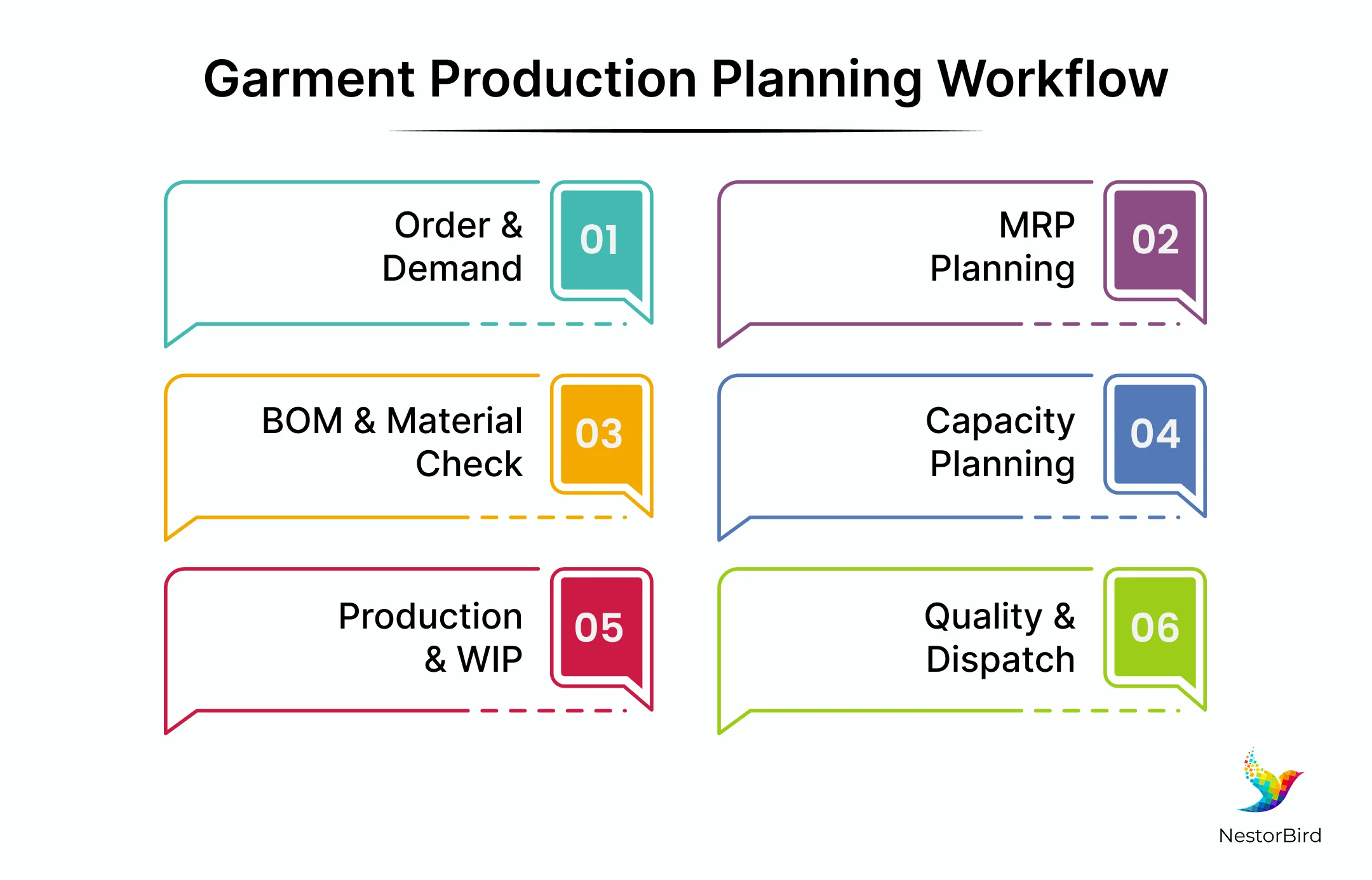
How to Build a Reliable Garment Production Plan
A reliable plan starts with clean information and moves progressively from demand to execution. The process should not begin by asking, “Which Excel sheet should we update?” It should begin by asking, “What orders must we deliver, what resources are required, and what constraints could prevent us from meeting those dates?”
Review confirmed orders and demand.
Establish production priorities and delivery dates.
Validate product specifications and BOMs.
Check material availability.
Calculate material requirements through MRP.
Evaluate production capacity.
Allocate orders to suitable production lines.
Release work orders.
Track WIP and actual output.
Re-plan when conditions change.
This sequence creates a connection between planning and execution. It also gives production managers an opportunity to identify problems before they become urgent. Modern production planning systems can combine capacity planning, machine scheduling, shift planning, work-order allocation, and production monitoring in one workflow.
Start With Orders and Demand Forecasting
The first input should be demand. For many garment manufacturers, this includes confirmed buyer orders, expected seasonal demand, repeat programs, stock requirements, or forecast quantities. Confirmed orders usually carry greater priority than forecasts because they have contractual delivery expectations, but forecasts still matter when factories need to plan materials and capacity ahead of time.
Demand forecasting becomes particularly useful when procurement and production lead times are long. If the business waits until every order is fully confirmed before considering capacity, it may already be too late to secure fabric, trims, subcontracting capacity, or additional production resources. A connected planning environment can use forecasts and confirmed demand together while maintaining appropriate priorities.
The important point is to avoid treating demand as a static number. Orders can be revised, cancelled, split, expedited, or delayed. A good planning process therefore needs a way to evaluate the impact of demand changes on existing production commitments.
Check BOM and Material Availability
The Bill of Materials (BOM) is one of the most important foundations of apparel production planning. It defines the materials required to manufacture a particular product or style, including relevant fabrics, trims, labels, accessories, and packaging components. If the BOM is incomplete or inaccurate, the production plan may look perfect on paper while the factory discovers shortages after production has already started.
This is where Material Requirements Planning (MRP) becomes important. MRP takes production requirements and translates them into material requirements based on BOM structures, existing inventory, and planned receipts. For garment manufacturers, this can make a major difference. Instead of asking the stores team whether enough material “seems” to be available, planners can evaluate requirements systematically by order, style, color, size, and production period.
Match Orders With Production Capacity
Production capacity planning answers a simple but critical question: Can the factory actually produce what the plan demands within the available time?
Capacity is influenced by workforce, working hours, sewing-line availability, machine availability, efficiency, production method, style complexity, maintenance, changeovers, and other operational constraints. A factory might have 10 sewing lines, but that does not mean every line is equally suitable for every garment. A particular style may require machines, operators, or processes that are only available on selected lines.
A practical capacity calculation can also use Standard Allowed Minutes (SAM) or equivalent production standards. For example, a garment with a higher SAM requires more production time than a simpler style. The objective is to determine usable capacity, not theoretical capacity.
Connect MPS With MRP and Work Orders
The real strength of a master production schedule appears when it connects with MRP and production execution. MPS determines the production requirement, MRP determines the material implications, and work orders translate the approved plan into executable manufacturing activities. Understanding the ERP vs MRP distinction helps planners see where each system contributes.
The relationship can be visualized simply: Demand → MPS → MRP → Capacity Planning → Work Orders → Production → WIP → Quality → Dispatch.
Each stage answers a different question. Demand asks what customers need. MPS determines what should be produced and when. MRP identifies the materials required. Capacity planning determines whether the factory can execute the schedule. Work orders then give production teams the instructions needed to begin manufacturing.
This hierarchy prevents planning from becoming a collection of disconnected decisions. When the MPS changes, the organization should be able to understand which materials, work orders, production lines, and delivery commitments may also be affected.
Plan Sewing Lines and Prevent Production Bottlenecks
Sewing is often one of the most important capacity constraints in garment manufacturing, which makes sewing-line planning central to effective apparel production planning. A line may be technically available but unsuitable for a particular style, or it may be available for only part of the required period. If planners ignore these constraints, work can accumulate before sewing while downstream finishing teams remain underutilized.
Production bottlenecks can also move. A factory might initially have sufficient sewing capacity, but once several orders enter production simultaneously, finishing or quality inspection may become the constraint. This is why production control needs visibility across stages rather than focusing only on one department.
An integrated system can help managers see WIP and planned workloads across stages. The objective is not simply to keep every machine busy. The objective is to keep the overall production flow balanced so that work does not pile up in one area while another area waits for material.
Why ERP Is Better Than Excel for Production Scheduling
Excel can create a production schedule. An ERP can connect that schedule with the information needed to make the schedule meaningful.
That distinction matters. A spreadsheet can show that Order A is scheduled for Monday and Order B for Tuesday. But the planner may still need separate information to determine whether the fabric has arrived, whether trims are complete, whether the required line is available, whether the previous order is running late, and whether quality has released the material. ERP brings these dependencies together so that planning decisions are based on operational information rather than manual updates.
For manufacturers looking to understand how these capabilities fit into a broader system, manufacturing ERP provides the foundation for connecting production processes with other business functions.

Real-Time Visibility Across Departments
Imagine a buyer changes an order quantity in the morning. In an Excel-driven factory, the merchandiser may update one file, the planner another, procurement may receive an email, and the production supervisor may hear about the change during a meeting. By the time everyone has the same information, several decisions may already be outdated.
An integrated garment ERP approach changes the flow. Order changes can become visible to planning, material requirements can be recalculated, capacity can be reviewed, and production priorities can be adjusted based on the updated requirement. The benefit is not simply automation. It is one version of operational truth.
This is particularly useful for factories handling multiple styles, colors, sizes, production locations, or subcontractors. ERP-based planning can also connect job-work operations such as printing, embroidery, washing, or external stitching with expected return dates and production requirements.
KPIs to Track Garment Production Planning
KPI | What It Measures | Why It Matters |
|---|---|---|
Plan vs Actual Production | Planned output compared with actual output | Shows schedule reliability |
Capacity Utilization | Used capacity versus available capacity | Identifies underuse and overload |
On-Time Delivery | Orders completed by required date | Measures delivery performance |
Production Lead Time | Time from production release to completion | Helps identify delays |
WIP by Stage | Quantity waiting or processing at each stage | Highlights bottlenecks |
Material Availability | Required materials available before production | Reduces line stoppages |
Line Efficiency | Actual productive output against available capacity | Supports realistic scheduling |
Bottleneck Frequency | Recurring constraints in production flow | Helps target corrective action |
Tracking these metrics gives managers a more complete picture of production performance. For example, high capacity utilization might appear positive until the same data reveals that one sewing line is overloaded while another is idle. Similarly, high production output means little if finished goods repeatedly miss the buyer's dispatch date.
The best KPI system therefore connects production activity with delivery, material, capacity, and financial outcomes. ERP dashboards can make this information available without requiring planners to manually consolidate multiple reports. Fabric consumption tracking can also help garment manufacturers monitor material usage and identify waste patterns.
Conclusion
Garment production planning is ultimately about turning demand into a production commitment that the factory can realistically deliver. A strong master production schedule provides the central structure, while MRP, capacity planning, work orders, production control, and WIP tracking turn that structure into execution. Excel can remain useful for analysis and small-scale planning, but as order volumes, production stages, materials, and factory constraints increase, maintaining the entire planning process through disconnected spreadsheets becomes increasingly difficult.
The goal of moving beyond Excel is not to eliminate planners. It is to give planners better information and more control. An ERP-based planning environment can connect customer demand with BOMs, materials, capacity, sewing lines, work orders, production progress, quality, and dispatch. When these pieces work together, planners can identify shortages earlier, recognize production bottlenecks sooner, adjust schedules faster, and make delivery commitments based on actual factory capacity rather than assumptions.
The practical transformation is straightforward: move from “Which spreadsheet has the latest plan?” to “What does the factory need to do next, and can we deliver it?” That is the real value of connected production planning.

Frequently Asked Questions
Garment production planning is the process of determining what garments need to be produced, in what quantities, when they should be produced, and what materials, workforce, machines, and production resources are required. It connects customer orders and demand with actual factory execution.
A master production schedule (MPS) translates demand into planned production quantities and time periods. It provides a bridge between demand planning and detailed activities such as MRP, capacity planning, and work-order scheduling.
Yes. Garment factories can use specialized production planning software or ERP systems to manage schedules, capacity, materials, WIP, work orders, and production progress. Excel can still be useful for analysis, but an integrated system provides stronger visibility when production complexity increases.
ERP connects production planning with orders, BOMs, inventory, procurement, MRP, capacity, work orders, quality, WIP, and dispatch. This helps planners identify material shortages and capacity conflicts earlier and adjust production schedules using current operational information.
MPS determines what finished products should be produced and when, based primarily on demand and production requirements. MRP then uses the production plan, BOMs, inventory, and other inputs to determine what materials and components are required and when they are needed.